03 July, 2021

Global supply chains and sustainability

(Acknowledgment: All images used in this post sourced from Google image search) 

As kids, whenever we were difficult, our grandpa used to scold us: "Don't be the dog in the manger!" We didn't know what it meant, at that time. This metaphor, coming from Greek mythology, talks of a dog sitting on a bale of hay and shooing away the cattle that come to graze on the hay. "Dog in the manger" basically refers to someone who blocks others from using some resource, and neither uses it themselves. 

This metaphor was made famous (notorious) by Winston Churchill, who used it to justify colonial domination based on a sense of racial superiority: 


What Churchill didn't (or didn't want to) realise was that the native communities weren't protecting a "resource"-- but a complex ecosystem of being of which they were a part of, and would have probably gladly accepted others who can enrich this ecosystem harmoniously. Sadly, Churchill was too deluded about his "higher grade" race, to bother about these nuances. 

Today, Churchill's philosophy still rules the world. Visit tea estates in places like Ooty or Assam, we see entire hill ranges denuded of their rich ecosystem, to be replaced by homogeneous tea plantations, most of which are slated for export. 


A complex ecosystem of flora and fauna had to be destroyed, just so that some folks can have a cup of tea on their breakfast table! 

If it is tea in India, in Africa it is cocoa and diamonds, the demand for which, have destroyed several ecosystems and even today are known to employ child labour and repressive work practices-- just so that someone somewhere can enjoy chocolates or jewellery! 


China's recent growth in construction was supported by raw materials sourced from several countries. India's granite exports to China for instance, far outnumbers its exports to any other countries. This growth in demand for "natural resources" has lead to several forms of illegal quarrying and mining, leading to several hills and forest regions getting literally torn down. 

And let's not even talk about oil and petroleum. 

This entire supply chain is kept running by a variety of structural interventions into the political, economic and cultural fabric of these societies that supply "natural resources." Their currency exchange rates are kept artificially high, by a coterie of currency traders, that create a huge disparity between their market exchange rates and relative purchasing power. For instance, what we can buy for $1 in the US, on an average, we can buy for Rs. 15 in India. This is the "real" exchange rate according to relative purchasing power. But in the market, one dollar fetches close to 80 rupees! This exchange rate is decided by the sentiments of a few thousands of traders in currency markets, whose knee-jerk reactions shape the destiny of the entire country! 

*~*~*~*~*~*

Having said all this, I am not for one moment suggesting that global supply chains aren't important. Surely, it makes sense to procure raw materials from all over the world for say hi-tech requirements like building computers, airplanes, mobile phones, vaccines, life-saving drugs, and so on. 

So how do we distinguish between "good" and "bad" supply chains? Why is it so "bad" that people across the world can have a cup of tea from our tea estates or some countries can build great cities from the rubble of our hills and forests? 

The difference is that technology that addresses a global need, itself has a universal footprint. When raw materials are sourced from across the world, for building mobile phones, the output can be potentially enjoyed by the entire world. This does not of course, replenish the damage done to the ecosystem in procuring the raw materials, but improved technology carries a hope that we can move on to building better and more efficient systems and reduce our destructive impact on the environment, going forward. For instance, the carbon footprint of several office-goers has drastically reduced thanks to present-day video conferencing, cloud computing, and mobile payments-- catalysed of course, by the pandemic. 

For technology, the problem space is global, and naturally its solution needs to source elements from across the globe. 

In contrast, the problem space of tea and chocolate or construction, is local. On solving this problem, the beneficiaries are only the local population. But to solve this problem, elements of the solution are sourced from all over the world. This leads to a "linear" or "open loop" configuration, that just keeps tilting the balance in one direction, leading to an eventual collapse. 

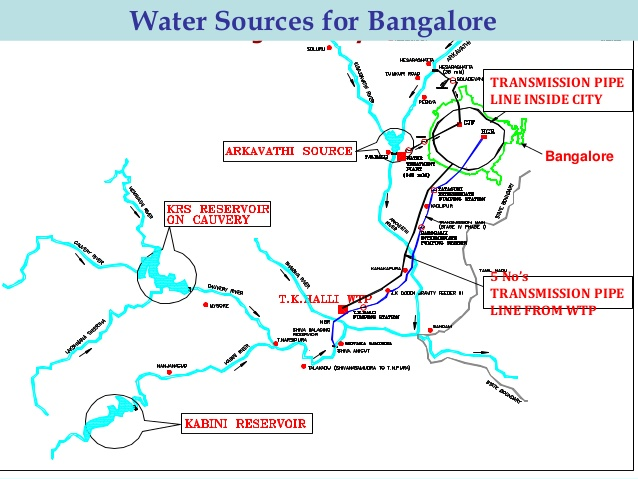
Yet another example of such a linear, "open loop" solution is the way Bangalore meets its water supply requirements. A large percentage of water used by Bangalore comes from the Cauvery river, which is almost 70 kms away and 600 feet below in altitude. Every day enormous amounts of water are pumped up a gradient, to keep the city running. The "open loop" nature of the problem is literally visible in the water map below:


When water supply for a city is sourced from such far away sources, this only results in disruption of livelihoods and ecosystem of the river downstream, and the benefits that the city dwellers get, are not enjoyed by the ones near the water source. 

Most major cities come up next to major rivers, and that's the reason for it. Bangalore is an exception-- it is the third largest metropolis in India, and which has no natural source of water. Sustainable solutions to our water supply need to be very different from what we have today, which is not at all sustainable. 

*~*~*~*~*~*

Global supply chains are needed for solving problems of a global nature-- not for local problems, regardless of how superior or "higher grade" the population consider themselves to be.

22 June, 2021

Knowledge Management in Oral Traditions

In one of the chapters of his book "Savarkar", author Vikram Sampath talks about the kinds of legends that went around in the Indian population about key figures of the Indian freedom movement. 

Mahatma Gandhi for instance, so meticulously planned and executed his strategy of non-cooperation that, the ruling British government could not keep him imprisoned for long. Among the population however, this understanding took on a rather literal form. There were legends of Gandhiji having "supernatural powers" that he could escape from any jail cell within moments of the jailor locking his door! 

Similarly, there was an account of a daring escape by Veer Savarkar at the port of Marseilles in France, where he jumped from the window of the ship in which he was imprisoned, and reached the shore. This episode, while resulting in his recapture, also lead to a major diplomatic controversy between Britain and France. Among the population in India, this episode took on dramatic forms, where Savarkar was thought to have swum across the English channel for several days to reach France! Savarkar himself recounts that when he told his prison guards in Andaman and Ratnagiri that his swim lasted only for a few minutes, he lost their respect and admiration as a hero! 

Those were times when there was minimal mass communication, and newspaper reading wasn't really a thing among the population. In fact, for much of our history, knowledge has been passed and diffused through the population by word of mouth-- and subject to distortions and hyperbole like the above. 

There are various reasons for this oral tradition of knowledge management, to have become the norm. Even though language and writing had developed greatly since ancient times, the technology for writing and record-keeping were crude and expensive to scale. Block printing did exist, but it was used mainly in the textile industry for fabrics, rather than printing of books. 

But more importantly, India also experienced several invasions where books, monuments and other recorded forms of knowledge were destroyed by the invading hordes. In just one example, in Nalanda University-- one of the world's oldest universities-- an estimated 9 million books were destroyed in the 1193 invasion of Bhaktiyar Khilji.

These invasions were followed by centuries of suppression and subjugation of the population, depriving them of opportunities to manage their collective knowledge and and understanding of their history. To counter this, the population developed a variety of oral techniques by which, common knowledge about our history and cultural values were sought to be preserved. These took different forms like stories, dramas, street plays, games, puzzles, harikatha (temple discourse), songs, etc. 

The challenge as we saw with oral traditions is that, it would be subject to great levels of distortions and subjective elements like the artistic freedom of the narrator. Over generations, these distorted accounts become established in the population and set in stone-- sometimes literally. 

For instance, in the Ramayana, Valmiki describes the tribe of Hanuman as Vanacharyah, which means "forest dwellers". But somewhere along the thousands of years of retelling of these stories, the term that has come to be associated with the tribe of Hanuman is Vanara, which means monkey! Not just that, there are even additional legends of Hanuman's tail setting Lanka on fire, and of Bheema from Mahabharata unable to lift Hanuman's tail because of his arrogance! In our temples, Hanuman is literally carved on stone in the face of a monkey, with a tail. 

Distilling and managing social and historical knowledge from such an oral tradition is a completely different ballgame, compared to how "mainstream" academic processes manage knowledge today. 

Take for instance, Wikipedia, that is supposed to offer a free (as in, freedom) way to aggregate knowledge from different cultures into a single melting-pot. 

There is no way we can incorporate social and cultural knowledge embedded deep within cultural practices and oral traditions, into Wikipedia. Wikipedia articles need to be based on "credible" sources, which in turn refers to knowledge constructs that are recorded in written form-- typically by third-party observers, who bring in their own biases and agendas in their narration, and are in turn ratified by other observers from the written tradition, with similar biases. 

It is no wonder then that, by and large, Indians find explanation of their history and culture recorded in books and on Wikipedia, to be so very different from their lived experience in this society and culture. 

On Wikipedia, a viewpoint published in a journal, written by an external observer, and peer-reviewed by a couple of other external observers with a similar viewpoint, carries more weight and credibility, than say a viewpoint expressed in a harikatha or a street play that has been witnessed and critiqued by hundreds or thousands of people, over several years! 

Clearly, we are not even aware of the biases and limitations in our underlying paradigm with which we strive to manage knowledge. 

As our formal education system relies more and more on written forms of knowledge (and by implication, on its aggregations like Wikipedia), we stand to lose out on the knowledge and worldview of our oral traditions completely. 

Although oral traditions contain a lot of distortion, the thinking population in the society had developed techniques to distill out a plausible essence from the narration, setting aside the hyperbole. For instance, regardless of the legends of a flying machine called Pushpaka Vimana in which Rama returned to Ayodhya after defeating Ravana, a quick search on Google maps will show us that it takes about 21 days to walk from Sri Lanka to Ayodhya-- which is exactly the number of days between Vijayadashami (commemorating the defeat of Ravana) and Diwali (commemorating the arrival of Rama in Ayodhya). Similarly, many would agree that Sita's Agni Pariksha  or "Trial by fire", was basically some form of intense cross-examination, like in a courtroom (which is no less demeaning), rather than a literal entry into a raging fire, to prove one's "purity". 

While epics like Ramayana are widely studied and also documented, they are just a small fraction of the body of knowledge that have been passed around through generations in our oral traditions. Many of these narrations contain rich insight into several matters, and many survival tactics. 

For instance, in most south Indian cultures, it is widely narrated and believed that a lone wild male elephant is likely to be extremely aggressive and would have been likely rejected by its herd. Many oral legends abound about "heroes" encountering a lone tusker and either escaping its wrath or fighting it valiantly. But my limited searches for documented knowledge about this, hasn't yielded anything so far. 

With our increasing emphasis on excluding anything other than written forms of knowledge documentation and dissemination, we may lose out on such important information, that may affect our survival someday. 

There is a need to not only preserve, but also reinvent oral traditions of knowledge dissemination for the connected generation of today, if we are to maintain our cultural connections with the past and learn from our history. 

26 February, 2021

The wonder that was India

 Once upon a time, philosophers-- men and women alike-- observed systems of interacting elements, and noted that the system as a whole, can be in different "states of being." They also noted that some states of being are more "stable" and "sustain" against perturbations. It is in these sustainable states, we can nurture life. The entire ecosystem of our planet, they noted, is just a sustainable state of being.

They called this phenomenon of sustainability against perturbations, as "dharma".
Sustainability is not a binary. Some states are more sustainable than others. They also noted that regardless of how sustainable was a state of being, every physical system eventually collapsed. Nothing in this physical world, they noted, is in a state of eternal dharma.
This prompted them to embark on a quest for "eternal sustainability" which is called "Sanatana dharma".
Physical systems are trivially not eternally sustainable. They hence called physical reality as "Maya." Eternal sustainability, if it exists, needs to be in the realm of prajna or consciousness, they noted. Even here, they saw that not every element of data, information and knowledge, represented eternally sustainable assertions. For example, an assertion that "summer is hotter than winters" is mostly true, except when there have been exceptions.
They then noted that, as long as assertions connected with physical reality, they can't be eternally sustainable. But then they saw that no matter how much they tried to go meta, some connection to physical reality remained. But some of them managed to get into a state of consciousness, that was completely unconstrained by physical reality.
They called this, the universal consciousness or Reality or Brahman.
They then went on to create a vibrant civilization that was based on this quest for experiencing the state of eternal sustainability. They saw that, when the core inquiry of the population is on eternal sustainability, we can derive notions of ethics, fairness, harmony, freedom, and other elements of humanities, fairly easily.
This in a nutshell, was the wonder that was India. Not the drivel meted out by Indology experts in high citadels today.

07 December, 2020

Delusions in Indian thought - I

 While Indian thought has profound fundamentals, like every other hermeneutic framework, there are a number of mistaken notions and delusions that continue to bring untold misery. Reform and rejuvenation is nothing new to Indian thought-- which has seen several reformers over the years including Buddha, Mahavira, Shankara, Ramanuja, Madhwa, etc. Indeed, the resilience of Indian culture is due to its ability to reflect, question and reform itself. 

In this series, I'll put forth some delusions that I've encountered, that continue to complicate our lives and brings unnecessary hardship. 

One of the most damaging delusions in Indian thought is the idea of "prarabda karma" or the "karmic baggage" (whatever that means), that we start off at the beginning of our lives, based on our actions in our "previous life".


This mistaken concept leads to a variety of cognitive fallacies like self-fulfilling prophecies, affirming the consequent, begging the question, etc. Somebody is suffering? Oh, he must have done something bad in his past life. Someone feels they have bad prarabda karma? Well then lead your entire life under a cloud of guilt and be defensive.


Firstly karma simply means action. It is not some kind of retribution, and there is no such thing called "karmic baggage". "karmaphala" means the response we get to our karma-- and it is not the same as some kind of moral retribution. Karmaphala for our actions is based on systems and their sustainable states, which I've explained in my book called the Theory of Being. It is not a simple, moral retribution of the form "As you sow, so shall you reap." It is a much more profound concept that is based on a deep understanding of systems and ergodicity.

To be sure, we are born with "prarabda guna" or some characteristics (guna) that are hardcoded into us by birth. Some of us are nervous by nature, while some are gregarious by nature, and some are hypersensitive by nature, and so on. Our birth characteristics or our emotional disposition, comes from our genes. We are pretty much stuck with our prarabda guna and it is futile to change our basic nature. What we can do however, is to become aware of our basic nature, and this awareness leads us to better strategies for managing it. We can use our basic nature to our advantage, if we are aware of it-- without which, our basic nature will be using us.

But this is not the same as "prarabda karma". Sure of course, we may get undeserved accolades or brickbats. We may be adored or hated just for being who we are. That again is not some "karmic baggage"-- it is a question of what we identify with, and the history of that object of our identification.

For instance, Indians and Indian thought faced and continue to face a lot of contempt in the Western and West Asian world. By calling this our "karmic baggage" the guilt is put back on Indians by saying that Indians must have done something bad in our "previous life", etc. And there is a whole ecosystem called "atrocity literature" that does just this. The contempt of course, comes from the oppressor's need to justify oppressive policies. How can one morally justify colonial occupation or plunder and loot of a vast civilization, other than by calling it the "white man's burden" to bring civilization to the primitive natives, and so on?

The saddest part of this story is the extent to which, flawed concepts like "prarabda karma" are internalized within India itself.

If we need to unshackle ourselves, it is imperative that we "smash" such delusions and understand the law of karma for the profound concept that it actually is.

30 November, 2020

Dharma and Ergodicity

In the last couple of years, I have spent a lot of time trying to interpret the notion of dharma and traditional Indian worldview using systems theory. You can check out older posts with the label "Theory of Being" and also my book on Amazon called "Theory of Being". 

In this post, I put forth some more working ideas towards building a more comprehensive theory of systems using Indian thought. The ideas presented here are work in progress-- meant to provoke thought and get feedback. Ideas presented in this blog are subject to future revisions as I get more clarity. 

*~*~*~*~*~*

When we study systems we are first taught that a system is an ensemble of interacting parts. The interaction between the parts or the system dynamics, is what characterises a system-- without which, it would just be a collection of different parts, and not a system. 

Systems are everywhere-- in fact, a non-system is much harder to find and/or create, than a system. Even an inanimate piece of matter, like a stone, is a system of tightly interconnected molecules interacting in specific patterns that keep the solid matter intact. 

When we study systems in today's world, we are taught about two kinds of systems called as: linear and non-linear systems. The latter is also sometimes called "complex" systems. 

Linear systems are so called because their dynamics can be represented in the form of linear differential equations. In an intuitive sense, they represent an "open loop" interaction with their environment where inputs from the environment and the outputs to the environment do not confound one another. 

Almost all machines adopt a linear design model. Even with complex machinery like say an airplane, the overall flight dynamics is still linear. What this means is that the input that goes into the airplane (the air in front of the engines) is separate from the output (or the exhaust) that comes from the airplane. Airplanes in their current design would find it very hard to fly, if the exhaust and the turbulence it creates, were to somehow come back to the front of the engine. Indeed, when planes fly too close behind other large airplanes, they are known to even crash from the exhaust turbulence, also called the wake turbulence. 

But most natural systems are non-linear in nature. Human societies, ecosystems, weather, etc. all display rich forms of "closed-loop" interactions where the output of some unit in the system comes back to affect it subsequently. We see that in human societies all the time. Our output or actions have consequences that can come back to haunt us, in the (wrongly) called "law of karma".

Non-linear systems are known to be very hard to model, understand and predict. The term "butterfly effect" comes from the study of non-linear systems, representing what is called "sensitivity to initial conditions"-- which means that a small change in the initial conditions of a non-linear model, can result in vastly different ways in which its dynamics would pan out over time. Colloquially, it is said that, a butterfly flapping its wings in one part of the world, can potentially create a chain of events causing thunderstorms in some other part of the world. 

While non-linear systems are hard to model and understand, not all non-linear systems pose a hopeless case. Ludwig von Boltzmannn, who was one of the pioneers in statistical mechanics-- or the study of large number of interacting entities using statistical techniques, had this hypothesis about complex systems: large systems of interacting particles settle down to a stable state where the time average along a single trajectory equals the ensemble average.

This hypothesis was later found to be false, and not applicable universally. But it was true of a specific class of interacting, non-linear systems that has now come to be called "ergodic" systems and the above hypothesis is now called the Ergodic Hypothesis.

To understand ergodicity, let us take an example. Consider a music troupe-- my favourite is ABBA-- (I know, I am old!) who are famous and have a large fan following. They are known for their superlative performance that draws a huge audience whenever they perform. But each time they sing, their performance would not be an exact replica of previous performances. The same song sung at different times would be a little different from one another. But this difference will not be arbitrary-- most of the performances would hover around an expected set of metrics about music quality, beats, emotions, etc. that have made them famous. It would hardly ever be the case that the first time they sing a given song, it would be sublime and the next time it would be downright jarring. 

Suppose, in order to "quantify" ABBA's performance, we develop a set of metrics like highest musical pitch, number of frenzied fans, number of beats per minute, and so on, and we measure them painstakingly across each of their songs. Now, we can see the ergodic property that in a single long performance, the average of these metrics would likely be the same as the average of these metrics obtained from a large number of independent concerts. In other words, to get a good idea of an ABBA performance, we could either take small samples from several of their performances, or sit long enough in a single performance. In both cases, we would get a pretty good idea of an ABBA performance. 

Sometimes the troupe may try to experiment with their performance and change some fundamental stylistic elements. Most likely, such fundamental changes from their signature performances would not have gone down so well with the audience. In other words, the more the troupe changes, the more they would remain in the same neighbourhood of activities that made them what they were.

The ergodic property of systems points to a number of interesting implications. One, it indicates the presence of an "invariance" or a stable set of characteristics of the system that regulates and keeps each individual instance of the system around this stable region. It is almost as if, the system-- the music troupe in our example-- has its own characteristic sense of "self" that is expressed in its performances. Just like when we express ourselves as individuals, we display both a signature set of invariant properties that characterises us, as well as a randomised but bounded distribution of each individual expressions. If a single musician (my favourite now is M S Subbulakshmi) were to sing a given song (my favourite is Bhaja Govindam and here are two different performances of the same song: Performance 1 and Performance 2), each rendition would be somewhat different from each other-- yet all of them have the signature tune of the singer, whom we can recognise instantly. 

Consider again, our music troupe. Suppose that they hire a manager to promote their music, and the manager starts insisting on various changes to their styles according to what he thinks is the latest fad. Each new idea from the manager pulls the troupe's style in a different direction. But one day, if they grow weary of the manager and fire him, the troupe would then almost immediately revert back to their original characteristics. The "invariance" property again. Or shall we say the "elastic" nature of ergodic systems? That is, subject to minor distortions, the system reverts back to how it was, once the distorting influence is removed. 

Suppose also that the favourite troupe was once just a garage band when they started out. As they become rich and famous, they lifestyles change. They move on to bigger houses, buy cars and travel, and even invest in better, high quality instruments and audio systems. Despite all this, their signature distribution would still remain pretty much the same. The sound and video quality of their music may vastly improve, because of which, their impact may become even higher than before. But yet, the better "capability" they now have due to better instruments and money, only serves as a catalyst-- and not as a replacement or an alternative-- for their signature brand of music. 

If you have read about the Theory of Being, the above characteristics would have sounded very familiar. 

Dharmic thought that developed in India, was primarily based on observing life forms and its variegated characteristics. This is in contrast to the physics and mechanics developed in ancient Greece, that models the world in terms of inanimate matter. 

Dharmic philosophers observed living beings and were able to understand the invariance property of living beings. They could see that, despite the variegated behaviours of an animal-- these behaviours were not completely arbitrary. There was something latent and invariant behind the rich set of behaviours, which they could identify as the self. 

It was also apparent that it is our sense of self that drives us, and this is what we strive to preserve, and this is what sustains us. This characteristic of sustaining our sense of self is what is called dharma. They could also see that not every kind of interaction is conducive to dharma, which leads to the concept of adharma. We know this today as not every kind of non-linear interaction is ergodic, and there are indeed non-ergodic systems. 

Dharmic philosophers could also see that they could extend this concept of self and dharma to systems of being, like human societies, ecosystems, climate, and so on. Indeed, they could also use this method of inquiry to even understand the behaviour of metals and annealing, and in understanding several forms of systems of inanimate objects and their interactions. 

This lead to the development of a complete abstract theory of "being" which characterised Eastern thought for several thousands of years and sustained a vibrant civilisation under this thought umbrella. In Indian society, dharma is seen as an essential property for sustenance of life, since thousands of years. Life indeed is ergodic and to preserve life (and human societies and ecosystems), we need to preserve its ergodicity. 

Yet, if we see current day public rhetoric and self-help "motivational" books, many times they fail to recognise this important characteristic. 

"Travel and discover yourself" they say, and keep urging people to spend their money on "experiences" rather than "things". Travelling all the time helps us discover something alright-- we discover that we have spent most of our money, have no place we can call home, have no sense of belongingness anywhere, and so on. Travelling indeed does help us discover new things about the world and about ourselves-- provided we can do this in a sustainable fashion. If our passion for travel uproots us from our homes and our sense of identity and belongingness to somewhere, we have indeed paid a very high price. 

Indian wisdom on the other hand, always advised us to invest our money on building strong relationships and develop new ideas, rather than the dichotomy between experience and things. The underlying reason was of course, dharma

Similarly, "live outside your comfort zone" they say. And I'm tempted by Sheldon's quote in the Big Bang Theory: "It is called comfort zone, for a reason". Our best performance may indeed be outside of our comfort zone. But if our life motto is about living outside our comfort zone, we are most likely neglecting an important part of what sustains us. The fact that we feel comfortable in some settings says something about ourselves. It is one thing to just enjoy the comfort of our comfort zones, and yet another thing altogether to discover what does our comfort zone say about ourselves and how can we use it for self actualisation. 

Indian wisdom does not compel us to either be comfortable or uncomfortable. It instead urges us to meditate and observe ourselves, understanding what drives us, what is it that we seek, and by what do we feel disspirited. Our best performance comes not from being comfortable or otherwise, but from a deep sense of self awareness.

Let me stop at this note for now. There are several more interesting characteristics of ergodicity, and the dharmic way of life. More on them in some future posts.

07 November, 2020

The importance of identity

During the recent election for the next US president, there were a lot of expert opinions, debates and analyses by WhatsApp experts going around. 

In one of these recent debates, I witnessed a debate that went something like this. One member of the group criticised one of the candidates in the US election fray, saying that even though the candidate had her roots in India and was wooing Indian-American voters, she would be bad for Indian interests, given her stance on several issues bothering India at the moment. To this, one of the others answered that, the candidate's misadventures with India would be of no interest to them, and that there are several American issues that she would address well, which is enough to get her elected. 

The above opinion would have been nothing out of the ordinary, had this been said by an American. But this was said by someone who grew up in India, went to the US a couple of decades ago and became a naturalised US citizen, and who still has a large extended family back in India and keeps visiting India often to be with family. And she just said that what her former country is concerned about, is of no consequence to her. 

It was surreal to see this. It reminded me of another instance several years ago when a professional acquaintance, had referred to "Jana gana mana.." when speaking to her children, as "India's national anthem," and not "our national anthem" as parents usually refer it to their children. 

I'm not judging either of these people for their choices-- just that, the experience was so surreal. It was as if, some core element in our conversational semantics has suddenly been replaced with something else. Something that was so deep and fundamental, that we had considered axiomatic, was suddenly no longer so. 

What is that deep rooted element that has changed? It is our sense of Identity. Something that most of us don't even understand what it is and its impact on our lives, and give it up for short-term material benefits. 

Identity is the set of external entities-- including physical entities, ideas and concepts that we associate our sense of "self" with. In other words, the set of things we identify with-- psychologically we feel that they are part of us, or make us who we are. 

Psychologically, we are also hardwired for sustainability or upholding our sva-dharma. All our biological and psychological actions are fundamentally driven by the need for sustaining our sense of self for as long as possible. So what exactly are we striving to sustain? It is simply the set of all entities that we identify with. 

Our sense of self is something internal to us-- not an external entity. When we attach our sense of self to something external, we treat that external entity as something internal to us. Our caring for our sense of self is not driven by "rational" considerations like returns on investment, or utility. Our sense of self is the driver of our decisions-- and is not an external rational choice. We work for the interests of whatever we identify with, regardless of what it gives back to us. We don't stay with family only because they provide for us-- we stay with them through joy and sorrow, through sickness and health, and so on. Because at some level, they are part of our sense of self. This is also the reason why we grieve more when we lose a family member, versus when we lose some stranger. In the former case, it is as if we have lost some part of ourself, because they were part of our identity. 

All economic arguments and considerations can be thrown into the dustbin when our sense of identity is involved. 

Soldiers are indoctrinated with an intense and passionate sense of identity with their country-- which makes them even sacrifice their own lives to protect their country. Similarly, parents see their children as an extension of their own sense of self, and hence strongly identify with them, leading them to sacrifice their own comfort and economic well-being, for the well-being of their children. 

We literally surrender our lives to whatever it is we identify with. It is our sense of identity that brings us all the travails of our lives. Attaching our sense of self to something, without putting enough thought into it, may result in our lives becoming a psychological roller-coaster, and may result in identity crises leading to different forms of dissonance and disorders. 

The archetypal question "Who am I?" is precisely us questioning our identity-- or the set of all things that are driving us. Most of us go through this phase some time or the other in our lives, when we can't understand what is driving us-- prompting us to ask: Who am I?

Our sense of identity is the cause of all joy and misery in our lives. It is the reason why existential philosophers often advocate identifying our sense of self (Atman) with the entirety of the universe including its physical and conceptual realms (Brahman). Working on associating the entire universe with our sense of self, helps keep our equanimity. Nothing that happens in our lives will ever threaten the sustainability or dharma of the entire universe-- which is now our sense of self. 

But associating our sense of self with the entire universe, is easier said than done. It needs enormous practice, determination and focus, which very few of us manage to achieve. 

We can then safely assume that for most of us, our sense of self does not transcend too much beyond our worldly affairs. Some of the things we commonly identify with include: our houses, our cars, our children, our family, our religion, our language, our ethnicity, our country, and so on. These objects of identity are not as eternal as the universe. Sure, they may outlive us, but they still face existential crises. Religions get wiped out, countries get dismantled, cultural groups get diluted (which is why some cultural groups, deluded with a sense of "purity" lead very insular lives-- even inter-marrying within their cultural group, to prevent it from getting diluted). 

By attaching our sense of identity to some worldly entity, it is as if we have tightly attached ourselves to some large creature, like an elephant. We are affected by what happens to the elephant, but we may have little or no control over the elephant itself-- its preferences and actions. 

It is hence, very important to think deeply before identifying with some worldly entity. Do we understand the values and principles with which the entity functions? Do we know the entity's history well enough to understand what kinds of challenges it is going to face? Do we have enough clout over the entity to influence its actions? Are we prepared to remain attached with the entity through all its crises? Do we know how its crises would affect us? And worse, if we have strong links back to the elephant from which we thought we uprooted ourselves from, to attach ourselves to the other elephant, do we know how these two elephants interact? Where do we wish to be if these to elephants start moving in different directions or start fighting with one another? 

29 October, 2020

Bhajagovindam English Translation

 Bhaja Govindam (Think of Govinda-- Krishna) was a great composition of Adi Shankara, written in the 9th century CE. This composition was immortalised into music by the famous M S Subbulakshmi, and her renditions are widely played today. 

Here is an English translation of the composition by Ramesh Krishnakumar, which I encountered today and thought of sharing through my channels. The translation written in red is my translation from my understanding.


Bhajagovindam bhajagovindam .. O, Worship Govinda, O worship Govinda..... Govindam bhaja muudhamadhe ...Let Govinda be the object of your worship... O ignorant one.... Bhajagovindam bhajagovindam O, Worship Govinda, Worship Govinda ... govindam bhajamuudhamate . ...Let Govinda be the object of your worship... O ignorant one....

sampraapte sannihite kaale
..when the time of death comes..
... regain real happiness at least at the end of your time (death)....

nahi nahi rakshati dukrijnkarane ....your knowledge of grammar (worldly wisdom) will not save you.... mudha jahiihi dhana agama trishhnaam ...O foolish one, give up your craving to amass wealth.... kuru sadbuddhim manasi vi trishhnaam. ... Be desirous in your mind to act with good sense ..... yallabhase nija karmo paattam ... whatever you obtain by your duty ("nija karma" honest actions) .... vittam tena vinodaya chittam ... be content with that earning. .... yaavad vitto paar jana saktah ... as long as one is earning and is healthy..... staavan nija parivaaro raktah ... he will be supported the family..... Pashcha ajjiivati jarjara dehe ... but later when one is without earnings and old in the body ..... vaartaam koapi na prichchhati gehe ... there may be none to even enquire in the house..... bhagavad giitaa kijnchid adhiitaa ... study a portion from the Bhagavad Gita as a least ..... gangaa jalalava kanikaa piitaa ... drink a drop of the ganga water ..... sakridapi yena muraari samarchaa ... worship Lord Krishna (Murari) even once ..... kriyate tasya yamena na charchaa ... then the Lord of death will not have an argument about you ..... punarapi jananam punarapi maranam ... there is, birth again and again, there is, death again and again ..... punarapi jananii jathare shayanam ... one has to lay in a mother's womb, again and again ..... iha samsaare bahudu staare ... one has to struggle in this ocean of life ..... Kripayaa apaare paahi muraare ... Protect me with boundless compassion, O Krishna,..... artham anartham bhaavaya nityam ... Remember that wealth seeking is always purposeless..... naastitatah sukha leshah satyam ... the truth is that one cannot derive sustained happiness from it..... putraadapi dhana bhaajaam bhiitih ... ones who are after money even fear their sons..... sarvatra ishhaa vihiaa riitih ... that is the way of wealth always.....


Models of Intelligence

Today, whenever we speak of AI, we mean a specific model of AI based on large language models and diffusion, both of which, undergo foundati...