Showing posts with label India. Show all posts

05 March, 2022

Indian History Chronicles: The Hoysala Splendour

Of the many impactful kingdoms of south India, the Hoysalas stand out in their own niche. Like much other non-Delhi empires, the Hoysalas are relatively lesser known or completely unknown, outside of Karnataka. Nevertheless, the Hoysala influence on the present day culture and worldview of Karnataka, continues to be strong. 

Hoysala Empire
Extent of the Hoysala Empire. Image Source: Wikipedia

The Hoysalas were a relatively small empire who ruled between the 10th and 14th century CE, from their capital city Belur, which was later shifted to.a new town called Dwarasamudra, which is presently called Halebidu. The term Halebidu literally means "old/destroyed town", which was the name given to the Hoysala capital after it was destroyed by multiple invasions from Malik Kafur, sent by the Sultan of Delhi, in the 14th century. 

Police patrol vehicles in present-day Karnataka are called "Hoysalas". This comes from the legend of the extraordinary bravery of the kings who ruled this empire. There is a legend of a boy named Sala who fought and killed a rampaging tiger. This motif is carved in stone in just about every Hoysala monument, and is a signature of the Hoysala influence on that monument. 
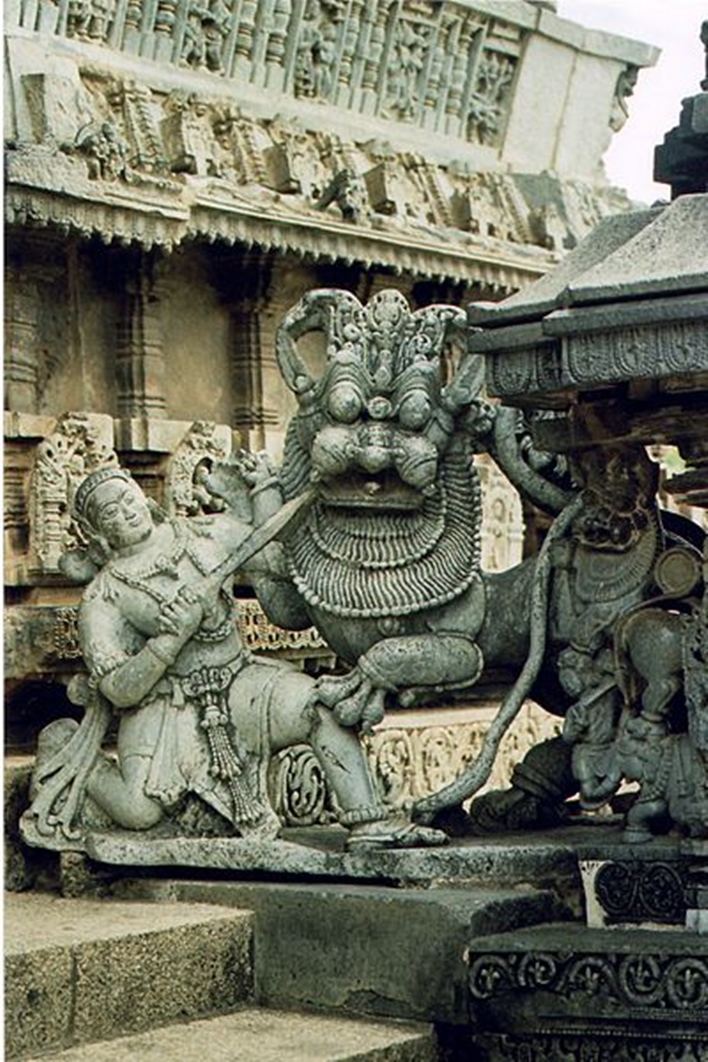
Hoysala signature motif found in most Hoysala temples. Image source: karnataka.com

The Hoysalas were a great patron of arts, culture and architecture. Hoysala temples are famous for their very intricate carvings, depicting lots of stories and information about their times. The picture below shows just a small part of an entrance door to one of the smaller Hoysala temples in Somanathapura in Mysore district. 

A small part of an entrance door of a Hoysala temple, adorned with intricate sculpture. Photo taken by author.

A characteristic feature of Hoysala temples is the use of soapstone rather than more widely available granite, for their carvings. Soapstone is more amenable for intricate carvings, unlike the much harder granite. 

The Hoysalas were also the inventors of the lathe machine. A characteristic feature of Hoysala temples is the round shaped pillars that were shaped using a hand-turned lathe. 

Lathe turned rounded pillars at a Hoysala temple. Image source: https://heythatseemscool.wordpress.com/

The figure below shows a graphical reconstruction of the main temple at Halebidu, of which only a small part stands intact today, following invasions from the Delhi Sultanate. 

Graphical reconstruction of the Halebidu temple. Image source: Facebook group on Temples of India

Of the many kings who ruled in the Hoysala dynasty, the most well known is king Vishnuvardhana who ruled between 1108 and 1152 CE. His queen Shantaladevi was an acclaimed mathematician, musician and a dancer. She was a great patron of arts, literature and science. She is depicted in several carvings in many of the Hoysala temple. Her own personal life however, was far from peaceful. And she is said to have ended her life, by jumping off a cliff at Shiva Gange hills near Bengaluru. 

Sculpture of queen Shantaladevi. Image source: Google image search 

Under king Vishnuvardhana, the acclaimed Vaishnava philosopher Ramanucharya was invited from his hometown in Sri Perumbudur, to spend several years in Hoysala empire and popularise the Vaishnava philosophy of Vishishtadvaita

Vishnuvardhana is also well known for his defeat of the mighty Chola empire and take back some of the territories they had captured from the Western Gangas who were ruling from Talakadu. The Cholas were a formidable force, who are well known for having ruled for over 1200 years, and having expanded their empire throughout the eastern coast of India and to several regions of south-east Asia, including present day Indonesia, Malaysia and Singapore. 

The acclaimed Kannada writer TaRaSu (T R Subba Rao) has written extensively about how Vishnuvardhana managed to defeat the mighty Cholas. A major factor that led to his victory were the several technological innovations driven by an eccentric inventor called Gaurachari. These innovations include: an early form of undercarriage suspensions for horse carriages so that they could travel much more smoothly, flywheel based mechanisms to maintain stability of chariots, and an early form of the telescope (about 300 years before Galileo), with lenses made from the almost transparent Spatika stone. The image below shows a Shivalinga carved from the Spatika stone. 

A Shiva linga carved from the transparent Spatika crystal. Image Sourve: Google image search

This invention of Gaurachari is also immortalised on stone, in one of the Hoysala temples in Halebidu that depicts a soldier scanning the area using a telescope. 

Man holding telescope. Hoysala sculpture. Image source: Google image search

The Hoysala influence continues to be strong in southern Karnataka even today, with several of their key personalities-- including queen Shantala, their chief architect Jakanachari, capturing popular imagination in several forms. 

26 February, 2021

The wonder that was India

 Once upon a time, philosophers-- men and women alike-- observed systems of interacting elements, and noted that the system as a whole, can be in different "states of being." They also noted that some states of being are more "stable" and "sustain" against perturbations. It is in these sustainable states, we can nurture life. The entire ecosystem of our planet, they noted, is just a sustainable state of being.

They called this phenomenon of sustainability against perturbations, as "dharma".
Sustainability is not a binary. Some states are more sustainable than others. They also noted that regardless of how sustainable was a state of being, every physical system eventually collapsed. Nothing in this physical world, they noted, is in a state of eternal dharma.
This prompted them to embark on a quest for "eternal sustainability" which is called "Sanatana dharma".
Physical systems are trivially not eternally sustainable. They hence called physical reality as "Maya." Eternal sustainability, if it exists, needs to be in the realm of prajna or consciousness, they noted. Even here, they saw that not every element of data, information and knowledge, represented eternally sustainable assertions. For example, an assertion that "summer is hotter than winters" is mostly true, except when there have been exceptions.
They then noted that, as long as assertions connected with physical reality, they can't be eternally sustainable. But then they saw that no matter how much they tried to go meta, some connection to physical reality remained. But some of them managed to get into a state of consciousness, that was completely unconstrained by physical reality.
They called this, the universal consciousness or Reality or Brahman.
They then went on to create a vibrant civilization that was based on this quest for experiencing the state of eternal sustainability. They saw that, when the core inquiry of the population is on eternal sustainability, we can derive notions of ethics, fairness, harmony, freedom, and other elements of humanities, fairly easily.
This in a nutshell, was the wonder that was India. Not the drivel meted out by Indology experts in high citadels today.

10 December, 2017

An Indian Teacher's Dilemma

Every year, when bright students come to me for advice and recommendation letters for them to pursue their careers abroad, I'm stuck with a debilitating dilemma, which I'm sure, is not unfamiliar to teachers all over India.

India is a wounded civilisation that is emerging from centuries of oppression, and grappling with collective trauma. The challenges it faces are immense and we require the brightest of minds working endlessly to make even small collective improvements. There is still life left in its civilisational roots, and it takes enormous care and nurture for these roots to grow back into the magnificent tree that it once was.

India needs bright minds, and bright minds are likely to be consumed by its challenges, with little or no traces left of their individuality.

On the other hand, moving abroad to a more developed country does wonders for these bright minds for developing their individuality. They get exposed to new cultures, new experiences, greater wealth, greater power, etc. However, none of these are likely to add much value to address the challenges that India is facing.

My Western, liberal education tells me that individual liberty is the basis for all free societies and development. Any society in which the individual cannot express their individuality is not free, and hence it is not only rational, but also moral, for individuals to seek greener pastures where they can grow and express their individuality.

As a teacher operating in the same hermeneutic echo chamber, no doubt, I would have implicitly endorsed and repeated those values to my students.

However, the values of dharma or sustainability that we learnt at home, teaches us something slightly different. It says that every individual is essentially a complex system of being, who themselves become components of a much larger and even more complex system of being, called the human society. And the basis for all free societies is to maximise the sustainability of all systems of being -- be they the individual, or the collective. Freedom in the dharmic sense, is hence, a multivariate optimisation problem. Individuals have to sustain their system of being, while at the same time, they are also responsible for helping sustain the collective system of being.

Promoting individuality by encouraging migration to greener pastures, greatly impedes the sustainability of the collective system of being. Individuals, by their mere presence can contribute greatly towards affective benefits of others around them. The mere presence of people we care about being in our vicinity gives us hope, strength and gumption to take on life's challenges for yet another day.

Of course, every student who wishes to go abroad, says that they are going to come back soon and they are only trying to "expand their horizons". But data tells us otherwise.

It is very rare for expat Indians to return to India after their studies. Their studies would have created some debt, which forces them to look for jobs after their studies. By which time, they would be married and having kids. And so on.

But more insidious is not these rational decisions that drives them to grow their roots elsewhere. The real scary and insidious elements are the narratives their minds (subconsciously) build to justify for themselves emotionally, that they are doing the right thing.

We are not rational beings who are emotional. We are emotional beings who are rational. Our system of being is largely driven by our emotional connects. And the decision to break away from one's emotional roots and settle down in a different country and culture is a decision fraught with trauma.

Our system of being -- the system that strives to keep us alive, quickly jumps into action and builds defences to justify the rational decision. Hence, people who decide to settle abroad end up with extra hate and resentment about their Indian roots. Indian culture, Indian values, Indian worldview, everything becomes the evil incarnate, which kept them oppressed in creepy ways, and which they have escaped to find a refuge in their new home.

The specific trajectory of each expat would be different -- but the broad template of experience that they go through is somewhat like the above. And I know that when I write a reference letter to a bright student who can solve complex math problems and write great code, they are actually diving headlong into an existential crisis, in a few years time. Not every one emerges out of existential crises, stronger. Most of them are scarred and traumatised for life.

So am I really helping them when I encourage them to expand their horizons? Can't they expand their horizons using the Internet and with the myriad exchange programs that exist to bring people of different cultures together? Do they have to essentially uproot themselves in their quest for their individuality?

On the other hand, if I discourage them, will I be hurting them emotionally? If I convince them to put their minds for work in India and they end up struggling and getting consumed by its problems, without being able to express their individuality, did I not fail the trust they had in me?

The dilemma continues...

Models of Intelligence

Today, whenever we speak of AI, we mean a specific model of AI based on large language models and diffusion, both of which, undergo foundati...