Showing posts with label depression. Show all posts

13 May, 2018

Ruminations

Recently, a well-known researcher in my area of work, died an untimely death. He was just 42. While we were recovering from the shock of the sudden news, a colleague pointed to a news story that said the he had most likely taken his own life -- by jumping off from the terrace of his apartment building.

And while we were still reeling from this even more troubling news, another colleague of mine found his online blog post, where he had written about his fight with depression -- and had ended the post with a note of optimism that depression can be overcome.

It was particularly poignant to read this, and I think something snapped inside me. It was too much for me to remain silent.

Depression is a problem that is not new to me at all. I've written extensively about it on this very blog, including my own experiences as well as my analysis of what is the cause of such high rates of depression in our society. And like any other post on depression, I've hopefully ended my posts on a positive note, that life is worth living after all.

But clearly, in his case, depression seems to have won the battle. And it is not reassuring at all.

One of the reasons for my "coming out" publicly with my struggle with depression is that I see this as an endemic social problem afflicting our society. It is not just my problem, and my writings are not just for me to feel better. I have cited stats and formal studies to show that levels of depression and suicide are very high (compared to the global average), especially in south India. And also that the primary causes for depression are social in nature -- not physical.

My writings are meant to be an appeal to our society in general, to put a stop to this social "auto-immune disorder" and to recognise the latent trauma and insecurity that is driving and amplifying such problems. My writings are meant to be a fervent appeal to central elements of our society -- like parents, teachers, political leaders, bosses, line managers, industry leaders, religious leaders, etc. -- to please stop psychological assaults on those in a weaker position than them, using euphemisms like humility, discipline, chastity, submission, etc. It is literally killing people.

Most importantly, my writings are meant as an appeal to the next generation -- including my students -- to become aware of their own sense of insecurity and fear that is driving them. Becoming aware of these emotions is the first step towards overcoming them.

I have seen layers and layers of defences among our student population, who not only distrust the "system" and any person whom they associate with the "system", but have also learned to cynically play the system.

When going through other blog posts from this person, one thing stuck me as kind of odd. Most of his other posts were about the "outcomes" of his research. They were not about the research itself -- but its outcomes. They talked about the conference or journal where it was published, the impact factors of these venues, the bibliometrics of his work (h-index, i10 index, etc.), the peer review process, etc. I could not see any post that talked about the research itself -- the ideas that he was pursuing, the significance of those ideas, the new perspectives he is bringing to the table, the implications and possibilities of an idea becoming a reality.. stuff like that.

If my hunch is right, then I think I know why depression won the battle in this case. According to his posts, he first started experiencing depression in the year 2013. While for me, my first major visible tryst with depression was during my student days in the 1990s. And with more exploration, it was not hard for me to figure out that I'd been coping with trauma ever since kindergarten.

And the problem that was causing the trauma was also clear. The education system continuously asked for just two things -- compliance and outcomes. It wanted us to be docile, passive and compliant "good" children, and wanted us to generate superlative outcomes after superlative outcomes. The more we complied, and the better we performed, the more expectations we had to shoulder.

The system was not at all interested in how we were developing as individuals. It was not at all interested in what we were thinking, or what kinds of challenges we were facing while growing up. Nobody talked to us about adolescence or puberty. The changes in our body and mind in our teenage years was a matter of deep shame and guilt, for us. We read Archie comics on the sly, with a feeling of guilt, when we knew we should be studying for that board exam or entrance exam. We often bragged to one another about how much we studied -- the least was 10 hours every day (outside of school hours). I remember this one friend of mine, who used to keep a log of what time he went to sleep and what time he got up, and ensured that he never slept for more than 4 hours every night, so that he may be well prepared for his exams.

In high school, we often heard of some student or the other committing suicide, for having got less than what they expected in their exams. "Dull" students were often thrashed physically by their parents after their exams. And parents and teachers, often extolled the virtue of "fear" that younger generation should have towards elders and towards God ("God fearing" meant someone with good virtues). 

The same culture continues to this day, and in many ways it has become worse. I have somehow survived so far, that too in academics -- that is still ruled by prestige, pedigree and medals. I do not know what is keeping me going. Perhaps it is my undying curiosity to learn what is causing something. Every time I have been hit by something, while others have run away from it, I have naively tried to get hit again, to see what is causing it to happen:
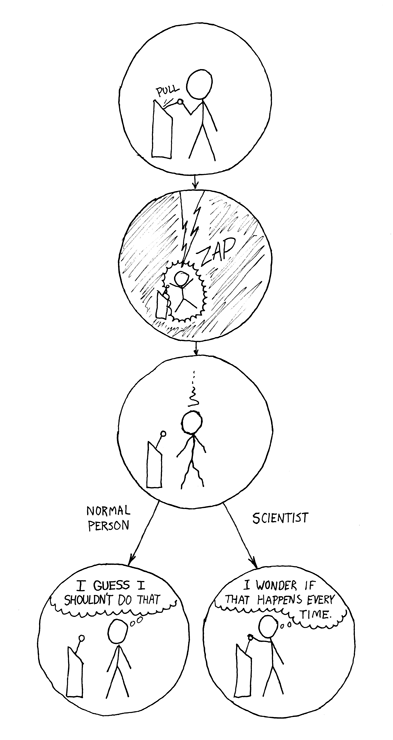
There have been several times for instance, where I have been subject to rampant slander and derogatory gossip. And I'd also seen some very high-achieving individuals around me, get completely destroyed by such kinds of slander. But so far, what I have done is to only act even more provocatively and elicit more such gossip to try and understand how it works. This has given me rich data about the psychology underlying social cognition, the role of "narratives," and how it shapes our collective worldview. It has also led me to develop a formal model of what is an opinion, and the different ways in which opinions can come together to result in different forms of collective phenomena.

We have applied this understanding to model the dynamics of social media, political movements and economic battles.

Studying slander and gossip has also helped me understand the difference between "private" information and "secure" information. It has also helped me narrow down the question of information utility to four primary factors.

The study of narratives has also helped me understand predatory and non-predatory (sustainability) dynamics of social cognition. Predatory approaches to social cognition model knowledge creation as a "convergent" process. All parties involved in the process have to converge to one narrative. Some elements of "fairness" are introduced to provide a semblance of balance. However, on the whole, it would be amply clear that prevailing power asymmetry would be the primary factor that governs the final shape that the knowledge takes.

For instance, on Wikipedia, every topic has to have one page that all different perspectives have to agree upon. To keep the process "fair" some rules are introduced, like NPOV (neutral point of view), NOR (no original research), VS (verifiable source), etc. However, it is amply clear that the model is biased towards a Western worldview that has had a tradition of formal book-keeping and recording of research. Consider an article about (say) the Mahabharata, which has been kept alive for thousands of years in India, by a tradition of story-telling. None of these stories would be considered a credible, scholarly source, while a "research" article published in a Western journal about the Mahabharata, based on flawed colonial theories of Indian history, would be considered more credible.

Such kinds of questions have prompted us to explore non-predatory models of knowledge representation, where multiple narratives can co-exist without necessarily having to blend into one another in a semantic melting pot. This question also has implications on managing a large country like India, that has ample amounts of innate diversity. We cannot have a pan-Indian "melting pot" (like for example, having everyone speak in Hindi), without causing severe cultural damage. Yet at the same time, we have to nurture and develop the sense of Oneness underlying the diversity such that the disparate cultures exist separately, yet interoperate seamlessly.

Inspired by such thoughts, we have developed a knowledge model in our lab, called Many Worlds on a Frame (MWF), which we have in turn, applied to several problems like knowledge integration, privacy preserving transactions, decentralised access control, etc.

While we have published much of our work, I really do not know the impact factors of the venues where we published, nor have we kept track of the citations. We have not really tried to play the research networking game of increasing citations and impact either.

Whenever faced with a dilemma of working towards greater impact, or working towards greater insight, we have always favoured insight over impact.

I have seen that working towards impact is primarily driven by a sense of insecurity, and it only ends up increasing the insecurity. Working towards insight on the other hand, gives us more insight into the insecure and fragile nature of our lives and careers, and ironically, this insight helps us manage our insecurities better.

Much as we like to be objective, and separate ourselves from our ideas, it is amply clear that the original ideas we develop are an extension of our selves. We develop it in an objective fashion, because we care about the quality of the idea. But that does not refute the fact that ultimately we see ourselves in the ideas that we develop.

To live in a system that judges solely based on our outcomes and quantifiable factors, makes us vulnerable to getting assaulted at every step. It is a matter of time before depression gets the better of us, if we start implicitly believing that our outcomes and metrics somehow define our worth, as a person. 

05 April, 2016

Invalidation and disqualification

In several of my earlier writings and posts on social media, I have talked about how south India is notorious for its high rates of depression (much of which goes unreported due to social stigma). It is comparable to that of Scandinavian countries, which has the highest depression rates in Europe.

However, there is an important difference. Depression is primarily driven by physical causes in Scandinavia (specifically, lack of adequate sunlight in winters). In south India, it is primarily due to social causes.

For this reason, much of the cases of depression in south India -- severe, as they may be -- are not "clinical" cases.

However, perhaps due to a lack of adequate literature, or perhaps due to the fact that "Science" is still predominantly characterized and driven by the West, most "mainstream" therapists treat these cases as clinical and prescribe medicines -- usually hormone supplements or mood stabilizers.

But then, the patients would not really be suffering from hormonal imbalances, and these supplements often result in side effects like nausea, drowsiness, etc. During my student days (in the 1990s), I have even been subject to Ketamine injections to treat depressive symptoms. While they give instant relief, they usually end up making us feeling much worse over time. They do not address the primary source of depression -- which is social in nature, which is exacerbated by the drug side effects. Not only are social factors driving the patient to a depressed state, the effects of the drug make them even more vulnerable to these social dynamics that made them depressed in the first place!

So what are these invisible social dynamics that are proving so deadly?

For several years, I've searched hard to characterize this. I've trained my focus on distorted notions of "humility" that pervades our culture, which sometimes includes elements of submissiveness and slavery. Submissiveness and "surrender" are often celebrated and venerated as virtues in the name of humility and devotion.

However, while submissiveness and slavery are closely related, submissiveness or a "divine" form of surrender is also an integral element of any deep spiritual quest. It is quite easy to trace the roots of submissiveness in our culture to spirituality rather than slavery.

I have now come to believe that interpreting humility as submissiveness and glorifying it, is not really the source of rampant depression in our society.

There is I believe, something even more insidious than submissiveness.

This is the characteristic of invalidation and disqualification, which are again distorted notions of humility, but much more harmful than submissiveness.

Invalidation is the process of illegitimizing someone as a person. It is different from skepticism, disagreement or rejection. Invalidation does not reject a person's ideas or their values or their worldview. It is a judgement on the person and rejects the person itself.

Persons subject to repeated spells of invalidation ends up "disqualifying" themselves psychologically. They end up believing that they are illegitimate as a person and they don't deserve to exist. Routine life becomes an intensely painful experience for them, as they are continuously fighting a deep-rooted battle to retain their sense of an integral self. This deep-rooted battle is not visible outside, but it nevertheless has its impact on the person's persona and social life.

An invalidating environment is self-perpetuating, in that, a people who invalidate others are often struggling to validate their own selves. Hence, a self-disqualifying person would receive little or no support from others in an invalidating environment. Worse, they would probably be subject to even more judgement and invalidation due to their sub par social skills.

Invalidation does not need any kind of physical or sexual abuse. It does not leave behind any physical scars or hormonal imbalances. A sense of self-disqualification can set in by repeated exposure to invalidating stimuli. If a child is brought up hearing "No", "Don't", etc. or is lectured and chided at every step at home or at school or in the outside world in general, they end up disqualifying themselves. Similarly, if children are repeatedly ridiculed for their emotions, are ignored when they express an emotional need, or are told with the best of intent to "cheer up and be strong" or urged to be not so "selfish" and  "think about others" when they need emotional support, they end up disqualifying themselves.

Even worse, invalidation is often a self-fulfilling prophecy. When children are repeatedly invalidated, they end up treating the invalidating behaviour as normal and start acting in a manner that elicits such a behaviour. Hence, the more the elders and teachers worry and fuss about their children's inability (to perform well in school, for example) the more their children will act in a manner that will elicit such a worry.

And finally, self-disqualification is an intensely distorted form of humility. Self-disqualification is even more intense than self-deprecation, which is again treated as a virtue. Self-deprecation is superficial, while self-disqualification operates at much deeper levels. Self-disqualification is often masked in layers of denial or defense by rationalizing it away as being humble, or even promoted and advocated as a virtue.

After long years of suffering and even longer years of searching, I think I've finally got a handle on what is the source of depression that has brought much suffering to our society.

04 April, 2015

On the causes of depression and suicides in south India

South Indian states are known to have the highest levels of suicides in the world, which is starkly different from north Indian states. Suicide is the culminating state of an intensely depressed mind.

I have been to hell and back myself, including attempts to take my life during my school days back in the '80s. Since then, I have tried hard to understand and model what is happening around us. And what I have learned is if anything, even more depressing. The roots of our depression problem go deep.

Worldwide, there is a stigma around depression and other mental illnesses. There are several well-intentioned initiatives to address this stigma by calling depression as just an illness. Like this video for example, which basically repeats several oft-heard statements about depression, like women suffer are more likely to suffer from depression than men, and it is an illness that can be treated.

But look at the statistics from the NIH study linked earlier, in south India, men are almost twice as likely to be driven to suicide (44.7/10,000) than women (26.8/10,000).  To put these numbers in perspective, the worldwide average for suicides is less than 3 per 10,000.

And if I've understood our dynamics well, calling depression an ``illness,'' is not likely to reduce the stigma -- it is only going to make things worse.

Studies and theories on clinical depression that are considered authoritative have been predominantly developed in the Western world, studying for example, the high incidence of depression in Scandinavia.

However, the causes of depression in south India are characteristically different from that of Scandinavia. According to the NIH study, the main causes of depression induced suicides in India are: "individual, family, and societal level factors." While in Scandinavia, depression is a result of vast changes in the physical climate and weather. This is also called Seasonal Affective Disorders (SAD).

Physical factors lead to neurological causes for depression like degeneration of cells, stunted growth, etc. On the other hand, depression triggered by social factors are caused by having forced into an intense emotional state like frustration or submission or helplessness for long periods of time. 

Imagine someone getting locked up in a cell for several years for no fault of theirs. They go on to become depressed. This depression is not due to the physical surroundings, but due to the intense emotional state of desperation they stay in for a long time. The paucity of light inside their cell is no more a cause of depression, than the intense emotional state of having been confined to a cell for no reason.

An emotional state results in the release of specific sets of hormones, And staying in an intense emotional state for a long time results in a hormonal imbalance. This is characteristically different from depression caused by physical factors leading to neural or other forms of cellular degeneration.

So why did our society become so deadly unto itself? 

The main social factor leading to depression is our cultural emphasis on deindividuation. Our culture is based on instilling a sense of social membership in the individual and encouraging them to work towards collective good. This has several desirable outcomes. Our society is characterized by its strong dynamics around religion and spirituality, sensitivity towards other living beings including the environment and emphasis on harmonizing with the environment, rather than taking charge or control. 


However, over the last several decades, with increasing education, awareness, technological advancement and connectivity with the rest of the world, our society has seen a lot of changes taking us away from these collective ideals. To counter this, and to maintain homeostasis of our earlier social state, these collective ideals are pursued with renewed intensity and vigour.

Beyond a certain point, emphasis on the collective starts to de-emphasize the importance of the individual and the individual autonomy. "Selflessness", deindividuation and self-deprecation become virtues. Right from a young age it is common to see people being shamed or morally admonished into compliance to the collective. 

Moral admonishment like shaming is the cognitive equivalent of throwing acid on someone's face. The damage it does is basically irreversible. For some reason, we have not understood how potent a weapon it is, and tend to bring the moral lens into everything. 

A sense of individual identity is very important to face challenges of life and to keep one's body, mind and spirit together. Without a sense of one's individual it is very hard to just convince oneself to keep breathing and be alive. 

In south India at least, deindividuation afflicts both men and women. Statistically men, are more likely to be driven to suicide, as any attempts by them to portray their problem will only subject them to even more moral admonishment.

Calling this form of depression as an "illness" makes things even worse. An illness carries no less a stigma in our society. 

Besides, an "illness" is something that can be "cured" by treatment. But a hormonal imbalance created by social pressure, cannot be "cured" by restoring the hormonal balance. It is not some form of a deficiency created by the physical environment, that can be replenished by medicine. 

To really counter the problem of depression and suicides in south India, we need to comprehensively infuse ideas in the society that respect the individual. We need to help the society understand why people pursuing their individuality does not necessarily result in collective misfortune. In fact, if the collective ideals are so good that people voluntarily associate themselves with the collective, then it only makes the collective stronger, not weaker.

19 December, 2014

Mindfulness about second-order emotions

Situations -- both real and hypothetical -- often create an emotional response in our minds, which we express in a variety of ways.

The general belief is that emotional responses are "irrational" and need to be replaced with stoic and dispassionate reasoning.

But emotions are what makes us human and embody the essence of life. Emotions are our naturally endowed physiological responses to stimuli -- it is our "firmware" in computer science parlance. This firmware logic is encoded in our genes and essentially embodies the essence of what our genetic ancestors experienced.

Our emotional reactions are hence an important repository to understand our history -- basically the unwritten and experiential part of our personal history that we won't find in history textbooks.

Emotional turmoil and mental trauma results not from these emotional responses, but from our "second-order" emotional responses.

Next time, observe how you feel about things. But more importantly, observe how you feel about how you feel about things.

It is these "second-order" emotions that are the root cause of most of our emotional turmoil.

Do you enjoy ice-cream? Do you feel guilty about enjoying ice-cream when you should be watching what you eat?

Does something make you frustrated? Are you depressed that that something makes you frustrated?

Does something cause outrage in you? Do you feel helpless about this sense of outrage, knowing at the back of your mind that you cannot control it and it may end up complicating things?

Do you feel indignation when you witness any form of injustice? Do you feel proud that you feel moral indignation in response to injustice? (That's problematic too!)

Emotions are like a child's reaction to something. A second-order emotion is like someone with a child's maturity, managing a child. It is a sure recipe for disaster. If our response to an emotional reaction is another emotional reaction, it is like an ineffective parent who just screams back at their children when they disapprove, or flatters and pampers them when they approve. The children will only learn how to manipulate around these emotional outbursts from the elders.

The stoic and dispassionate reasoning is relevant here. Replace second-order emotions and not your primary emotions with a stoic abstraction, that is built on axioms that are prudent and humane and represents your mature understanding of the situation. Let this stoic mental model interact with your primary emotions like a good parent -- reasoning with it logically, patiently and with empathy, without trivializing the emotions.

See how things change.

02 March, 2014

Mindfully connecting with ourselves

Several times in the past, I've written about my traumatic and depressive childhood, stemming primarily from what I consider to be severe philosophical defects in our approach to education and social life in general. Our schooling primarily emphasized on conformance, passive compliance, operational-skill building and performance within strict boundaries. It didn't emphasize on elements like curiosity, insight-building, contemplation, argumentation, empowerment, problem-solving skills, etc.

And the emphasis on conformance was so high that, curiosity to ask questions beyond what is taught, or any form of non-conformance was seen as something immoral. Let me emphasize on the word "immoral" again.. Like for example, in our English-medium school, speaking in Kannada or any of our mother tongues was considered "immoral" enough to be subject to punishments like being humiliated publicly, beatings, being locked up in the bathroom, and such.

I've often compared this kind of schooling with "slave-training," and it indeed stems from what our society has been through over the last several centuries. This form of schooling (and even our approach to governance, law-making and law-enforcing, for example), is still very very rampant all over, even today.

Recently, I heard a statistic -- suicide rates in Bangalore is pretty high and comparable with that of Sweden. Except that in Sweden, suicides are primarily caused by physical reasons (inadequate light in winters), while in Bangalore, suicides are almost wholly due to social reasons. That should put things in perspective!

It is one thing to appreciate the beauty that is latent in a harmonious, obsequious and compliant lifestyle, but it is yet another thing to adopt it as a philosophy of life -- by stifling away curiosity, accepting ideas without judgment, and compromising the search for truth with faith in our beliefs.

Our state of affairs pained me and continues to pain me at such a deep level. It provokes a visceral response whenever I see or are asked to conform to some ritualistic activity or notion, or to go with the herd.

Perhaps naively, several years ago, I had decided that even though I'm pained no end to simply lead a normal life here, I will not run away from here, but instead, do my bit to bring about some change in our society. I'd been inspired by several parables like the following:
A man walking on the beach saw that the tide had turned at the beach and the sea had receded, leaving behind several thousands of fish that were suddenly separated from water and writhing in the sand. There was a boy who was diligently picking up one fish after another and throwing them back in the water. But there were so many of them.. "It is no use," said the man.. "you will never be able to save them all." The boy picked a fish, threw it back into the water, and said, "Well, I saved that one!" and went about his activity.. 
After looking around aimlessly for several years, I thought I'd found my calling -- in doing my bit towards re-educating and re-wiring our society. It was of course a naive belief. Our current ideas are so deeply entrenched and so rampant, it was not before long that I've encountered all kinds of things that has pained and outraged me no end.

Soon, it became clear that I need to be dispassionate, objective and not react emotionally to keep myself sane. And slowly I began to ignore what I felt about things and subdue my emotions in order to keep my judgment engine working.

Every morning, I developed a ritual to tell myself several times over: "How you feel about things, does not matter.."

It worked for a while and helped be become level-headed and dispassionate. How I felt about stuff, indeed didn't matter to the world at large. Only hard-headed argumentation showing and demonstrating flaws in our current beliefs, could send some messages across.

But, how I felt, did indeed matter to me -- to my body. An emotional reaction is a physical response to stimuli. My body was reacting when someone spoke in a patronizing, head-patting tone or made a moral issue over some kind of unfamiliar idea, without applying their minds to it. But I had told myself that my body's response didn't matter and had subdued my emotional responses.

This in turn had started to affect my health in a slow and insidious manner -- affecting everything from general health to overall efficiency in leading a routine life.

Finally, fighting stereotypes and societal stigma against mental health, I went to several psychiatrists. But it only made things worse. The shrinks turned out to be preachers in the guise of doctors, preaching me back into conformance and submission -- and prescribing drugs to keep my emotional response subdued. They worked under the assumption that there was something wrong with me and I need to be "corrected" to fit in back into the society. They were the epitome of the very ideas that I was fighting against!

I realized what I was doing wrong. My emotional response may not matter to the world -- but it is not wrong or immoral to respond emotionally! There is no need for it to be subdued! My emotional responses are innate -- it is nature speaking! My body was protesting against injustice in its own way and by subduing it, I was subjecting it to even more injustice! The problem that I was fighting against, indeed lay outside of me, and here I was, punishing myself for protesting against beliefs that are indeed wrong! Those beliefs preaching unquestioning submission and conformance -- they are what are immoral, not the ones who don't conform to them!

Needless to say, I threw away all those prescription anti-depressants. There is no way I was going to punish my body for a crime that it didn't commit.

Some time ago, I met this person, let me call him P. Ironically, he is a preacher by profession. But he taught me something, which even the psychiatrists could not. He taught me to "mindfully" and amorally (not immorally) connect with my emotional self.

Till now, either my emotional response was coloring my judgment or it was being forcefully subdued by my judgment engine. It was as though they were both at war with one another -- trying to prove who is more powerful. My judgment engine was "unmindfully" engaging with my emotional engine.

Mindfulness is the opposite of this -- it is a means to obtain internal harmony before trying to bring about external harmony. It is a way by which we can allow our emotional self that also controls our physical response, to express what it is feeling, without passing a judgment or without jumping to conclusions based on what it is expressing.

Mindful connections with ourselves requires us to feel fully and wholly our emotional responses to stuff that are stored away in our episodic memory. But this has to be done in a fully conscious manner -- knowing fully well that this is only a physical response -- not a semantic response. These emotions are not to cloud our judgment and our balance in perspectives. They just need to be expressed.

Meditating in a mindful manner is all about the concept of mindfulness. It has got nothing to do with watching our breathing, posture, etc. (which are the stuff of what I was preached about meditation. I could never understand why focusing on our breathing will help us in giving an answer to why do we have such a slave mentality and how to get out of it.)

With the help of P, I've been practicing mindfulness for some time now. It has been a very painful and tumultuous journey so far. So many episodes, right from my childhood came hitting back at me in full force. So many pains re-emerged so much so that my body started paining in all those places that I'd been hurt earlier. I remember once my school principal had pulled me up by pinching my shoulder and had started slapping me. That pain came back in full force! I was even limping for several days after one such mindful connection sessions.

The only difference now was that, the "I" was separate from what was happening inside me. I was a mindful spectator of myself -- watching what was stored in my episodic memory and how it had affected my emotional self. I could see how deeply hurt I was -- at a moral, emotional and spiritual level. Except that this hurt was not controlling my judgment anymore. I could see this hurt in a dispassionate and objective fashion by turning my level-headed judgment engine towards observing myself. I could see how at an emotional level, I could not trust anyone -- including anyone who called themselves a friend -- including P, who had taught me mindfulness. Indeed, I could not trust myself fully to not breakdown and lose my head in the face of some kind of emotional stimuli.

Connecting with myself was so painful, it had literally knocked me down several times. I'd slept for almost entire parts of weekends (when I used to practice this). I was urged not to let myself be knocked down, which makes the experience unmindful, and instead, try and keep myself awake and observant.

After several such sessions, one day I suddenly saw myself as my childhood self, emerging from deep within all these stored up episodic memory. I could literally visualize myself as emerging from under a huge rock face that was all my episodic responses, weighing down under me. I could visualize myself hiding under the bed in my childhood home, in sheer terror -- precisely the way I used to react at the prospect of going to school in kindergarden.

I suddenly realized that my entire life till now has been shaped and built by this terrified boy hiding under the bed. Who I am has been shaped by things that are so deep down, that I had no other strong enough emotions at this level, to balance my understanding of the outside world. My distrustfulness emanates right from those days hiding under the bed as a 3-year old.

I do not want to associate yet another emotion towards this discovery. I state the above observations dispassionately, without judgment towards myself or towards the external world. I state this publicly on this blog, in the hope that it can help others mindfully connect with themselves and discover what's been driving them all along.

All of these only reinforce my judgement that we are deeply messed up as a society. Even at a philosophical level, we are damaging our children by not nurturing their thinking and problem solving skills, and instead stressing on performance, compliance and operational skill building. Creating craftsmen from our children is fine, but it should not come at the expense of not creating thinkers from children who want to become thinkers.

We teach children to respect adults, but never teach adults to respect children. But most importantly, we do not realize that the adults treat children this way, because they themselves were treated like this -- this is a problem that has been imposed on us for several centuries. I do not like to call this "abuse" -- because none of these actions were intentional. Even the principal who terrorized us in school, perhaps genuinely believed that this is the "right" way to discipline children. By calling this "abuse" and harassing the adults, we are in fact as a system, abusing a similar terrified child inside these adults, that is hiding under a bed itself.

The only way we can "fight" this problem is by spreading compassion and genuine respect -- among children and adults alike. We have to build a society where people of any age, gender, ethnicity or whatever, can freely express themselves. At least for a start, we should build safe places or supporting communities, where people can express their emotions without fear of being judged or admonished. The child in us never dies -- who we are as adults is just the persona created by our child within, as defenses to deal with the external world.

Who we really are, is the child within. Unless we can "re-parent" the distrustful child and get our emotional and judgment engines to trust one another, we cannot hope to bring about any major changes outside.

27 May, 2008

Fighting inner demons

For some strange reason, I had always been attracted towards stories in the Reader's Digest about Nazi and other atrocities happening around the world. For some strange reason, I could sense that I was able to empathize and feel the terror of these victims.

For some strange reason, there has always been a vague fear stalking me ever since I know. I remember once when a doctor had asked me whether everything was alright as I sat wringing my palms in front of him when complaining about sinus. This vague fear has been the single biggest crippling factor, which, among other things, has made me literally collapse on the ground from exhaustion -- after doing nothing.

For some strange reason, I never remember having a good night's sleep. My sleep has always been disturbing and nightmarish -- ever since I know.

For some strange reason, I never felt the urge to go "seek out greener pastures" like the rest of my classmates after graduation. Something instead pulled me towards Germany and no less than Berlin to go study.

And during my stay there, when I was visiting one of the erstwhile concentration camps of the Nazis, it stuck me. This place reminded me of school! The vague feeling of terror, the feeling of hopelessness and helplessness that I always feel -- all of them were due to this school!! The strong emotions that I fought internally when seeing movies like The Big Escape and Schindler's List, all traced down to this stupid school!!!

~~~~~~~~~~~~~~~~~

In the years when I was born, the rampant belief about education was the need for "discipline" and how "character" is molded by facing adversity.

The school where I went, took this to heart in a sadistic way, I guess. Some of the things I remember of this school are the following:

First day I was taken to kindergarden (yes, kindergarden) and the first thing I see is a teacher hitting a child hard. I remember feeling very uneasy, but was not able to comprehend anything.

Over the next couple of years, the routine thing in the morning was that I hid under the bed out of sheer terror not wanting to go to school. I was forcibly pulled out from under the bed by well-meaning grand parents, relatives, etc. and nicely packed off to school.

And every day at school we used to witness some child being thrashed, some being locked in the bathroom, some made to kneel down, some even having their hands bound.

As a 5-year old, I used to pray to God everyday that let my teacher and principal meet with an accident today and not come to school.

In sixth standard, after reading some stories about Gandhi's experiments with Truth, I spent many weeks contemplating several ways of suicide just like he did in his experiments.

Sixth standard was particularly bad for me. There was this teacher who kept on preaching her religion to us in school. (Now let us not start this religious angle thing now, I have nothing against any religion -- they're all equally stupid). She used to send us home with lots of booklets and pamphlets. It naturally caused a lot of friction at home and my grand parents once threw away one of these booklets. Next day in school, the teacher found me without the booklet and wanted to punish me (I forget exactly what was the punishment though). But I refused to admit that I did anything wrong. She pulled me away from my bench, hit me and made me stand facing the wall and I had remained completely defiant. I don't know what gave me so much strength that day. That was a Saturday and she had left me with a threat of dire consequences on Monday. On Monday morning, I promptly ran away from home without telling anyone and ended up in my grand parents place. My parents found me by evening (phones were not really around at that time) and the next morning I again tried to run away. My well-meaning folks came behind me on scooter, brought me back and sent me back to that *&%*(*! school. I guess my teacher had forgotten about her promise of dire consequences, because nothing happened.

But that same week, the bugger, I mean bigger, terror -- the principal -- walked in. And before I knew it, he is pinching me on my hands and pulling me up. Before I had a chance to react, I was hit with a volley of slaps and ruler thrashes. In the midst of all the different voices that were screaming inside me, I could vaguely hear the teacher tell the other students, "Let this be an example" or something such. Only later in the day I learnt that what had made the principal so happy was all those smudge marks in my book from my ink pen.

Somehow, one element of victory I have for myself is: I never cried in front of my teachers. They could never bring me to tears. It was another thing altogether that as soon as they left, I was livid. But never in front of them. So there!

~~~~~~~~~~~~~~~~~~

Isn't it amazing that amidst such sheer terror, life still wants to live? I used to live in my own fantasy world most of the time. Science, mathematics, social studies, everything fascinated me at some level.

I remember when I first visited Bombay at the age of 3 and saw the beach for the first time; I was making up fantastic and detailed plans of how to build a beach in Bangalore.

I also remember how after watching a Republic Day tri-colour fly-past by planes (and having watched the movie Absent minded professor), I used to imagine myself in a flying car with flubber, and making the wheel of our national flag, to complete the tri-colour of the planes.

I also remember how I had a hobby that was distinct from the usual goody-goody things like stamp-collection and coin collection. I had my own science lab, where we did such dangerous things (literally!) like trying to make glass by burning sand; and building rockets and spaceships. Even then, we had enough sense in us to take adequate precautions when playing with fire (and keep the adults completely in the dark about our activities!)

And of course, I used to bunk classes and run away from school several times -- not to go to movies or anything -- but to go to Vishveshwariah Technological Museum in Cubbon Park!

~~~~~~~~~~~~~~~~

I've always wondered why I was one of the very few who suffered so much at school. Most of my then classmates seem to be leading happy lives now.

Guess the reason is that, I am sort of a deviant kind who will not accept any idea unless I am convinced of its sensibility in my own way. Every new idea thrown at me has to go through a maze of other ideas and experiences and resolve all inconsistencies, bound all unknowns and then find its rightful place in the scheme of things. I also now understand why I get so irritated at things like name-dropping and citation-mania. I don't care which great person said what; I just want to make sense of the idea just thrown at me and give it its rightful place in the large scheme of things.

(I can see this very similar trait in some of my students and in my little niece. When one of my student says, "All I want from life is peace of mind," I know exactly what he means. When another of my student doesn't want to take up a job for fear of managers and processes, I empathize completely. When yet another takes personal offense when people behave in an insensitive manner against a population or a cultural group, I can associate with that as well. And when one more gets irritated at people pointing to Wikipedia pages in response to his cogitations, I see myself smiling. I can see a little bit of me in all of them and I'm sure it is the same way from the other direction as well.)

But society doesn't have so much patience. It wants compliance. Not solutions to problems, but compliance to its norms. And it wants it now. (A well known person once publicly defined the term "integrity" as "100% compliance". 'Nuff said).

When pushed by societal pressures, I sometimes end up pretending to accept an idea without really doing so -- usually with long term disastrous consequences.

Even in the recent past, I remember how as a new faculty member some years ago, I had succumbed to pressure by the system to have journal publications -- right now! Doesn't matter that we don't have a research program. Better get a publication or else (since we copy the US now), you know what.. Succumbing to pressure, I finally send out a paper that I myself knew was too raw. The consequences were just as I had feared -- no worse, with the added feature of having irrevocably molded the opinions of me from several of my peers in the field.

And even today, every so often, I come home with a voice screaming inside me: To hell with your prestige; to hell with your social standing; just let me think, let me explore, let me teach and let me live in peace. This voice keeps me awake for the greater part of the night and several hours are gone before this voice calms down.

~~~~~~~~~~~~~~~~~~

Sigh. Just calculating the amount of time and energy I need to spend to battle these inner demons makes it so depressing. If only I had invested half of that energy into channelizing my once hyper-active imagination into something creative, things would have been much different. But invariably, whenever I have started enjoying myself, there is this voice inside me, insidiously sounding like that stupid school principal, whose very presence cripples everything; sapping every ounce of energy.

But as I said earlier: life. just. wants. to. go. on.

Now I know why I am moved to tears whenever I listen to ABBA's "Move On":

Like a roller in the ocean, life is motion
Move on
Like a wind that's always blowing, life is flowing
Move on
Like the sunrise in the morning, life is dawning
Move on

..and especially..
I've traveled every country, I've traveled in my mind
It seems we're on a journey, a trip through space and time
And somewhere lies the answer
To all the questions why
What really makes the difference
Between all dead and living things, the will to stay alive..

..and..
I see it and I hear it
But how can I explain
The wonder of the moment
To be alive, to feel the sun that follows every rain
I ain't dead yet! Isn't that just great by itself!?! :)

PS: Er.. please don't pressurize me to do yoga or meditation or join Art of Living or watch Aastha channel or ... puhleeeze :-)

Models of Intelligence

Today, whenever we speak of AI, we mean a specific model of AI based on large language models and diffusion, both of which, undergo foundati...