Showing posts with label history. Show all posts

05 March, 2022

Indian History Chronicles: The Hoysala Splendour

Of the many impactful kingdoms of south India, the Hoysalas stand out in their own niche. Like much other non-Delhi empires, the Hoysalas are relatively lesser known or completely unknown, outside of Karnataka. Nevertheless, the Hoysala influence on the present day culture and worldview of Karnataka, continues to be strong. 

Hoysala Empire
Extent of the Hoysala Empire. Image Source: Wikipedia

The Hoysalas were a relatively small empire who ruled between the 10th and 14th century CE, from their capital city Belur, which was later shifted to.a new town called Dwarasamudra, which is presently called Halebidu. The term Halebidu literally means "old/destroyed town", which was the name given to the Hoysala capital after it was destroyed by multiple invasions from Malik Kafur, sent by the Sultan of Delhi, in the 14th century. 

Police patrol vehicles in present-day Karnataka are called "Hoysalas". This comes from the legend of the extraordinary bravery of the kings who ruled this empire. There is a legend of a boy named Sala who fought and killed a rampaging tiger. This motif is carved in stone in just about every Hoysala monument, and is a signature of the Hoysala influence on that monument. 
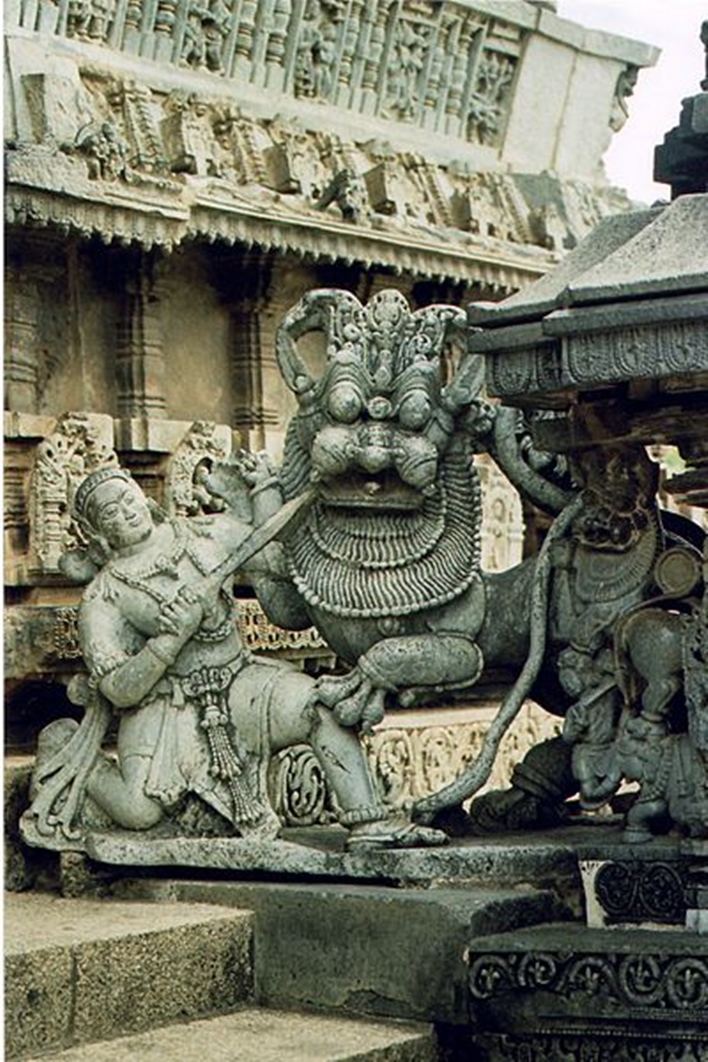
Hoysala signature motif found in most Hoysala temples. Image source: karnataka.com

The Hoysalas were a great patron of arts, culture and architecture. Hoysala temples are famous for their very intricate carvings, depicting lots of stories and information about their times. The picture below shows just a small part of an entrance door to one of the smaller Hoysala temples in Somanathapura in Mysore district. 

A small part of an entrance door of a Hoysala temple, adorned with intricate sculpture. Photo taken by author.

A characteristic feature of Hoysala temples is the use of soapstone rather than more widely available granite, for their carvings. Soapstone is more amenable for intricate carvings, unlike the much harder granite. 

The Hoysalas were also the inventors of the lathe machine. A characteristic feature of Hoysala temples is the round shaped pillars that were shaped using a hand-turned lathe. 

Lathe turned rounded pillars at a Hoysala temple. Image source: https://heythatseemscool.wordpress.com/

The figure below shows a graphical reconstruction of the main temple at Halebidu, of which only a small part stands intact today, following invasions from the Delhi Sultanate. 

Graphical reconstruction of the Halebidu temple. Image source: Facebook group on Temples of India

Of the many kings who ruled in the Hoysala dynasty, the most well known is king Vishnuvardhana who ruled between 1108 and 1152 CE. His queen Shantaladevi was an acclaimed mathematician, musician and a dancer. She was a great patron of arts, literature and science. She is depicted in several carvings in many of the Hoysala temple. Her own personal life however, was far from peaceful. And she is said to have ended her life, by jumping off a cliff at Shiva Gange hills near Bengaluru. 

Sculpture of queen Shantaladevi. Image source: Google image search 

Under king Vishnuvardhana, the acclaimed Vaishnava philosopher Ramanucharya was invited from his hometown in Sri Perumbudur, to spend several years in Hoysala empire and popularise the Vaishnava philosophy of Vishishtadvaita

Vishnuvardhana is also well known for his defeat of the mighty Chola empire and take back some of the territories they had captured from the Western Gangas who were ruling from Talakadu. The Cholas were a formidable force, who are well known for having ruled for over 1200 years, and having expanded their empire throughout the eastern coast of India and to several regions of south-east Asia, including present day Indonesia, Malaysia and Singapore. 

The acclaimed Kannada writer TaRaSu (T R Subba Rao) has written extensively about how Vishnuvardhana managed to defeat the mighty Cholas. A major factor that led to his victory were the several technological innovations driven by an eccentric inventor called Gaurachari. These innovations include: an early form of undercarriage suspensions for horse carriages so that they could travel much more smoothly, flywheel based mechanisms to maintain stability of chariots, and an early form of the telescope (about 300 years before Galileo), with lenses made from the almost transparent Spatika stone. The image below shows a Shivalinga carved from the Spatika stone. 

A Shiva linga carved from the transparent Spatika crystal. Image Sourve: Google image search

This invention of Gaurachari is also immortalised on stone, in one of the Hoysala temples in Halebidu that depicts a soldier scanning the area using a telescope. 

Man holding telescope. Hoysala sculpture. Image source: Google image search

The Hoysala influence continues to be strong in southern Karnataka even today, with several of their key personalities-- including queen Shantala, their chief architect Jakanachari, capturing popular imagination in several forms. 

14 April, 2016

Ideas and identities

For a long time now, I have resisted any effort to bring research on topics like language, culture and history into my lab. It is not that I think that these topics are unimportant. But it is because I think that as a society, we do not have the skill to extract ideas from identity for scholarly perusal.

Topics like language, culture, history etc. are teeming with issues and controversies regarding social and cultural identities. Identity driven politics is an intense element that we endure daily.

A research lab is by definition, a battleground. It is a battleground for ideas, where ideas clash and transform and evolve.

But when identities masquerade as ideas, it spells nothing but trouble.

A clash of ideas is invigorating, dispassionate and impersonal. We end up energised and enthusiastic after a successful clash of ideas.

A clash of identities is disspiriting, passionate and deeply personal. We end up feeling battered and bruised after a clash of identities.

Much of the issues in academic environments (including the recent JNU controversy) are because of our collective inability to separate ideas from identity.

A clash of ideas makes no noise and is hardly apparent to anyone other than those involved in the clash. A clash of identities on the other hand, spills over to the streets, gets paraded on news hour, along with a whole lot of other dispiriting elements.

Ideas do not have boundaries, while identities do. Cultures that are supposedly enemies of one another, watch each other so much with trepidation, that they end up exchanging and adopting ideas from one another.

One of the worst things one can do to subjugate others is to impose our idea of their identity on them. And that is what happens quite routinely, in studies of language, culture and history. Sure, there objective elements of language, culture and history; but these things are also deeply personal. Oh, and let us not even talk about religion.

The origin of language and culture is the human mind. The language that we speak is created by us in our minds. We only borrow linguistic constructs like vocabulary, metaphors, etc. from whatever we interact with, to help in reducing the effort in building our language.

Similarly, culture is an emergent characteristic of our values and the way we interact with others when driven by our values. We borrow cultural constructs from the environment, but it is we who create our culture.

If an alien virus were to infect the human race such that, the human mind were to stop functioning and stop interpreting our world, language and culture would cease to exist.

The same is true with history and religion. We all have our personal history and a personal sense of spirituality. The objective elements of history and religion we study are driven by clash of identities to result in some dominant idea.

None of the above arguments imply that we should stop studying subjects like language, culture, history and religion. If anything, these subjects require a lot more discipline than the study of the impersonal physical world or the elegant mathematical world. A discipline that requires one to separate ideas from identities and allow the ideas to clash in a way that is elucidating and empowering, rather than passionate and disspiriting.

Sure, all of us like to believe that we have such a discipline. But allow me to be sceptical of such over confidence.

Models of Intelligence

Today, whenever we speak of AI, we mean a specific model of AI based on large language models and diffusion, both of which, undergo foundati...