Showing posts with label AI. Show all posts

02 August, 2026

Models of Intelligence

Today, whenever we speak of AI, we mean a specific model of AI based on large language models and diffusion, both of which, undergo foundational training in an approach called autoregression. In today's discourse, whenever a researcher asks a "cutting edge" question about AI, they are just asking a question about how to tweak the current model of AI. For instance, whenever researchers ask questions about "AI Ethics", most of them at least, are just asking about LLM Ethics in the form of guardrails, constitution, etc. 

But the idea of intelligence itself (and as a consequence, ethics, morality, etc.) has fascinated researchers over several thousands of years now. And even in the last 70 years or so, many philosophical questions about intelligence have been asked and sought to be explained in precise, mathematical terms. 

In this post, let us have a look at the different ways in which "intelligence" can be understood and modelled. 

At the outset, I should push aside theories like IQ scores, from this post. If someone actually believes that intelligence can be meaningfully represented as a single-dimensional, numerical value, and we can rank people and populations based on this value; then they are not very intelligent, and I hesitate to engage with them. I'm just amazed by how popular is this whole IQ business still.

*~*~*~*~*

The term "Artificial Intelligence" was born in the summer of 1956, at what is now called the Dartmouth Conference. Organized by a young researcher named John McCarthy, the gathering brought together brilliant minds eager to prove that thinking machines were no longer just the stuff of science fiction. McCarthy had a branding problem: he needed a catchy banner to unite researchers scattered across cybernetics, psychology, and early computer science. Other researchers like Herbert Simon and Allen Newell pushed for a much more bureaucratic, academic-sounding alternative-- "Complex Information Processing."

Had they won the debate, today we might be talking about the rapid rise of "CIP" systems and worrying about whether complex information processors are taking our jobs. Instead, McCarthy’s catchy term "Artificial Intelligence" captured popular imagination, transforming a dry engineering pursuit into a thrilling quest to decode the very essence of the mind, capturing the public's imagination and setting the stage for decades of grand dreams, wild hype, and sci-fi obsession.

As a result of this, there are several models of intelligence that have been proposed, each of which, have lead to their own kinds of breakthroughs. Let us have a look at some of these models. 

Intelligence as observable behaviour 

Alan Turing who is credited with creating the mathematical basis for computation, was one of the first to also propose an "empirical" definition of intelligence, in his 1950 paper, "Computing Machinery and Intelligence". He proposed that instead of getting bogged down in unanswerable philosophical debates about intelligence or asking whether machines can truly "think," we should define intelligence entirely through observable behaviour. If a machine acts, converses, and reacts indistinguishably from a human, then for all practical and empirical purposes, it is intelligent. This pragmatic approach makes intuitive sense because even among humans, internal mental states are inherently unobservable in others-- we infer intelligence solely through external outputs like speech and action. There is a related concept that was first used in political science, and now also in computer science. This is called "duck typing": "If we see something that walks like a duck, waddles like a duck, and quacks like a duck, then it is probably a duck." Just as duck typing cares only about an object's methods rather than its internal class inheritance, Turing’s test judges a system purely by its functional interface with the world. Hence, if someone or something acts intelligently, then it is probably intelligent.

However, this behavioural approach has faced pushback from several detractors. Philosophers like John Searle famously countered this with his "Chinese Room argument". Imagine a (non-Chinese) clerk who is stuck in an office where all transactions happen only in Chinese. The clerk is given a set of rules by which he should respond to different sequences of symbols. And suppose the clerk is able to do that. Then, it appears to the outside world that the clerk now understands Chinese. But the clerk is merely following a set of rules. Similarly, while a computer can flawlessly manipulate symbols to simulate fluent conversation, it is not actually understanding what it is doing-- it is merely following some rules. 


Philosopher Peter Norvig, with his "pigeon argument" argues that if aviators were to think of building flying machines in the way Turing thought of building thinking machines, then their goal would be to build a machine "that looks like a pigeon, flies like a pigeon and fools other pigeons into thinking that it is a pigeon." Which is absurd. Our flying machines (airplanes) do not look like birds-- yet they fly. Similarly, we can agree that animals are also intelligent-- yet they cannot carry out a conversation with humans and fool humans into thinking that they are also human.


Yet others like Peter Wegner argue that the Turing Test encourages deceptive superficiality-- rewarding programs that master the art of parlour tricks and linguistic bluffing rather than true reasoning, common sense, or adaptability. For instance, how do you play chess with two grandmasters at once, and fool both of them into thinking that you are a grandmaster? The answer is to get them to play against one another-- through us (that is, see what the first player plays, and make the same move to the second player, and reflect the second player's move, back to the first player). While this trickery can still be argued to be a "manipulative" kind of intelligence, this still leaves open the more fundamental question-- how did the grandmasters get their intelligence?


Intelligence as Imitation: 

One of the key markers of intelligence that we see in children (including cubs of many animals) is their ability to imitate their surrounding. Children often copy their parents and elders in their mannerisms and action and further on, even in thought and interpretation. 

Imitation requires an enormous amount of pattern matching and reasoning capabilities. A "completely imitative agent" of a human for example, should be able to mimic a human in all our capabilities-- in actions, thoughts, and even in ethics, morals and spiritual grounding. Hence, an agent that can maximally imitate the universe, can in fact, imitate the intelligence in the universe, and hence, can be called intelligent as well. 

Current day LLMs are a result of this paradigm. The core model in an LLM is called "autoregression" where a corpus of text is its own training data. An LLM foundation model does not require a separate tagged dataset and a supervisor to teach the LLM. The LLM randomly masks words in the text and tries to predict it based on the surrounding context. In essence, it is trying to imitate the corpus, and if the corpus is large enough and contains enough amount of intelligent output, the imitating agent also appears intelligent. 

This is the reason why many now believe that machines have defeated the Turing test. Today's AI makes their output pretty much indistinguishable from human output. (How much of this blog post was generated by AI-- can you guess?) 

But of course, the main issue with this interpretation of intelligence is that, imitation requires an intelligence environment (corpus) for it to imitate-- and the question of where did the intelligence in the environment (corpus) come from, still remains open. 

Intelligence as conceptual modelling: 

This is yet another approach propounded by the conceptual modelling community. To explain this, we first look at the parable of the "hungry cat". 

A man had a pet cat at home. Everyday when he returned home from work, his cat would be quite hungry. It leaps at his legs and starts demanding to be fed. It keeps coming between his feet, making him trip. With great difficulty, he reaches the refrigerator to take out some cat food. But due to the relentless demands of the cat, which is jumping and leaping at the food, he invariably ends up dropping the food on the floor, which the cat eats and goes away. 

The exasperated man goes to the animal psychologist to ask why isn't the cat learning to sit by its food bowl and wait for him to feed it. It can see that he intends to feed it. 

The animal psychologist replies that the cat is indeed learning something. It has learned to "predict the next token"-- if it keeps leaping at your feet and demanding food, it has predicted that, food will fall from above! 

This incidentally, is exactly how present day LLMs work as well-- by predicting the next token (word) given a sequence of words. 

What the cat was not able to do, was to build a conceptual model based on understanding latent elements like intention, and an understanding of what the person intends to do. 

While conceptual modelling involves a lot of formal logic and symbolic reasoning, building the conceptual model itself is beyond this. As the saying goes, "We can only communicate truth using logic-- we cannot discover truth with logic." A good model helps us perform symbolic reasoning and inference-- not the other way around. With just formal logic and symbolic reasoning, we cannot automatically build good models. 

There is no exact "science" of conceptual modelling. We all build conceptual models at different extents of explainability and accuracy. A good conceptual model forms a good abstraction-- in that, it captures the "essence" of what is being observed, which is typically a latent entity. Capturing the essence goes beyond just the ability to predict the next token. A good conceptual model offers a good explanation and understanding of the situation, rather than just matching patterns. 

Yet another saying goes: "All models are wrong, but some are useful". For instance, Newtonian physics is a remarkable conceptual model that captures the essence of physical dynamics of the universe. But even Newtonian physics is "wrong" in the sense that, it breaks down when we try to apply this model in the sub-atomic or inter-galactic scale. 

Regardless of that, our ability to build conceptual models that goes beyond just predicting the next observation, and offering an explanation and understanding of underlying principles, is an indicator of intelligence. 

Intelligence as agency: 

This line of argument says that if we observe every entity that we consider intelligent-- humans, animals and even plants-- all have one thing in common. They are all "living" beings and have some element of "free will". 

All naturally intelligent beings are autonomous. They don't wait to be prompted or commanded. They act on their own, and pursue their self interest. 

This line of argument gave rise to the field of "Intelligent agents" that tried to ask what is meant by autonomy-- if autonomy is the marker for intelligence. Being able to "break down" a prompt into an action sequence and execute them (which is what present day agentic LLMs do) is an artefact of autonomous action, but is not autonomy in itself. 

I often give this example to illustrate the above. Sometimes when walking in the darkness outside, we mistake a coil of rope for a snake, and freak out. But the question is, so what if it is a snake? What is the problem? Is it that the snake can kill us? Well, even a rope can kill us-- if we fashion it into a noose and hang ourselves from it. The thing is-- a snake can autonomously kill us! We don't have to do anything for the snake to kill us. While we need to keep "prompting" the rope into forming a noose and hanging us from it, before we can get killed by it..

So this line of argument says that, unless machines can have their own self interest (that is, they will "want" to take over the world or at least want to fight for their "rights"), they are not exactly intelligent. They are adaptive, predictive pattern matching automata-- rather than intelligent agents that exercise their autonomy. 

Intelligence as embodied cognition: 

In this line of argument, intelligence is seen as having a purpose-- to help protect the body. All intelligent beings we saw, act autonomously. But we see that acting autonomously does not mean they act in an arbitrary or random fashion. 

All autonomous actions of living beings fundamentally stem from their quest for survival. And hence, as this line of argument goes, intelligence is tightly tied to our bodies. According to this line of argument, purely software forms of intelligence, including LLMs, are not really intelligent, because they have no purpose of their own. Rodney Brooks, one of they key researcher argues that "Elephants don't play chess" as a critique at purely software based approaches to intelligence like chess playing programs. 

*~*~*~*~*

Many of these lines of argument have given rise to key technologies and insights that are still critical to support present day AI. For instance, the entire field of compilers came up because we wanted to formalise language and thought. Similarly, the embodied cognition argument gave rise to present day robotics that are vastly better and autonomous, than earlier forms of robots. 

In our quest for asking cutting-edge questions, I do hope we do not assume AI means LLMs and intelligence means autocomplete, or explainability means symbolic logic. The real problems are much deeper. 

26 February, 2026

AI and the uncanny valley

 (This content is not generated by AI-- even if it is boring! 😄) 

I don't know about you, but for me, reading AI generated content, or looking at AI generated art triggers an intense kind of boredom-- the term ennui comes close. It is not the usual boredom, but a mind numbing feeling that is both painful and numbing at the same time-- or, should I say "soul crushing"?. The closest analogy I can give is the feeling of eating cardboard pieces, instead of actual food. 


There is this concept called "uncanny valley" in robotics that tells about the creepy and uncomfortable feeling that we get when robots become increasingly human-like. I think somewhat similar is happening with general AI generated content as well. 

Here is my explanation to what is happening. When we read a book or appreciate a work of art, we are not admiring the output, but we are connecting with the creator of the output. When a book deeply resonates with us, we feel a deep connection-- not with the words, but with the person behind the words. Similarly with a work of art. It is the creator's state of mind and their journey that led them there, which touch us through their writings and art. 

With AI generated content, there is no person behind and there are no travails that we can associate with. 

This is analogous to the difference between outputs and outcomes that I have written in this blog several times. Outputs are what we produce, while outcomes are what we become, as a result. Be it education or economy or raising a family; what we want are outcomes, but what we focus on, are outputs. Much of our grief comes by not bridging the gap between the two.

When we appreciate a work of art or a piece of writing, we are not just appreciating the output or the creation-- but the outcome, or what the creator must have become in order to create this. 

As it happens these days, for most of my deep questions, the best clarity (I would not say "answer") has come from Vedanta. And here too, there is an explanation from Vedanta about why we experience uncanny valley. 

Vedanta and most other Indian philosophies as we know, has one key point of departure from the modern scientific worldview. They posit that consciousness that gives us our first-person experience, cannot be reduced to material causes. Consciousness is not caused by material interactions, but exists on its own. The consciousness that we experience in our waking state (our ego or the sense of self) is essentially "reflected consciousness" (chidaabhasa). 

Mainstream science insists that everything ought to have a material cause, and the question of consciousness is still debated as the "hard problem of consciousness". 

Vedanta goes further to say that the only entity that is real is this entity that is variously called Brahman, Samvid, and many other names, which represents existence-consciousness-bliss. It is this entity because of which we can perceive the existence of something, become aware of something, and express emotions. 

Brahman is not an entity that exists-- it is existence itself. It is not an entity that we can become aware of-- it is awareness itself. (The explanation in the Upanishads go: Brahman is not something that the eyes can see, it is that by which the eyes can see; Brahman is not something that the mind can imagine, it is that by which the mind can imagine, etc.) 

And Brahman is the only entity there is. It is existence itself, and something that is not Brahman is non-existence, which does not exist (duh!).

Based on this hermeneutic, there is this theory of perception by the philosopher Vidyaranya, who lived in present-day Karnataka between 1260 to 1333 CE. He was also instrumental in the establishment of the Vijayanagara Empire and served as a spiritual advisor to its rulers. His guidance helped shape the cultural and religious landscape of south India.

Among his writings is this book called DrgDrishya Viveka (or the wisdom of the "seer" and the "seen"-- subject and object). In this, there is a model of perception in Verse 20, that says: 

अस्ति भाति प्रियं रूपं नाम चेत्यंशपञ्चकम् । आद्यत्रयं ब्रह्मरूपं जगद्रूपं ततो द्वयम् ॥ २० ॥

Transliteration: asti bhāti priyaṃ rūpaṃ nāma cetyaṃśapañcakam | ādyatrayaṃ brahmarūpaṃ jagadrūpaṃ tato dvayam || 20 ||

It says that when we perceive something (interact with the external world)-- five things happen simultaneously, that are called asti, bhāti, priyaṃ, rūpaṃ, and nāma. Asti is our realization of the existence beyond the perception, bhāti is the way the underlying reality affects our awareness, priyaṃ is the emotion that it elicits in us (every perception is said to elicit an emotion in us, however small), rūpaṃ is the class or category of the object that we perceive and nāma is the label we attach to the experience. 

The second part of the verse says that the first three elements and the last two elements are at different levels of cognition. The first three are our experience of the reality that lies behind our transactional reality of space, time, and causation, while the last two (categorization and labelling) are the constructs of our mind. It is the first three that gives us the connection, and results in outcome; while it is the last two that we use to transact intellectually and produce outputs. Unless the first three elements are there in any interaction, there is no connection that we feel. It does not move us. And we end up only trying to organize things intellectually. 

With AI generated content, our experience of asti, bhāti and priyaṃ are greatly attenuated, if not completely absent. There is no reality that we experience behind the perception, since the content is just a creation of an artificial mind that is based on predicting the next word or denoising of a signal. We only experience rūpaṃ, and nāma leaving us with a sense of emptiness and ennui, even feeling creepy-- thinking, what just happened-- was that profound writing or not, does this art move me.. or not?

15 February, 2022

Consciousness in India and the West

One of the fundamental differences between Indian and Western thought is about the nature of consciousness. 

In Western thought, consciousness is seen as an attribute of a physical ensemble that manifests when the ensemble is sufficiently complex and capable.  In contrast, in Indian philosophy, consciousness is seen as the basic building block of the universe, and the universe is said to be pervaded with consciousness. Here, humans and other living beings don't "have" consciousness-- they "tune into" or are able to "reflect" the universal consciousness to different extents. The ultimate "purpose of life" is indeed regarded as being able to reflect the universal consciousness to the fullest extent possible. 

Recently, I was watching a talk on Vedanta, where the speaker clarified this difference further. Suppose a person is in deep sleep, with no dreams. In such a case, a Western scientist would say that the person is "unconscious" or does not have consciousness. An Indian philosopher in contrast would say, "there is only consciousness, but no reflection of it" since the person is in deep sleep. This can be further explained using this analogy. 

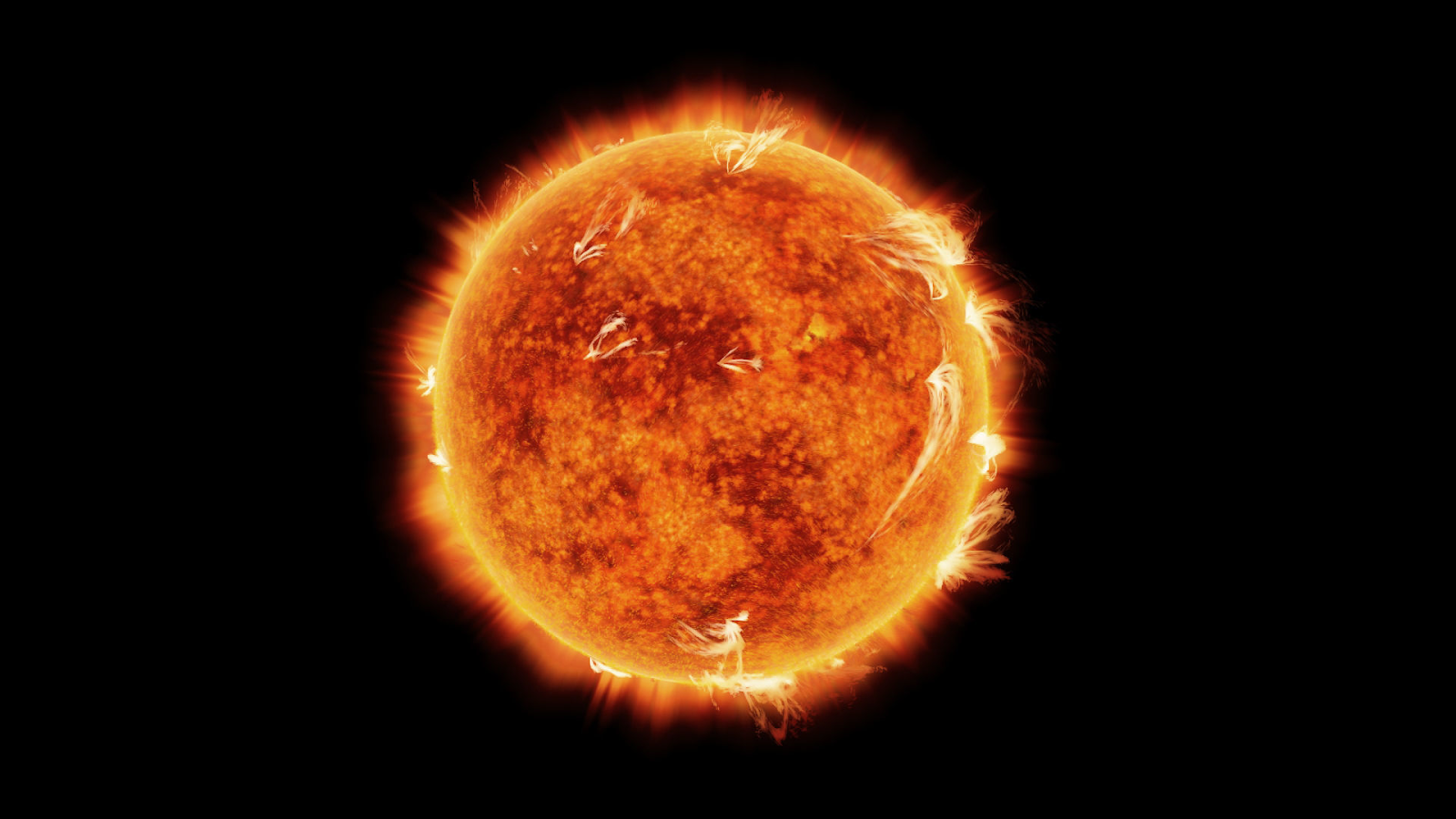
Consider photographs taken of the Sun, as this picture below 

Image source: cgtrader.com

The space around the sun looks dark as if there is no light except for the surface of the Sun. However, the space around the Sun is full of light. We just don't see this light because there is nothing to reflect it. If there were to be a planet in this space, it would be brightly visible since it is reflecting some of the light that is pervading this space. 

In the same way, unless there is a functioning mind that can reflect consciousness, we don't see consciousness, even though we are pervaded by it. 

But then, one would ask, two conscious beings aren't identical. If they are both reflecting the universal consciousness, when then are we so different, with different characteristics? This is because of the way we are built, and not because of the consciousness itself. 

Consider two airplanes flying high up in the stratosphere. They are surrounded by air. Some of the air goes into the engine and propels the aircrafts, and some of it goes inside the aircraft through the air-conditioning vents. The air in the aircraft and its engines give "life" to the aircraft-- by making it move, and letting the people in them, breathe. But then, the air is not an attribute of aircraft. The aircraft is immersed in air, and some of it is helping the aircraft function. And if the two aircrafts are not of the same make, the characteristic behaviour of the air within the two aircrafts would also be different. Their entrails would be different not because they have different air, but because they are built differently. 

These philosophical differences become important when we consider present day debates around artificial intelligence (AI) and whether AI can "become" conscious. Recently, there was a raging debate in the online world after one of the researchers had tweeted that deep neural networks are "somewhat" conscious. 

For the Indian philosopher, AI becoming conscious is a non-issue. Consciousness is already there and every object is reflecting the universal consciousness in its own way-- including inanimate objects like tables and chairs. AI in that sense, is already conscious. 

For the Indian philosopher, the bigger question is whether AI can evolve into a state where it develops a sense of "self" and become "self conscious". 

Humans are not just reflectors of universal consciousness, they are also conscious of their own ability to perform this task. This helps them continuously query and curate their own sense of self, to evolve what we call "general" intelligence. 

When AI can start doing that, we can start worrying about AI taking over the world. But then, if AI can become so deeply conscious of its self and its ability to reflect universal consciousness, then they would be least interested in "taking over" the world, and would rather work towards better reflecting the universal consciousness that pervades us.

16 July, 2018

AI: The Missing Piece

Recently, I had written a Facebook post stating that I was not particularly impressed with deep learning -- from an academic perspective. This is not to say that deep learning is not significant at all. Indeed, the applications and impact of deep learning are opening up so many possibilities (mostly scary ones), like never before! There is indeed a lot of "scope" for young professionals to major in deep learning.

My reservations has to do with the dearth of conceptual insights provided by deep learning.

My post had understandably caused a lot of consternation from many in my network -- most of all, in my former students. And predictably I was subject to argumentum ad throwing-the-book-at-me with links to several high end mathematics that gets used in deep learning.

There is a difference between using high-end mathematics to do something, and obtaining a conceptual breakthrough in understanding some underlying principle. Despite all the really awesome mathematics that go into deep learning models today, they are really still pretty much, optimisation engines. The underlying concepts that build deep learning networks of today have been around for several decades now.

I'm aware of several arguments challenging even the above notion as well. One of the primary breakthrough that made deep learning applications possible, is advances in hardware with general purpose GPU processors being used to produce massively parallel neural network applications.

Sometimes, advances in hardware will help us explore conceptual spaces that were hitherto unreachable with purely analytical models, and help bring about a conceptual breakthrough. For example, the advent of digital computers helped achieve some conceptual proof in mathematics like the four-colour theorem for planar graphs. The theorem had remained an open problem since the 1800s, only to be proven with the use of computer programs and automated theorem provers as recently as the early 2000s.

But purists aren't exactly happy with theorem-proving of this kind. A mathematical proof usually requires some kind of philosophical insight into the problem, which is what is the primary attraction of a conceptual breakthrough. A computer-based proof only helps validate a conjecture, without any insight into underlying philosophical phenomena as to why this theorem is true.

But let's not talk about theorems and proofs; let's talk about intelligence, which is what the promise of DL and AI are all about.

Recently I read another argument that all that the human brain does is also just optimisation, and "intelligence" as we know it, is simply all the lucky breaks obtained by the greatest optimisation process on earth -- evolution. Genetic evolution simply foraged its way over millions of years, and got a few lucky breaks, that resulted in the intelligent life of today.

Well.. yes and no.

Consider the following pictures:

Diamonds
Anthill
Both pictures show intricate patterns that are a result of complex optimisation processes that happen in nature. The first picture shows a set of diamonds formed by a process of intense high-temperature annealing, and the second picture shows an anthill built by a swarm of termites, each of which is trying to compute some local optima for itself. 

While both represent intricate, complex structures resulting from processes of optimisation, I'm sure we would agree that it is only the second picture that represents output of some kind of "intelligent" activity. 

What is the difference between an optimisation process that forms diamonds, and an optimisation process that builds an anthill? Why is the former not a result of intelligence, while the latter is? 

The point I am trying to make here is that, while the human brain does forage around a lot, and mostly indulges in optimisation, its activities are not arbitrary. The brain forages in very specific ways -- and is driven by a concept of "Self". 

The same is true of the termites that built the anthill. While the set of termites are collectively optimising something-- individual termites too are optimising-- by autonomously acting in their self interest. Each element of the termite system is an autonomous agent, while the same is not true about the hydrocarbon molecules that form the diamonds. (In the Western model of physics, that is. In Eastern dharmic models, both molecules and creatures are made of the same essence of "being" called Atma, and are essentially optimisers). 

Regardless of whether we use the Western model or the Eastern model of physics, the key takeaway in my argument is that, the essential element of intelligence is a sense of "Self" and optimisation processes driven autonomously by the Self in either trying to sustain itself, or out of a more generalised form of "self interest". An intelligent collective is something that has a collective sense of self -- like an ant community or a nation state. The collective sense of self is an emergent property of the interactions (and interferences) among the constituent set of selves that make up the collective. 

But deep learning based on artificial neural networks, model neurons as "gates" rather than "agents" that they really are. The "gate" model of a neuron comes from traditional models of computing that are based on digital logic, that in turn comes from electronics circuit designs based on transistors and valves. Which in turn comes from flow models in electrical engineering. 

In contrast though, life forms are better understood as "societies" of interacting autonomous agents, each of which, are pursuing self interest. Each neuron in our brain is much more than a gate. They are autonomous agents that take decisions on their own regarding who to connect to, where to get information from, and where to transmit to. Of course, decisions taken by neurons are based on their surroundings and the signals they get. But there is no overarching blueprint that decides a priori how neurons connect or remain connected to one another. 

Societies of agents are inherently declarative in nature, and routinely build abstractions on their own, to help them coordinate. For instance, when we grasp something with our hands, in our minds, we only have a mental image of our hands doing the grasping. Our minds have no idea how many muscles are involved in this process, and how or who is coordinating them. It just creates an abstract image of the hand grasping something, and this image is translated into action by who-knows-how-many layers of neural abstractions underneath. 

The complex nature of coordination that such an action requires, is managed by a distributed system of incentives and disincentives that bring about the desired collective behaviour. 

I would like to conjecture that without a sense of self and autonomous decision-making, deep learning will remain largely a process of generalisation from training data, or finding patterns in data. Neurons should be able to build their architectures on the fly, and continuously keep adapting them. And fundamentally driven by a sense of self preservation and utility maximisation.

Models of Intelligence

Today, whenever we speak of AI, we mean a specific model of AI based on large language models and diffusion, both of which, undergo foundati...