Showing posts with label academics. Show all posts

06 December, 2025

The product and byproduct of universities

Several years ago, I heard this interesting argument in a speech by a famous academic. It said that, the primary product of a university is the ideas and knowledge it generates-- while its graduates are just the byproducts created in this process

It was very intriguing to hear this, and I found it quite a profound observation. Indeed, as the speaker argued, universities are not meant to create trained personnel for the industry-- that needs to be primarily addressed by industrial training itself. "Industry" does not mean one thing-- and indeed within the same industry there are vastly varying needs that are constantly changing. An independent body like universities cannot put its entire focus on the narrow goals of meeting variegated and changing industry needs for the next placement cycle. 

Universities and higher-education are also not meant for imparting "conceptual foundations" in students-- students are expected to enter universities with fairly strong foundations. 

The primary role of the university in a society-- as the argument went-- is to act as a catalyst of progress-- by infusing fresh new ideas and perspectives that give us new understanding of our world and our challenges, and equip the society better. Societies have an incentive to build universities, when universities become the source of thought leadership through original, rigorous research by exploring ideas that are relevant, pertinent and timely to the society. 

As a byproduct of this activity, universities also create graduates, and the graduates get "prestige" and social status because of the brand value that the university has earned by its thought leadership and impact on the society. Their pedigree of having been associated with teh university opens doors and creates opportunities for them. But all this is possible only if the university was a thought-leader in the first place. 

*~*~*~*~*~*~

This argument is compelling, and I do believe it has a lot of merit. 

But over the years, my perspective has slowly started to change, as I found the opposite argument just as compelling. 

One of the pathologies of placing our primary focus on ideas, and treating people as byproducts is that such a setup can easily slide into toxic work environments. It is generally difficult to understand the worth of a new idea when it is generated (to quote Michael Faraday when he was asked what is the "use" of his discovery of electromagnetism: "What is the use of a new born baby?"). Because of this, some arbitrary, dominant ranking or metric becomes center-stage and gets brutally pushed down on researchers and students. Having no other frame of reference, graduates who are the byproducts of this system, emerge bruised and abused, and end up believing that toxicity is what "rigour" means! And then they move on to other institutions and implement the same toxicity there. 

This is the context in which I came across the opposite argument, which says that the primary objective of a university is to bring about a transformation in its students-- from novices to experts to eventually transform the population to a collective state of responsible empowerment. In order to do this, the university needs to generate new ideas and thought-leadership, as byproducts

I have argued this point of view in some of my previous posts on outcomes versus outputs: here and here

In this mode of thinking, it is the people who are the primary focus. It is the people who create ideas and take the ideas-- and more importantly, the hermeneutics or the way of thinking, that they developed in the universities back into the society and bring about changes. It is imperative on the university to watch how their students are transforming through their journey, and facilitate desirable transformations by removing roadblocks in their journey. 

In such environments, reflection and introspection are very important. Not only are we creating solutions, applying knowledge and driving change, we are also deeply aware of how we are ourselves transforming in this process. The transformation that we go through is the outcome, while the things that we produce in this process are the outputs

I often tell my students that there is a difference between "doing the job of a teacher, and being a teacher" and similarly, between "doing the job of a student, and being a student". 

The latter is the personal change that we encounter, which remains with us throughout our lives. 

It is not that people don't get transformed in an output oriented environment-- they do get transformed into cynical, insecure, and toxic professionals, confusing this for rigour and discipline. Scale this at a country level, and we can see that despite having several engineering colleges, we do not create any new idea or new ways of thinking of solving our own problems, and instead, all that the graduates of our premier universities dream of, is to go abroad and settle down there. This is the transformaton we are creating. 

Once, apparently someone visiting from abroad asked the Director of one of our premier tech institutes, "You guys have created such a miracle that we are struggling to understand! You take the best and brightest young minds of the country and make them good for nothing in just four years! How do you do it?" 😜

I don't know how true that story is-- but you get the idea! 😁

So yeah, the products are still the people-- who are transformed from complainers to solution-givers, from insecure and fearful creatures to confident yet humble professionals. In this process, they go through the latest tech, the latest framework, the latest whatever, and produce the best papers and ideas according to whatever metric-- those are all important, to the extent of being byproducts.

13 May, 2018

Ruminations

Recently, a well-known researcher in my area of work, died an untimely death. He was just 42. While we were recovering from the shock of the sudden news, a colleague pointed to a news story that said the he had most likely taken his own life -- by jumping off from the terrace of his apartment building.

And while we were still reeling from this even more troubling news, another colleague of mine found his online blog post, where he had written about his fight with depression -- and had ended the post with a note of optimism that depression can be overcome.

It was particularly poignant to read this, and I think something snapped inside me. It was too much for me to remain silent.

Depression is a problem that is not new to me at all. I've written extensively about it on this very blog, including my own experiences as well as my analysis of what is the cause of such high rates of depression in our society. And like any other post on depression, I've hopefully ended my posts on a positive note, that life is worth living after all.

But clearly, in his case, depression seems to have won the battle. And it is not reassuring at all.

One of the reasons for my "coming out" publicly with my struggle with depression is that I see this as an endemic social problem afflicting our society. It is not just my problem, and my writings are not just for me to feel better. I have cited stats and formal studies to show that levels of depression and suicide are very high (compared to the global average), especially in south India. And also that the primary causes for depression are social in nature -- not physical.

My writings are meant to be an appeal to our society in general, to put a stop to this social "auto-immune disorder" and to recognise the latent trauma and insecurity that is driving and amplifying such problems. My writings are meant to be a fervent appeal to central elements of our society -- like parents, teachers, political leaders, bosses, line managers, industry leaders, religious leaders, etc. -- to please stop psychological assaults on those in a weaker position than them, using euphemisms like humility, discipline, chastity, submission, etc. It is literally killing people.

Most importantly, my writings are meant as an appeal to the next generation -- including my students -- to become aware of their own sense of insecurity and fear that is driving them. Becoming aware of these emotions is the first step towards overcoming them.

I have seen layers and layers of defences among our student population, who not only distrust the "system" and any person whom they associate with the "system", but have also learned to cynically play the system.

When going through other blog posts from this person, one thing stuck me as kind of odd. Most of his other posts were about the "outcomes" of his research. They were not about the research itself -- but its outcomes. They talked about the conference or journal where it was published, the impact factors of these venues, the bibliometrics of his work (h-index, i10 index, etc.), the peer review process, etc. I could not see any post that talked about the research itself -- the ideas that he was pursuing, the significance of those ideas, the new perspectives he is bringing to the table, the implications and possibilities of an idea becoming a reality.. stuff like that.

If my hunch is right, then I think I know why depression won the battle in this case. According to his posts, he first started experiencing depression in the year 2013. While for me, my first major visible tryst with depression was during my student days in the 1990s. And with more exploration, it was not hard for me to figure out that I'd been coping with trauma ever since kindergarten.

And the problem that was causing the trauma was also clear. The education system continuously asked for just two things -- compliance and outcomes. It wanted us to be docile, passive and compliant "good" children, and wanted us to generate superlative outcomes after superlative outcomes. The more we complied, and the better we performed, the more expectations we had to shoulder.

The system was not at all interested in how we were developing as individuals. It was not at all interested in what we were thinking, or what kinds of challenges we were facing while growing up. Nobody talked to us about adolescence or puberty. The changes in our body and mind in our teenage years was a matter of deep shame and guilt, for us. We read Archie comics on the sly, with a feeling of guilt, when we knew we should be studying for that board exam or entrance exam. We often bragged to one another about how much we studied -- the least was 10 hours every day (outside of school hours). I remember this one friend of mine, who used to keep a log of what time he went to sleep and what time he got up, and ensured that he never slept for more than 4 hours every night, so that he may be well prepared for his exams.

In high school, we often heard of some student or the other committing suicide, for having got less than what they expected in their exams. "Dull" students were often thrashed physically by their parents after their exams. And parents and teachers, often extolled the virtue of "fear" that younger generation should have towards elders and towards God ("God fearing" meant someone with good virtues). 

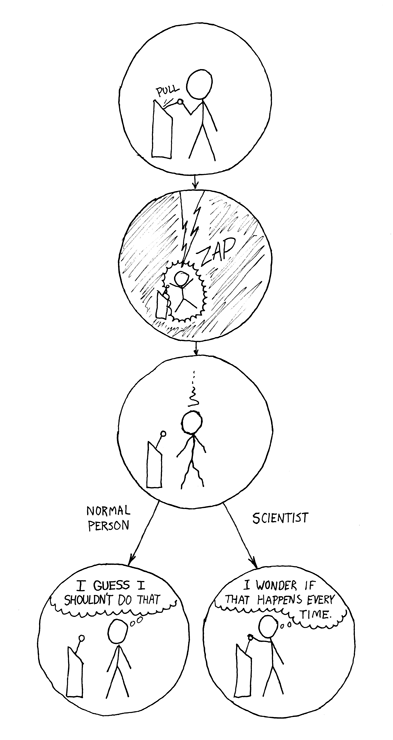
The same culture continues to this day, and in many ways it has become worse. I have somehow survived so far, that too in academics -- that is still ruled by prestige, pedigree and medals. I do not know what is keeping me going. Perhaps it is my undying curiosity to learn what is causing something. Every time I have been hit by something, while others have run away from it, I have naively tried to get hit again, to see what is causing it to happen:
There have been several times for instance, where I have been subject to rampant slander and derogatory gossip. And I'd also seen some very high-achieving individuals around me, get completely destroyed by such kinds of slander. But so far, what I have done is to only act even more provocatively and elicit more such gossip to try and understand how it works. This has given me rich data about the psychology underlying social cognition, the role of "narratives," and how it shapes our collective worldview. It has also led me to develop a formal model of what is an opinion, and the different ways in which opinions can come together to result in different forms of collective phenomena.

We have applied this understanding to model the dynamics of social media, political movements and economic battles.

Studying slander and gossip has also helped me understand the difference between "private" information and "secure" information. It has also helped me narrow down the question of information utility to four primary factors.

The study of narratives has also helped me understand predatory and non-predatory (sustainability) dynamics of social cognition. Predatory approaches to social cognition model knowledge creation as a "convergent" process. All parties involved in the process have to converge to one narrative. Some elements of "fairness" are introduced to provide a semblance of balance. However, on the whole, it would be amply clear that prevailing power asymmetry would be the primary factor that governs the final shape that the knowledge takes.

For instance, on Wikipedia, every topic has to have one page that all different perspectives have to agree upon. To keep the process "fair" some rules are introduced, like NPOV (neutral point of view), NOR (no original research), VS (verifiable source), etc. However, it is amply clear that the model is biased towards a Western worldview that has had a tradition of formal book-keeping and recording of research. Consider an article about (say) the Mahabharata, which has been kept alive for thousands of years in India, by a tradition of story-telling. None of these stories would be considered a credible, scholarly source, while a "research" article published in a Western journal about the Mahabharata, based on flawed colonial theories of Indian history, would be considered more credible.

Such kinds of questions have prompted us to explore non-predatory models of knowledge representation, where multiple narratives can co-exist without necessarily having to blend into one another in a semantic melting pot. This question also has implications on managing a large country like India, that has ample amounts of innate diversity. We cannot have a pan-Indian "melting pot" (like for example, having everyone speak in Hindi), without causing severe cultural damage. Yet at the same time, we have to nurture and develop the sense of Oneness underlying the diversity such that the disparate cultures exist separately, yet interoperate seamlessly.

Inspired by such thoughts, we have developed a knowledge model in our lab, called Many Worlds on a Frame (MWF), which we have in turn, applied to several problems like knowledge integration, privacy preserving transactions, decentralised access control, etc.

While we have published much of our work, I really do not know the impact factors of the venues where we published, nor have we kept track of the citations. We have not really tried to play the research networking game of increasing citations and impact either.

Whenever faced with a dilemma of working towards greater impact, or working towards greater insight, we have always favoured insight over impact.

I have seen that working towards impact is primarily driven by a sense of insecurity, and it only ends up increasing the insecurity. Working towards insight on the other hand, gives us more insight into the insecure and fragile nature of our lives and careers, and ironically, this insight helps us manage our insecurities better.

Much as we like to be objective, and separate ourselves from our ideas, it is amply clear that the original ideas we develop are an extension of our selves. We develop it in an objective fashion, because we care about the quality of the idea. But that does not refute the fact that ultimately we see ourselves in the ideas that we develop.

To live in a system that judges solely based on our outcomes and quantifiable factors, makes us vulnerable to getting assaulted at every step. It is a matter of time before depression gets the better of us, if we start implicitly believing that our outcomes and metrics somehow define our worth, as a person. 

Dharma and Systems Theory

A term that has made a major comeback in our vocabulary these days, is " dharma "-- which is used in various senses, including: ri...