Showing posts with label education. Show all posts

13 July, 2026

Insights - 2: Weaving a Bharatiya approach to academics

Manju (name changed) is a high school student in a small village in a remote corner of Karnataka. I knew him from when he was just a 4 year old kid. 

A couple of years ago, I and my family members met him again after several years, and were amazed at what he has become. He is in high school now, and was showing us a toy tractor he had built from cardboard boxes and bottle caps. What was amazing was not just the structure of the toy that resembled a real tractor. It was also powered by two motors-- one for the wheels, and another stepper motor for controlling the plough. He had also created a small control panel with which we could control the movement of the tractor, as well as the plough behind! 

We were seriously impressed with his engineering skills and strongly encouraged his parents (who were low income farmers with very little schooling themselves), to get him to study and go to college. 

Fast forward a couple of years. Manju no longer lives with his parents after having had a showdown with them regarding his low marks in school and not having performed up to expectations in school making his prospects of entering college, dim. He has run away to his grand-parents place and cannot face his father. 

I was aghast when I heard this. And even more aghast (with a sense of deja vu) when the dad said that Manju was not all that bright a kid, unlike his elder brother who is so enterprising and dashing. 

*~*~*~*~*

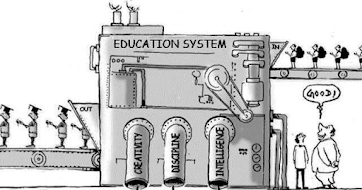
The above episode is in a nutshell, the epitome of the serious pathology that afflicts our formal education today. Formal education in India today is a nightmare for anyone who have their own creative potential and can think independently. The system systematically dispirits individuals to make them into insecure automatons with certificates, who can then be exploited employed in some form of compliant service. 

We keep talking about our "demographic dividend" and keep lamenting why Indians are not innovative or creative, and ask how do Indians excel abroad when they struggle in India itself? 

But hardly anyone seems to be interested in systematically analysing the pathologies that afflict our formal education system and do something about it. 

The formal education system in India, is an efficient system of deracination. Through relentless conditioning and pontification, it makes us dissociate the knowledge that we learn, from our sense of individual personhood based on lived experience and original thought. With several years of schooling, where students are measured on narrow metrics that have little or no relevance to the world around them, they end up learning to live almost completely within their minds with no sense of ownership or belongingness to the reality around them. 

Which is the reason why, in many of our "elite" and "premier" institutions, it feels like we are in a different country altogether. Some of these elite institutions have existed for several decades now, where they impart advanced training and conceptual insights to their students. Yet, outside the campus, the city would have remained as backwards as it were when these institutions started. Very few of the "elite" students engage with the city council or the municipality or the community around them. One would imagine that the entry of an elite academic institution, will change the social ecosystem around it too. Yet, (with some exceptions in recent years), it has hardly been the case. 

Knowledge systems in our formal education today is a direct import from the West. Right in kindergarten, we learnt about summer vacations where people go on picnics to "soak up the sun" and eat plum cakes. Never mind that we had never seen a plum cake before-- and I'm not sure I have seen one even now, and "soaking up the sun" in our summers would be a really bad idea! (Nowadays it is a bad idea even in Europe!) And all the way into higher education several decades later, we learnt about "market basket analysis" without having seen a single supermarket store (at that time), and at work where I remember having written a device driver for a CD changer device just from a textual description of what is a CD changer, and without even having seen such a device! 

Even as researchers, we find today that our work is valued only so much as some major community in the US or Europe values it. No amount of logical arguments or evidence or proofs would serve to convey the importance of any original idea we have developed. All argumentation about originality will be seen as lame excuses, with the only evidence of research quality is to be recognised by some "worldwide" community that is directed by institutions in Europe or US. When we do manage to convey the importance of our original idea, in order to be granted our degrees, we are then expected to work it out to the minutest detail, including implementation and deployment-- a process that would have taken decades even in the Western world. 

(In one of my courses, I include John Nash's seminal paper about the existence of Nash equilibria in finite non-cooperative games, that lead him to eventually win the Nobel prize in economics. I make it a point to note that the first version of this paper had no equations at all in it! It just provided an idea that a result in algebraic topology can be directly applied here. Fat chance in India today that we can ever publish an idea at this preliminary stage and expect to be taken seriously!). 

And whenever I have argued for a need for a Bharatiya approach to academics and research, I usually get a pushback saying that the age old wisdom of Vedas and Upanishads are not relevant today, and that "science is universal" and there is no such thing called "Bharatiya approach" to science. 

I refute both these arguments as follows: 

  • By Bharatiya approach, I am not necessarily advocating returning to our education system from thousands of years ago (although it is a good idea in itself, to study our ancient knowledge systematically from today's hindsight-- without the contemptuous interpretations accorded to them by colonial interpreters). I only mean that we need to stop blindly copying either Europe or US or China or Japan or whatever else, and address our challenges with original thought and implement solutions that address our challenges directly (rather than implementing a solution for some other country first and let it "trickle down" decades later).
  • Second, the outcome of science may be universal knowledge, but the path to science is highly rooted in socio-cultural-political landscape of the population practising it. To quote Heisenberg, "What we observe is not nature itself-- but nature exposed to our method of inquiry." And there is definitely an original Bharatiya approach to the method of inquiry. When we change the method of inquiry, the universality of our discoveries will not change. Only what we end up discovering will change, and the outcomes of such discoveries will be more directly relevant to our lived experience.

*~*~*~*~*

So what would such a Bharatiya approach be like? I hesitate to offer specific structures and processes, because one, Bharat is way too complex to be described by one specific structure or process; and two, given the way we operate today, whatever specific structure or process we bring in, the system will quickly overfit to the metrics rendering the whole exercise meaningless. 

Instead, I am going to propose the following dimensions that we need to think through, for bringing about effective change: 

Resilience: One of the most important changes we need to bring about is make the education system more resilient. Today, a student's entire future is dependent on "cracking" one exam with stratospheric marks, that pretty much mean nothing in terms of what skills or insights they actually have. Our teenagers cannot afford to fall ill, or get tired, or pursue some creative activity, or take a break. If they do any of these, their future is gone-- not just in terms of jobs or money, but also in terms of basic dignity of existence. Our system is that brittle. 

In my own case, for the crime of having been interested in science as an end in itself during my high school (and having my own science lab at home, and having built my own ham radio, etc.) and not focusing on my exams instead, I am still paying the price in terms of greatly attenuated opportunities and having to receive a lot of contempt and derision. We are way too brittle, and if we wish to really address our mental health crisis, we need to start building resilience into the system, rather than removing ceiling fans from student hostels so that students cannot hang themselves

Capability: The second dimension that we need to work on is a holistic sense of "capability" (to use the term in the sense of Amartya Sen's "capability" approach). Capability is an abstract term that refers to how easy is it for someone to build the lives they want, and act meaningfully. Capability includes, but is not limited to the technical and scientific knowledge we learn in college. It has several more dimensions like managing health, wealth, culture, people, uncertainty, risk, etc. 

We often say that college education should be "job oriented" and we reduce it even further, to focus just on what companies coming for placement are looking for. However, in a more fundamental sense, what we are all insecure about is not "job" per se, but "livelihood". For most of the country, jobs are still hard to come by. And even for the "elite" ones today, thanks to disruptions caused by AI, a "job" is no longer a guarantee for "livelihood". 

When we address livelihood instead of jobs, we see that we will need to impart many more skills to our students. Most importantly, jobs require our students to compete for a small number of positions, while livelihood requires them to collaborate and promote teamwork to improve our chances of earning. Livelihood training requires us to teach how to identify problems, how to find what the market needs, how to manage costs, how to manage uncertainty, how to build networks, etc. A job oriented approach to education makes us more competitive and insecure, while a livelihood oriented approach makes us more capable as well as resilient. 

Creative agency: The real outcome of education is how we are ourselves transformed as a result of our learning journey. To promote this, we need to encourage originality of thought and action-- or our creative agency. In most of our curriculum, we only teach from books and get students to understand what knowledge others have built. We hardly ever get students to create their own knowledge. 

Knowledge creation is a very hard process. It is not as easy as it sounds. We easily form opinions-- but an opinion is not knowledge. The most important skill to learn for knowledge creation, is objectivity-- or separating the creation from the creator. Whatever we create will be subject to a lot of failures and criticism, and it is very important for us to learn how to direct the criticism to the idea (even if the critic aims it at us), and improve our creation, rather than respond to it as an assault. 

Sovereignty: Finally, if we really need to bring about Viksit Bharat, protecting and upholding sovereignty in all its dimensions is of utmost importance. Today, we are increasingly becoming dependent on technologies that are developed and even controlled from outside India (GPS, AI, Semiconductors, social media, mobile phones, etc.) And for a large part, it is our own former students who have been instrumental in developing these technologies, that are sold back to us at a premium, and which can be turned off by some external party, anytime. 

In recent times, there are some very encouraging efforts to move development of key technologies to within the country. But without ground level changes in our education and research ecosystem, it is very hard to really bring traction to these initiatives within the country-- and, like in the case of automobiles or mobile phones, we may just end up as another assembly line unit for technologies that are conceived, designed and developed outside the country. 

The above would be what I would call the foundations of a Bharatiya approach to our formal education. Indian Knowledge Systems (IKS) are definitely very important and should be introduced as a subject or even as an entire discipline of study in our formal education. But our indigenous approach to education should be based on original thought rooted in today's reality. 

06 December, 2025

The product and byproduct of universities

Several years ago, I heard this interesting argument in a speech by a famous academic. It said that, the primary product of a university is the ideas and knowledge it generates-- while its graduates are just the byproducts created in this process

It was very intriguing to hear this, and I found it quite a profound observation. Indeed, as the speaker argued, universities are not meant to create trained personnel for the industry-- that needs to be primarily addressed by industrial training itself. "Industry" does not mean one thing-- and indeed within the same industry there are vastly varying needs that are constantly changing. An independent body like universities cannot put its entire focus on the narrow goals of meeting variegated and changing industry needs for the next placement cycle. 

Universities and higher-education are also not meant for imparting "conceptual foundations" in students-- students are expected to enter universities with fairly strong foundations. 

The primary role of the university in a society-- as the argument went-- is to act as a catalyst of progress-- by infusing fresh new ideas and perspectives that give us new understanding of our world and our challenges, and equip the society better. Societies have an incentive to build universities, when universities become the source of thought leadership through original, rigorous research by exploring ideas that are relevant, pertinent and timely to the society. 

As a byproduct of this activity, universities also create graduates, and the graduates get "prestige" and social status because of the brand value that the university has earned by its thought leadership and impact on the society. Their pedigree of having been associated with teh university opens doors and creates opportunities for them. But all this is possible only if the university was a thought-leader in the first place. 

*~*~*~*~*~*~

This argument is compelling, and I do believe it has a lot of merit. 

But over the years, my perspective has slowly started to change, as I found the opposite argument just as compelling. 

One of the pathologies of placing our primary focus on ideas, and treating people as byproducts is that such a setup can easily slide into toxic work environments. It is generally difficult to understand the worth of a new idea when it is generated (to quote Michael Faraday when he was asked what is the "use" of his discovery of electromagnetism: "What is the use of a new born baby?"). Because of this, some arbitrary, dominant ranking or metric becomes center-stage and gets brutally pushed down on researchers and students. Having no other frame of reference, graduates who are the byproducts of this system, emerge bruised and abused, and end up believing that toxicity is what "rigour" means! And then they move on to other institutions and implement the same toxicity there. 

This is the context in which I came across the opposite argument, which says that the primary objective of a university is to bring about a transformation in its students-- from novices to experts to eventually transform the population to a collective state of responsible empowerment. In order to do this, the university needs to generate new ideas and thought-leadership, as byproducts

I have argued this point of view in some of my previous posts on outcomes versus outputs: here and here

In this mode of thinking, it is the people who are the primary focus. It is the people who create ideas and take the ideas-- and more importantly, the hermeneutics or the way of thinking, that they developed in the universities back into the society and bring about changes. It is imperative on the university to watch how their students are transforming through their journey, and facilitate desirable transformations by removing roadblocks in their journey. 

In such environments, reflection and introspection are very important. Not only are we creating solutions, applying knowledge and driving change, we are also deeply aware of how we are ourselves transforming in this process. The transformation that we go through is the outcome, while the things that we produce in this process are the outputs

I often tell my students that there is a difference between "doing the job of a teacher, and being a teacher" and similarly, between "doing the job of a student, and being a student". 

The latter is the personal change that we encounter, which remains with us throughout our lives. 

It is not that people don't get transformed in an output oriented environment-- they do get transformed into cynical, insecure, and toxic professionals, confusing this for rigour and discipline. Scale this at a country level, and we can see that despite having several engineering colleges, we do not create any new idea or new ways of thinking of solving our own problems, and instead, all that the graduates of our premier universities dream of, is to go abroad and settle down there. This is the transformaton we are creating. 

Once, apparently someone visiting from abroad asked the Director of one of our premier tech institutes, "You guys have created such a miracle that we are struggling to understand! You take the best and brightest young minds of the country and make them good for nothing in just four years! How do you do it?" 😜

I don't know how true that story is-- but you get the idea! 😁

So yeah, the products are still the people-- who are transformed from complainers to solution-givers, from insecure and fearful creatures to confident yet humble professionals. In this process, they go through the latest tech, the latest framework, the latest whatever, and produce the best papers and ideas according to whatever metric-- those are all important, to the extent of being byproducts.

12 September, 2025

Induced versus Intentional Attention

Yesterday, I was listening to a talk about the importance of sustained attention in today's world. Indeed, the crisis of attention in today's connected world, forms one of the core concerns that can affect our individual and collective well-being. 

It is well known that cursory attention is characteristically different from sustained attention. Cursory attention makes us process the input at very shallow levels and come to a hasty conclusion (which is often wrong), while a nuanced and deep inquiry into the object of our attention needs us to sustain our attention for extended periods of time. Interruptions during periods of sustained attention have known to be extremely expensive, requiring the person to expend significant effort and time to get back to the original state of mind. 


Recently, I was in a talk where the speaker was saying that in the current day, attention spans have reduced drastically due to constant interruptions from social media, mobile phones, and other sources. As a result it is important for teachers to cut down their classes into byte-sized chunks that are in line with the average attention span. 

I remember thinking that, the argument loses the whole point. The question is not about what should be the length of an instructional material in today's distracted world, but about how to create islands of sustained attention in today's distracted world. 

*~*~*~*~*

But, I have come to realise now that there is more to the fundamental dilemma. It is not about cursory versus sustained attention, but about induced versus intentional attention. 

In order to promote sustained attention, and a distraction-free learning experience, some educational institutions impose a ban on mobile phones and laptops in classrooms. Some institutions go even further to ban these gadgets from their entire campuses. 

In addition, several other mechanisms are also implemented-- like for example, compulsory attendance, social media ban in the campus, etc.

However, such measures are of course not exactly effective. Because, even if the students are physically present-- when they are forced to do so-- most of them are mentally absent. Although they are physically in the class, their minds are elsewhere. 

The fundamental issue here is not whether attention is sustained or cursory, but whether the attention is induced by the external system, or is an intentional and autonomous choice of the individual who is paying attention. 

Even with no ban on mobiles or laptops in the class, as teachers, we can see that in any class, a small proportion of the class is genuinely interested in the subject matter being taught, and intentionally engage with the teacher in learning the subject. While a few others who are physically mandated to be present are also paying attention-- but their attention is induced and forced. They have to expend an effort to sustain it. 

When attention is intentional, sustained attention becomes effortless, but when attention is induced, then sustaining attention becomes a big burden. 

Teachers and administrators wishing to improve educational outcomes, should not be asking how we can induce sustained attention over extended periods. Instead, they should be asking, how should we create an environment, where the students' attention are intentional rather than induced. 

Or rather-- how do we induce intentionality? 

One of the most powerful mechanisms of inducing intentionality is relevance. Our attention is not arbitrary or random. What we choose to pay attention to, is fundamentally derived from what we think is relevant for us.

This can be explained using what is called the "cocktail-party effect." Assume that you are in a party or a large marriage reception. There are people talking all around you, but you are in a small group yourself and chatting with others. Our attention is so effective that it completely attenuates what people in other groups nearby are talking, and focus solely on what our group members are talking. However, suppose somebody in another group happens to mention your name (or anything that you closely identify with). Then, you can see that your attention immediately shifts to the other group! 

Hence, even if our attention is attenuating all other signals, there is still some process that is scanning for anything that might be relevant to us! 

The same is true with classrooms as well. If we as teachers, are able to show that what we are teaching the students is actually relevant to their lives (beyond just in getting a job in the placement season), intentional attention and engagement develops naturally. 

But yes, how do we make our teaching relevant to a large group of diverse students coming from disparate background experiences, is a different matter altogether! We're actively researching this question and are working on an idea called "assimilation patterns"-- but that is a topic for a different time.

08 December, 2024

Designing for educational outcomes

A large part of the formal education landscape across the world, and also in India, is based on what is called Outcomes Based Education, or OBE for short. But the way it gets implemented on the ground is sometimes mind-numbingly tedious and only promotes a toxic compliance-driven culture, rather than nurturing a culture of inquiry. 

One of the first mistakes we do is to equate "outcomes" with "exam performance" and argue for all of education be designed around examinations. We sometimes hear weird axioms like "assessments drive learning". It is one thing for assessments to assess learning-- but once they start driving our learning, we have lost the very reason why we are educating the population in the first place. This culture has also completely taken out the emphasis on learning, in classrooms. Most of our courses today start as a contractual agreement where we first present the assessment model, exam pattern, etc. and students make a decision based on how well prepared are they to "crack" the exam. 

I remember in one of my classes on distributed computing, many years ago, there was this student who had scored very high marks, who was sitting in the first row. He seemed to be visibly distressed by my teaching. When asked what is the problem, he blurted out, "But what kind of questions can you possibly ask from what we are learning now?" I had to let him know that I was not even thinking of the exam at this time. 

I've also conducted this related experiment. To incoming graduate or undergraduate level students, I ask them about the marks they obtained in Std 10th Board exams. Most of the students remember their marks (and also where they stood with respect to their friends). But when I take a random topic from their 10th standard, like say, explain the axioms of Eucledian geometry, or explain Apollonius theorem, they would have forgotten them. This is a sad state of affairs because the learning is supposed to stay with them-- not the marks. 

We have systematically conditioned our students to perform, but not learn

At the core of this mess that we are in, stems from our inability to understand the notion of outcomes. We often equate "outcomes" with "outputs". Outcomes is not the same as outputs. A quick Google search will reveal several articles and videos contrasting outcomes with outputs. 

How do we understand outcomes? Here is a quick definition: 

  • Outputs are what we produce 
  • Outcomes are what we become 
Consider an example. A car factory adopts the latest robotic technology to manufacture cars. As a result it is now able to build up to 500 cars of different models in a month. This is its output. As a result of its increased and high-quality output, it may become the market leader and it may also become an attractive organization for both customers and employees. These are the outcomes

Increased outputs do not necessarily mean better outcomes. Even high-quality outputs also need not imply good outcomes. An organization may be producing a lot of high quality output-- but in order to produce high-quality output, it may have turned into a toxic and exploitative place to work in. Or it may have taken several debts and made bad financial decisions in order to improve the quality of its outputs. Hence, even if the organization creates high quality outputs, the outcome may still be that it ends up bankrupt. Producing something, and becoming something, are two different things altogether. 

Designing for outcomes is not the same as designing for outputs. While outputs do play a role in manifesting the desired outcomes, they are not equivalent to one another. We cannot replace outcomes with outputs. Outputs are visible, while outcomes are typically latent. We have to infer the outcomes from the outputs (and other visible cues). 

In an education setting, it is not what the students produce which should be our focus, but how they are themselves changing and transforming as a result of their educational journey. 

Similarly, outcomes are not the same as capabilities. When educators sometimes understand that outputs are not the same as outcomes, we often see them focusing on students' capabilities instead-- and equating that with outcomes. This is done using frameworks like the Bloom's Taxonomy that categorizes learning based on the kinds of capabilities that the student can demonstrate. 

What a student is capable of doing, is not the same as what they have become, or how they have transformed as a result of their education. A student may have acquired several skills and capabilities during their educational journey, but in this process they might have also become disillusioned, cynical, resentful, and manipulative. We can only imagine how they would put their capabilities to use, based on what they have become. 

So what exactly can we use to design for outcomes? What is the transformation that we seek to manifest in our students as they go through their educational journey? 

To address this, we have to first ask what is the role that education plays in a society. The most general answer that we can give for this is that the role of education in a society is to create an empowered population

What is meant by an empowered population? Is it about a population that can meet industry needs and earn their livelihood? Is it about a population that can take ownership and solve problems? Is it about a population that can live independently? Is it about a population that thinks creatively? Is it about a population that can organize, cooperate and build civilized societies? Is it a population that creates jobs? Is it a population that is empathetic and just?

Empowerment includes all of those capabilities, and more. But without a framework to think about empowerment, the above would just be "hand wavy" rhetoric without giving any insight as to how to we design for empowerment. 

In order to address this, we have developed a framework that we call the "empowerment lattice" which is shown below: 

Empowerment Lattice

This framework presents different stages of "becoming" or "transformation" that we can expect from a learner as they go through an educational journey. 

When a learner starts their educational journey, we can think of their state of being as "novice" or beginners. When we provide novices with some skills, they become "capable" of doing something. The entirety of Bloom's taxonomy, including a student's ability to analyze, synthesize and create, are all about capabilities, which is but just the first step in the long journey to empowerment. For someone who is capable of something, we can now provide them with insights and practice. A capable person obtaining insights will become "knowledgeable", while practicing one's capabilities makes the person become "talented". A person who is knowledgeable and talented, can now combine their knowledge and talent in different settings, leading them to become "experts". 

Expertise is what I would call the "base camp" for empowerment. We cannot build an empowered population without first building expertise. Expertise is also the point of independence. All other outcomes below expertise would primarily serve to augment existing workforce in different forms. Some occupations primarily look for capabilities-- be it for laying bricks or writing a program, while some other occupations require knowledge and talent. All outcomes below expertise serve to cater to the existing needs of different occupations. But someone who is an expert in something, is in a position to choose their occupation and even operate independently. 

But expertise is not the same as empowerment. Acting alone, an expert cannot effect much change. When experts are provided with an inter-disciplinary environment that enables them to operate autonomously and connect with other experts from other fields, eventually we can expect this population to become empowered to effect some changes. Empowerment is about inter-dependency rather than about independence. An empowered population comprises of several experts coming from different areas of expertise, with a sound understanding of not just their expertise, but also their limitations. Such a population collectively ends up addressing a larger issue and bringing about desired changes. An empowered population cannot be formed by experts forming their own fiefdoms, operating in isolation, and trying to grab territory from one another. 

Any major challenge that we face as a population-- be it poverty or illness or climate change or whatever, requires an empowered population of inter-dependent experts enriching one another and collectively tackling the challenge. This is what educators need to aim for, 

Education is called a noble profession for good reason. As educators, we not only get to see but also get to affect how students are transformed in their educational journey. It is tempting to use the capabilities and talents of students to serve our own professional goals or our standing in the peer community. But at all times, we need to be mindful of not just what the students are producing-- but also how are they transforming-- what are they becoming

The journey of transformation is not simple. It is full of unexpected twists and turns and is a deeply personal journey. To foster transformative journeys for students, it is important for educators to foster a collaborative environment among themselves within and across institutions and countries. Competition is for businesses and athletes-- not for educators. Educators across the world should meet-- not to compare their personal scorecards-- but to enrich one another to help build an empowered humanity. 

29 August, 2021

Outcomes versus Outputs

 One of the common grouse among serious educators today, is the rampant "factory" model of education, that aims not to empower the student to think and act independently, but to create a homogenised pool of skilled labour, ready for consumption by industry. 


Despite several leading educators being critical of such an approach to education, the factory model is still very strong, and is the de facto model of formal education. One of the most vocal voices against such a paradigm is the Harvard professor Todd Rose. (Actually a lot of educators are against such a model-- but Professor Rose is from an Ivy League university, so our hope is to latch on to his name to get someone to listen to what we're saying 😅). He runs a research program on the science of "individuality" where each individual is modelled as a complex dynamic system, rather than an "averagian" model that is characteristic of the factory. This TED talk here, explains the motivations behind the science of individuality: 


While these developments are underway, there is yet another movement in education that aims to model educational processes based on "outcomes." This is called Outcomes Based Education (OBE), and any resemblance to a certain empire is purely coincidental. 

OBE has been adopted by several countries, India included, which has resulted in a vastly increased bureaucracy around how courses should be specified, taught, assessed, etc.  The entire system of learning now revolves around assessments, and there is even a slogan saying, "Assessments drive learning." And to think, all along, I've tried hard to never let assessments come in the way of my learning. 

The entire activity around OBE is centred around what visible outcomes the students can produce. And outcomes are equated to exam performance. When specifying expected outcomes for a course in the course description, teachers were (until recently) forbidden to say anything about students needing to "understand" anything in the course. Because understanding isn't "visible"-- only what is visible, matters, and nothing else. Kind of, reminds me of John Searle's Chinese Room Argument about what constitutes intelligence. A clerk who doesn't speak Chinese, sitting in a Chinese office, and strictly following a set of rules about how to answer questions, appears to the outside world to be understanding Chinese. But all that the clerk is doing is to follow well-defined rules to produce some visible "outcomes." 

OBE seems to be the factory model on steroids. Individual agency, empowerment, awareness, etc. doesn't matter. Only what the individual can produce, matters. 

This is all the more strange, because, OBE itself says
There is no single specified style of teaching or assessment in OBE; instead, classes, opportunities, and assessments should all help students achieve the specified outcomes. The role of the faculty adapts into instructor, trainer, facilitator, and/or mentor based on the outcomes targeted.

Something seems to be amiss in the way OBE is implemented.

 In my opinion, OBE, at least the way it is being implemented in India, seems to be confusing between "outcomes" and "outputs." The idea of outcomes is not unique to education. It has been used in management theory for much longer. And there are several articles written, explaining outcomes versus outputs

Outcomes pertain to how the collective system state changes as a result of some activity. The change in the systemic state may or may not be "visible" directly-- but can be inferred by observing certain outputs or evidence. And while individuals in a system produce outputs, the outcome is about the system as a whole, and the change in its state.

Let us take an example. Assume that a new car factory has been set up in a state, which adopts the latest state-of-the-art manufacturing systems. As a result, it produces a lot of cars. This is the output of the activity. The outcome of this output is that-- in the larger system, car prices may go down, more people may start using cars, there will be more demand for fuel, more garages may come up, and ecosystem like motels, drive-ins, etc. may start emerging. And so on. 

The outcome is about the system-- and about what systemic changes (operational, structural, latent, etc. changes) are brought about by the individual outputs that are visible. 

Outcomes are much more comprehensive, much more deeper, and manifest over the longer term-- in comparison to the immediate outputs. In order to see outcomes, we need to have an idea of what was the state of the system before our intervention, and how did it change subsequent to our intervention. 

To understand what outcomes mean in an educational setting, consider this analogy between "irrigation" and "harvesting."

Consider a barren area, where we are nurturing a wide variety of plants. We irrigate them, provide them with soil, air, manure, etc. and each plant goes on to become a tree and produce its own outputs. If each plant were different we end up in a diversity of outputs for the same kind of nurture provided. 

The outcome of such an activity is that, we end up in a vibrant ecosystem, where outputs from one tree becomes inputs for the other, or may in some sense augment one another, resulting in a rich, self-sustaining ecosystem. 

Education is supposed to be somewhat like that. The outcome of education is supposed to be the creation of an interdependent, harmonious, empowered and aware population, that can take on problems faced by the society, and provide credible solutions. 

But that is not what is happening today. Graduates from our educational institutions are even more insecure after their education than before. When placements start, everything else takes a back seat. Hardly anyone seems to be looking around and asking how can we solve this problem-- or that problem. No one wants to solve problems-- they only want salaries-- not even jobs. In fact, I'd even seen this cheeky slogan in the email signature of a student once: "All along I thought I wanted a job, but what I really wanted was a salary." 

The reason for this state of affairs is that, education today, is modelled more as a "harvesting" activity, rather than an "irrigation" activity. 

In harvesting, we are interested only in specific outputs, and the quality of the outputs. We evaluate each plant based on the output it provides, and inject them with boosters to increase their output. We discard "bad" plants which don't provide the output we desire, or the quality of the output we desire. 

The outcome of such an activity is that the ecosystem is greatly denuded because of the narrow focus of our intervention. There is no diversity of outputs to supplement, complement and augment one another. Because natural interdependencies are broken, the system depends more and more on our intervention. The soil loses its potency over time, insects and other parasites start thriving, and we will need more and more potent toxins just to keep our outputs coming. 

Currently, the way OBE specifies and controls pedagogic activity, it resembles more of a harvesting process, rather than an irrigation process. 

Educational outcomes can only be seen over the long term. The investment we make over several years, in promoting original thought and problem-solving skills, will only produce outcomes after a decade or so. These outcomes need not be in the form of Nobel prizes or Olympic medals (but may also be), but in the form of greater ownership from the population towards our society and country, greater involvement in its activities, better work practices, greater acceptance of other subcultures, etc. Nobel prizes and Olympic medals resulting as one of the outcomes of our society developing a scientific temper and a sporting culture is one thing. But targeting them as intended outputs loses the entire picture. If we make Nobel prizes and Olympic medals as our intended outputs (and call them outcomes), we will be creating a harvesting system that can make whatever supporting ecosystem we have, collapse under its own weight. 

Of course, institutions are jittery about their survival, and want measurable outputs to pitch for funds and support and ensure their survival. This is a very valid concern. But we risk a much greater collapse, if we remain focused on specific outputs and remain impervious to the larger outcomes. We need better models to understand how to recognise outcomes and design for outcomes, rather than for outputs.

27 January, 2010

Synergistic thinking - VII: Resistance to depth

Synergistic thinking - I
Synergistic thinking - II
Synergistic thinking - III
Synergistic thinking - IV
Synergistic thinking - V
Synergistic thinking - VI

In this post, I'll not repeat myself and define synergistic thinking and contrast it with imperative thinking again.. Please read the earlier posts in this series for my theory of synergistic thinking.

~*~*~*~*~*~*~

As a teacher, one of the very common traits I see among students is what I call "resistance to depth." This is the mental reluctance to explore deeper in a given topic and instead, try to want to move sideways and work on several diverse projects -- albeit in a superficial manner.

There is nothing "morally" wrong about resistance to depth and it should not be treated as such, whenever I urge students to dig deeper. It is a very human tendency -- I display the very same resistance myself; and I'm sure most others do as well.

Resistance to depth is a fundamental survival tactic as I will explain below. Except that, the tactic manifests itself for very different reasons for the imperative thinker and the synergistic thinker.

Imperative thinking, as I'd mentioned earlier is "how-to" thinking. The imperative thinker registers to a course or a project with a "how-to" reasoning something like: "How to increase the chances that I will get a well-paying job in a prestigious company?"

(Again, to reiterate, there is nothing morally wrong about wishing good for oneself).

With this as the underlying question, it is clear now why resistance to depth makes sense. Working on a number of disparate projects in different fields "hedges risks" and increase the "catchment area" of companies that are in the fray for employment. This kind of "hedging of risks" is a fundamental survival instinct.

Unfortunately, the above reasoning is a bit incomplete; and it would still make sense for the imperative thinker to obtain depth in at least one field of expertise. The reason is competition.

Consider two contenders in the job market -- let's call them A and B. Suppose that A has superficial knowledge in 10 different fields, while B has in-depth knowledge and expertise in one or two fields. Now whenever a company that is looking for employees in the field of B's expertise comes looking, B would win over A.

And the more competition there is, the more likely it would be that no matter what field A chooses, there will always be someone else who would have more expertise than A in that field, at the cost of the breadth of knowledge that A has.

On the other hand of course, it does not make sense to just focus on one field of expertise only and get into tunnel vision. It amounts to keeping all eggs in the same basket. The answer then for the imperative thinker lies in striking the right balance between depth and breadth.

~*~*~*~*~*~

Synergistic thinkers on the other hand, are also reluctant towards depth -- but for a very different reason. As I'd defined earlier, synergistic thinking is "model building" or "theory forming" or "what-is" thinking.

Synergistic thinkers typically have problems focusing on one thing -- and especially in execution, or getting things done. They are rarely task masters and resist over-specification of requirements. Instead, they value freedom of thought and expression and favour loosely defined requirements for projects.

But then, the resistance to depth by the synergistic thinker is not because digging deeper somehow is akin to getting focus and practising discipline (as in task mastery).

The main reason for resistance to depth is the possibility of cognitive dissonance. Theories and models, by definition are incomplete descriptions of the world around us. They are typically based on axiomatic assumptions that may have certain simplifications embedded into them. Digging deeper typically requires us to challenge our deeply-held axioms, endangering the very model that we've based our lives on.

Let me give a rather trite, but elucidating example. There is this young relative of mine, (let me call her N) who's all of 4 years old. I think she is one of the best insights I've got into synergistic thinking -- because, as a kid, her thinking is unhindered by other hang-ups and put-ons that adults typically have.

The other day, there was a conversation something like the following, between N and her mom.

N: Mummy, why do I need to go to school?

Mom: Because you can grow up to be smart and intelligent

N: But I thought you said, eating cereals made me strong, smart and intelligent? Why do I need to go to school then?

There you have it -- classic cognitive dissonance :-)

If doing one unpleasant thing (like eating cereals) can achieve a superset of goals than another unpleasant thing (like going to school), why do we need to perform the latter? Occam's razor! :-)

I've seen metaphorically similar behaviour from my students those which are predominantly synergistic thinkers. They are typically not thinking about payoffs for themselves (increasing job prospects, for example) when they resist deeper exploration. They're resisting it because the depth is opening up some can of worms that is causing conflicts with their mental models.

~*~*~*~*~*~*~

Digging deeper for the imperative thinker typically means obtaining specialized skills. For the synergistic thinker, digging deeper means going meta.

I encountered this classic divide once when arguing with a colleague of mine who wanted to offer a course on "Advanced DBMS." (DBMS is database management systems). Our ideas of what constitutes "advanced" topics in DBMS basically went off on tangents.

According to my colleague, a course on advanced DBMS should open up the internals of a fairly large DBMS like Oracle or DB2 or MySQL, and look into how it is implemented.

According to me, a course on advanced DBMS should look into the limitations of the relational data model (which is by far the most widely used data model for commercial DBMS) and address the more general challenge of data management itself (as opposed to "database management").

Finally we agreed that using ambiguous terms like "advanced" in the title of a course does not make sense at all. Instead, we should perhaps have courses with more specific titles like "DBMS design" or "Challenges in Data Management" -- to label the above two versions of course contents.

Dharma and Systems Theory

A term that has made a major comeback in our vocabulary these days, is " dharma "-- which is used in various senses, including: ri...