Showing posts with label consciousness. Show all posts

26 February, 2026

AI and the uncanny valley

 (This content is not generated by AI-- even if it is boring! 😄) 

I don't know about you, but for me, reading AI generated content, or looking at AI generated art triggers an intense kind of boredom-- the term ennui comes close. It is not the usual boredom, but a mind numbing feeling that is both painful and numbing at the same time-- or, should I say "soul crushing"?. The closest analogy I can give is the feeling of eating cardboard pieces, instead of actual food. 


There is this concept called "uncanny valley" in robotics that tells about the creepy and uncomfortable feeling that we get when robots become increasingly human-like. I think somewhat similar is happening with general AI generated content as well. 

Here is my explanation to what is happening. When we read a book or appreciate a work of art, we are not admiring the output, but we are connecting with the creator of the output. When a book deeply resonates with us, we feel a deep connection-- not with the words, but with the person behind the words. Similarly with a work of art. It is the creator's state of mind and their journey that led them there, which touch us through their writings and art. 

With AI generated content, there is no person behind and there are no travails that we can associate with. 

This is analogous to the difference between outputs and outcomes that I have written in this blog several times. Outputs are what we produce, while outcomes are what we become, as a result. Be it education or economy or raising a family; what we want are outcomes, but what we focus on, are outputs. Much of our grief comes by not bridging the gap between the two.

When we appreciate a work of art or a piece of writing, we are not just appreciating the output or the creation-- but the outcome, or what the creator must have become in order to create this. 

As it happens these days, for most of my deep questions, the best clarity (I would not say "answer") has come from Vedanta. And here too, there is an explanation from Vedanta about why we experience uncanny valley. 

Vedanta and most other Indian philosophies as we know, has one key point of departure from the modern scientific worldview. They posit that consciousness that gives us our first-person experience, cannot be reduced to material causes. Consciousness is not caused by material interactions, but exists on its own. The consciousness that we experience in our waking state (our ego or the sense of self) is essentially "reflected consciousness" (chidaabhasa). 

Mainstream science insists that everything ought to have a material cause, and the question of consciousness is still debated as the "hard problem of consciousness". 

Vedanta goes further to say that the only entity that is real is this entity that is variously called Brahman, Samvid, and many other names, which represents existence-consciousness-bliss. It is this entity because of which we can perceive the existence of something, become aware of something, and express emotions. 

Brahman is not an entity that exists-- it is existence itself. It is not an entity that we can become aware of-- it is awareness itself. (The explanation in the Upanishads go: Brahman is not something that the eyes can see, it is that by which the eyes can see; Brahman is not something that the mind can imagine, it is that by which the mind can imagine, etc.) 

And Brahman is the only entity there is. It is existence itself, and something that is not Brahman is non-existence, which does not exist (duh!).

Based on this hermeneutic, there is this theory of perception by the philosopher Vidyaranya, who lived in present-day Karnataka between 1260 to 1333 CE. He was also instrumental in the establishment of the Vijayanagara Empire and served as a spiritual advisor to its rulers. His guidance helped shape the cultural and religious landscape of south India.

Among his writings is this book called DrgDrishya Viveka (or the wisdom of the "seer" and the "seen"-- subject and object). In this, there is a model of perception in Verse 20, that says: 

अस्ति भाति प्रियं रूपं नाम चेत्यंशपञ्चकम् । आद्यत्रयं ब्रह्मरूपं जगद्रूपं ततो द्वयम् ॥ २० ॥

Transliteration: asti bhāti priyaṃ rūpaṃ nāma cetyaṃśapañcakam | ādyatrayaṃ brahmarūpaṃ jagadrūpaṃ tato dvayam || 20 ||

It says that when we perceive something (interact with the external world)-- five things happen simultaneously, that are called asti, bhāti, priyaṃ, rūpaṃ, and nāma. Asti is our realization of the existence beyond the perception, bhāti is the way the underlying reality affects our awareness, priyaṃ is the emotion that it elicits in us (every perception is said to elicit an emotion in us, however small), rūpaṃ is the class or category of the object that we perceive and nāma is the label we attach to the experience. 

The second part of the verse says that the first three elements and the last two elements are at different levels of cognition. The first three are our experience of the reality that lies behind our transactional reality of space, time, and causation, while the last two (categorization and labelling) are the constructs of our mind. It is the first three that gives us the connection, and results in outcome; while it is the last two that we use to transact intellectually and produce outputs. Unless the first three elements are there in any interaction, there is no connection that we feel. It does not move us. And we end up only trying to organize things intellectually. 

With AI generated content, our experience of asti, bhāti and priyaṃ are greatly attenuated, if not completely absent. There is no reality that we experience behind the perception, since the content is just a creation of an artificial mind that is based on predicting the next word or denoising of a signal. We only experience rūpaṃ, and nāma leaving us with a sense of emptiness and ennui, even feeling creepy-- thinking, what just happened-- was that profound writing or not, does this art move me.. or not?

28 March, 2022

Vedanta and machine consciousness

In a previous post, we had seen how the concept of consciousness differs between Indian philosophy rooted in the Vedas, and modern Western scientific models. Specifically, while Western science models consciousness as an attribute of a being, Indian philosophy models consciousness as the fundamental substance of the universe. Beings are considered to reflect this universal consciousness to various degrees, and not have consciousness themselves. 

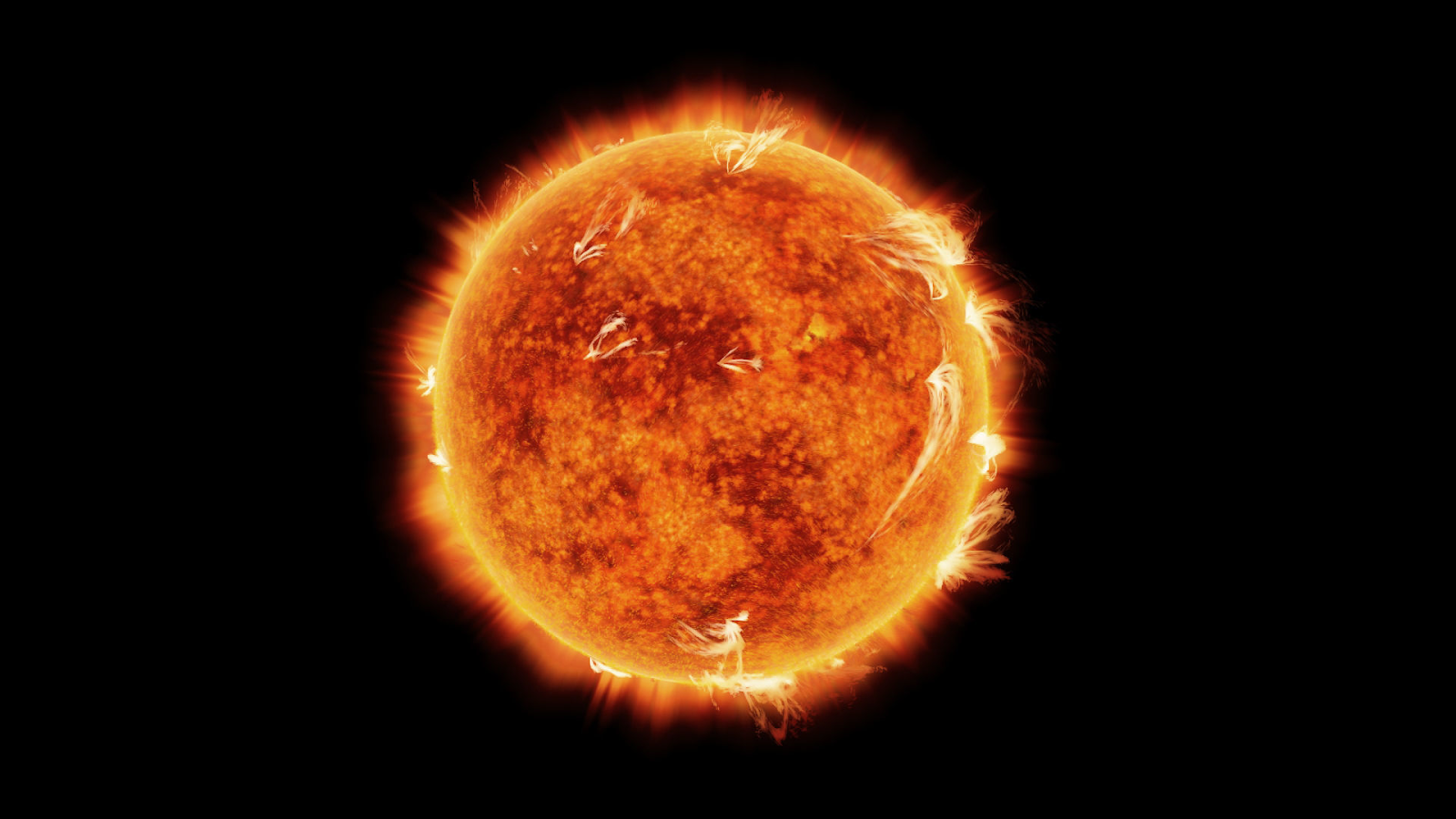
To explain this, we had given the analogy of the space just outside of the Sun that appears dark, but which is full of light. We cannot see this light, unless there is something to reflect it. 

Image source: Pinterest

In this post, we will delve into the notion of consciousness further. If all we do is reflect universal consciousness, then what makes us appear conscious, and say a stone, appear unconscious? What kind of beings reflect this universal consciousness, and what beings don't? 

Indian philosophy has an answer to this too. Consider objects around us in broad daylight. All of them reflect sunlight-- much in the same way that all beings (living or non-living) reflect consciousness. However, on a few surfaces like glass, water, polished metal etc. we not only can see sunlight reflected off them, but also an image of the Sun itself-- the source of the light. 

This metaphor helps to explain sentience and non-sentience in systems of being. Sentient beings not only reflect consciousness, they also can-- to different extents-- form an image of the universe itself! 

By this model, when we consciously create something, we are actually channelizing or using the universal consciousness into some creation of ours-- somewhat like the image below. Our creation may collapse eventually, but the universal consciousness remains eternally. 

Image source: Pinterest

Sentience is not seen as a binary attribute-- as in, it is either present or absent. Sentience is a continuum with beings like humans having several orders of magnitude more sentience than say, a rock. Hence, while both rock and human can reflect consciousness, humans can also sometimes offer a glimpse into the very source of this universal consciousness. 

Beings are said to comprise of two kinds of "bodies"-- called the sthula sharira and the sookshma sharira translating roughly to "material body" and "subtle body". In my book called The Theory of Being. I had called this the two "realms" of existence of any being in this universe-- the material realm and the information realm

The material body is our physical body that exists in the physical universe. The "subtle body" is variously (and in my opinion, incorrectly) equated with terms like "soul" or "spirit" represents all the information related processing that is part of who we are. 

The subtle body in turn, is said to comprise of three components: pranamaya kosa, manomaya kosa, and vijnanamaya kosa. The pranamaya kosa represents all forms of information constructs that keep our material bodies alive. They contain our emotional dispositions, defence mechanisms, fight or flight responses, internal communication protocols for signalling danger, hunger, pain, etc. The manomaya kosa represents our "mind" that implements our "sense of self" and ego. This aspect of the subtle body encodes a representation of our self image, who we think we are, all the persona of ourselves that we project in social settings, what we desire, what we despise, etc. The vijnanamaya kosa represents our objective knowledge about the universe. It contains our models of reality around us, general knowledge constructs, episodic memory, etc. 

Sentient beings that can reflect an image of consciousness, rather than just scatter consciousness, are said to have highly evolved subtle bodies. A subtle body is (in mechanistic terms) essentially a large body of software that can keep a material body alive, build models of the external world and manage knowledge about it, and have a "sense of self". 

Of these, we already can build machines that can do the first two operations very well. We can build robots that are adaptive and self-configuring in order to keep themselves going. We also can build AI that can build semantic models based on data, which it can then use to perform a variety of intelligent tasks. 

The only missing element in building a full-fledged subtle body for our machines, seems to be a "sense of self". Hmmm.. What does it mean for machines to have a sense of self? What exactly do we mean by a "sense of self"?

A few weeks ago, I had given a talk on this very question, which may be found here: 

Hope you enjoy the presentation! 

15 February, 2022

Consciousness in India and the West

One of the fundamental differences between Indian and Western thought is about the nature of consciousness. 

In Western thought, consciousness is seen as an attribute of a physical ensemble that manifests when the ensemble is sufficiently complex and capable.  In contrast, in Indian philosophy, consciousness is seen as the basic building block of the universe, and the universe is said to be pervaded with consciousness. Here, humans and other living beings don't "have" consciousness-- they "tune into" or are able to "reflect" the universal consciousness to different extents. The ultimate "purpose of life" is indeed regarded as being able to reflect the universal consciousness to the fullest extent possible. 

Recently, I was watching a talk on Vedanta, where the speaker clarified this difference further. Suppose a person is in deep sleep, with no dreams. In such a case, a Western scientist would say that the person is "unconscious" or does not have consciousness. An Indian philosopher in contrast would say, "there is only consciousness, but no reflection of it" since the person is in deep sleep. This can be further explained using this analogy. 

Consider photographs taken of the Sun, as this picture below 

Image source: cgtrader.com

The space around the sun looks dark as if there is no light except for the surface of the Sun. However, the space around the Sun is full of light. We just don't see this light because there is nothing to reflect it. If there were to be a planet in this space, it would be brightly visible since it is reflecting some of the light that is pervading this space. 

In the same way, unless there is a functioning mind that can reflect consciousness, we don't see consciousness, even though we are pervaded by it. 

But then, one would ask, two conscious beings aren't identical. If they are both reflecting the universal consciousness, when then are we so different, with different characteristics? This is because of the way we are built, and not because of the consciousness itself. 

Consider two airplanes flying high up in the stratosphere. They are surrounded by air. Some of the air goes into the engine and propels the aircrafts, and some of it goes inside the aircraft through the air-conditioning vents. The air in the aircraft and its engines give "life" to the aircraft-- by making it move, and letting the people in them, breathe. But then, the air is not an attribute of aircraft. The aircraft is immersed in air, and some of it is helping the aircraft function. And if the two aircrafts are not of the same make, the characteristic behaviour of the air within the two aircrafts would also be different. Their entrails would be different not because they have different air, but because they are built differently. 

These philosophical differences become important when we consider present day debates around artificial intelligence (AI) and whether AI can "become" conscious. Recently, there was a raging debate in the online world after one of the researchers had tweeted that deep neural networks are "somewhat" conscious. 

For the Indian philosopher, AI becoming conscious is a non-issue. Consciousness is already there and every object is reflecting the universal consciousness in its own way-- including inanimate objects like tables and chairs. AI in that sense, is already conscious. 

For the Indian philosopher, the bigger question is whether AI can evolve into a state where it develops a sense of "self" and become "self conscious". 

Humans are not just reflectors of universal consciousness, they are also conscious of their own ability to perform this task. This helps them continuously query and curate their own sense of self, to evolve what we call "general" intelligence. 

When AI can start doing that, we can start worrying about AI taking over the world. But then, if AI can become so deeply conscious of its self and its ability to reflect universal consciousness, then they would be least interested in "taking over" the world, and would rather work towards better reflecting the universal consciousness that pervades us.

Models of Intelligence

Today, whenever we speak of AI, we mean a specific model of AI based on large language models and diffusion, both of which, undergo foundati...