Showing posts sorted by relevance for query outputs and outcomes. Sort by date Show all posts

29 August, 2021

Outcomes versus Outputs

 One of the common grouse among serious educators today, is the rampant "factory" model of education, that aims not to empower the student to think and act independently, but to create a homogenised pool of skilled labour, ready for consumption by industry. 
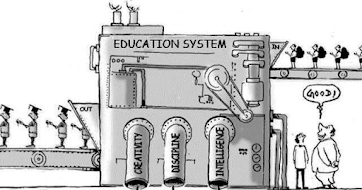

Despite several leading educators being critical of such an approach to education, the factory model is still very strong, and is the de facto model of formal education. One of the most vocal voices against such a paradigm is the Harvard professor Todd Rose. (Actually a lot of educators are against such a model-- but Professor Rose is from an Ivy League university, so our hope is to latch on to his name to get someone to listen to what we're saying 😅). He runs a research program on the science of "individuality" where each individual is modelled as a complex dynamic system, rather than an "averagian" model that is characteristic of the factory. This TED talk here, explains the motivations behind the science of individuality: 


While these developments are underway, there is yet another movement in education that aims to model educational processes based on "outcomes." This is called Outcomes Based Education (OBE), and any resemblance to a certain empire is purely coincidental. 

OBE has been adopted by several countries, India included, which has resulted in a vastly increased bureaucracy around how courses should be specified, taught, assessed, etc.  The entire system of learning now revolves around assessments, and there is even a slogan saying, "Assessments drive learning." And to think, all along, I've tried hard to never let assessments come in the way of my learning. 

The entire activity around OBE is centred around what visible outcomes the students can produce. And outcomes are equated to exam performance. When specifying expected outcomes for a course in the course description, teachers were (until recently) forbidden to say anything about students needing to "understand" anything in the course. Because understanding isn't "visible"-- only what is visible, matters, and nothing else. Kind of, reminds me of John Searle's Chinese Room Argument about what constitutes intelligence. A clerk who doesn't speak Chinese, sitting in a Chinese office, and strictly following a set of rules about how to answer questions, appears to the outside world to be understanding Chinese. But all that the clerk is doing is to follow well-defined rules to produce some visible "outcomes." 

OBE seems to be the factory model on steroids. Individual agency, empowerment, awareness, etc. doesn't matter. Only what the individual can produce, matters. 

This is all the more strange, because, OBE itself says
There is no single specified style of teaching or assessment in OBE; instead, classes, opportunities, and assessments should all help students achieve the specified outcomes. The role of the faculty adapts into instructor, trainer, facilitator, and/or mentor based on the outcomes targeted.

Something seems to be amiss in the way OBE is implemented.

 In my opinion, OBE, at least the way it is being implemented in India, seems to be confusing between "outcomes" and "outputs." The idea of outcomes is not unique to education. It has been used in management theory for much longer. And there are several articles written, explaining outcomes versus outputs

Outcomes pertain to how the collective system state changes as a result of some activity. The change in the systemic state may or may not be "visible" directly-- but can be inferred by observing certain outputs or evidence. And while individuals in a system produce outputs, the outcome is about the system as a whole, and the change in its state.

Let us take an example. Assume that a new car factory has been set up in a state, which adopts the latest state-of-the-art manufacturing systems. As a result, it produces a lot of cars. This is the output of the activity. The outcome of this output is that-- in the larger system, car prices may go down, more people may start using cars, there will be more demand for fuel, more garages may come up, and ecosystem like motels, drive-ins, etc. may start emerging. And so on. 

The outcome is about the system-- and about what systemic changes (operational, structural, latent, etc. changes) are brought about by the individual outputs that are visible. 

Outcomes are much more comprehensive, much more deeper, and manifest over the longer term-- in comparison to the immediate outputs. In order to see outcomes, we need to have an idea of what was the state of the system before our intervention, and how did it change subsequent to our intervention. 

To understand what outcomes mean in an educational setting, consider this analogy between "irrigation" and "harvesting."

Consider a barren area, where we are nurturing a wide variety of plants. We irrigate them, provide them with soil, air, manure, etc. and each plant goes on to become a tree and produce its own outputs. If each plant were different we end up in a diversity of outputs for the same kind of nurture provided. 

The outcome of such an activity is that, we end up in a vibrant ecosystem, where outputs from one tree becomes inputs for the other, or may in some sense augment one another, resulting in a rich, self-sustaining ecosystem. 

Education is supposed to be somewhat like that. The outcome of education is supposed to be the creation of an interdependent, harmonious, empowered and aware population, that can take on problems faced by the society, and provide credible solutions. 

But that is not what is happening today. Graduates from our educational institutions are even more insecure after their education than before. When placements start, everything else takes a back seat. Hardly anyone seems to be looking around and asking how can we solve this problem-- or that problem. No one wants to solve problems-- they only want salaries-- not even jobs. In fact, I'd even seen this cheeky slogan in the email signature of a student once: "All along I thought I wanted a job, but what I really wanted was a salary." 

The reason for this state of affairs is that, education today, is modelled more as a "harvesting" activity, rather than an "irrigation" activity. 

In harvesting, we are interested only in specific outputs, and the quality of the outputs. We evaluate each plant based on the output it provides, and inject them with boosters to increase their output. We discard "bad" plants which don't provide the output we desire, or the quality of the output we desire. 

The outcome of such an activity is that the ecosystem is greatly denuded because of the narrow focus of our intervention. There is no diversity of outputs to supplement, complement and augment one another. Because natural interdependencies are broken, the system depends more and more on our intervention. The soil loses its potency over time, insects and other parasites start thriving, and we will need more and more potent toxins just to keep our outputs coming. 

Currently, the way OBE specifies and controls pedagogic activity, it resembles more of a harvesting process, rather than an irrigation process. 

Educational outcomes can only be seen over the long term. The investment we make over several years, in promoting original thought and problem-solving skills, will only produce outcomes after a decade or so. These outcomes need not be in the form of Nobel prizes or Olympic medals (but may also be), but in the form of greater ownership from the population towards our society and country, greater involvement in its activities, better work practices, greater acceptance of other subcultures, etc. Nobel prizes and Olympic medals resulting as one of the outcomes of our society developing a scientific temper and a sporting culture is one thing. But targeting them as intended outputs loses the entire picture. If we make Nobel prizes and Olympic medals as our intended outputs (and call them outcomes), we will be creating a harvesting system that can make whatever supporting ecosystem we have, collapse under its own weight. 

Of course, institutions are jittery about their survival, and want measurable outputs to pitch for funds and support and ensure their survival. This is a very valid concern. But we risk a much greater collapse, if we remain focused on specific outputs and remain impervious to the larger outcomes. We need better models to understand how to recognise outcomes and design for outcomes, rather than for outputs.

08 December, 2024

Designing for educational outcomes

A large part of the formal education landscape across the world, and also in India, is based on what is called Outcomes Based Education, or OBE for short. But the way it gets implemented on the ground is sometimes mind-numbingly tedious and only promotes a toxic compliance-driven culture, rather than nurturing a culture of inquiry. 

One of the first mistakes we do is to equate "outcomes" with "exam performance" and argue for all of education be designed around examinations. We sometimes hear weird axioms like "assessments drive learning". It is one thing for assessments to assess learning-- but once they start driving our learning, we have lost the very reason why we are educating the population in the first place. This culture has also completely taken out the emphasis on learning, in classrooms. Most of our courses today start as a contractual agreement where we first present the assessment model, exam pattern, etc. and students make a decision based on how well prepared are they to "crack" the exam. 

I remember in one of my classes on distributed computing, many years ago, there was this student who had scored very high marks, who was sitting in the first row. He seemed to be visibly distressed by my teaching. When asked what is the problem, he blurted out, "But what kind of questions can you possibly ask from what we are learning now?" I had to let him know that I was not even thinking of the exam at this time. 

I've also conducted this related experiment. To incoming graduate or undergraduate level students, I ask them about the marks they obtained in Std 10th Board exams. Most of the students remember their marks (and also where they stood with respect to their friends). But when I take a random topic from their 10th standard, like say, explain the axioms of Eucledian geometry, or explain Apollonius theorem, they would have forgotten them. This is a sad state of affairs because the learning is supposed to stay with them-- not the marks. 

We have systematically conditioned our students to perform, but not learn

At the core of this mess that we are in, stems from our inability to understand the notion of outcomes. We often equate "outcomes" with "outputs". Outcomes is not the same as outputs. A quick Google search will reveal several articles and videos contrasting outcomes with outputs. 

How do we understand outcomes? Here is a quick definition: 

  • Outputs are what we produce 
  • Outcomes are what we become 
Consider an example. A car factory adopts the latest robotic technology to manufacture cars. As a result it is now able to build up to 500 cars of different models in a month. This is its output. As a result of its increased and high-quality output, it may become the market leader and it may also become an attractive organization for both customers and employees. These are the outcomes

Increased outputs do not necessarily mean better outcomes. Even high-quality outputs also need not imply good outcomes. An organization may be producing a lot of high quality output-- but in order to produce high-quality output, it may have turned into a toxic and exploitative place to work in. Or it may have taken several debts and made bad financial decisions in order to improve the quality of its outputs. Hence, even if the organization creates high quality outputs, the outcome may still be that it ends up bankrupt. Producing something, and becoming something, are two different things altogether. 

Designing for outcomes is not the same as designing for outputs. While outputs do play a role in manifesting the desired outcomes, they are not equivalent to one another. We cannot replace outcomes with outputs. Outputs are visible, while outcomes are typically latent. We have to infer the outcomes from the outputs (and other visible cues). 

In an education setting, it is not what the students produce which should be our focus, but how they are themselves changing and transforming as a result of their educational journey. 

Similarly, outcomes are not the same as capabilities. When educators sometimes understand that outputs are not the same as outcomes, we often see them focusing on students' capabilities instead-- and equating that with outcomes. This is done using frameworks like the Bloom's Taxonomy that categorizes learning based on the kinds of capabilities that the student can demonstrate. 

What a student is capable of doing, is not the same as what they have become, or how they have transformed as a result of their education. A student may have acquired several skills and capabilities during their educational journey, but in this process they might have also become disillusioned, cynical, resentful, and manipulative. We can only imagine how they would put their capabilities to use, based on what they have become. 

So what exactly can we use to design for outcomes? What is the transformation that we seek to manifest in our students as they go through their educational journey? 

To address this, we have to first ask what is the role that education plays in a society. The most general answer that we can give for this is that the role of education in a society is to create an empowered population

What is meant by an empowered population? Is it about a population that can meet industry needs and earn their livelihood? Is it about a population that can take ownership and solve problems? Is it about a population that can live independently? Is it about a population that thinks creatively? Is it about a population that can organize, cooperate and build civilized societies? Is it a population that creates jobs? Is it a population that is empathetic and just?

Empowerment includes all of those capabilities, and more. But without a framework to think about empowerment, the above would just be "hand wavy" rhetoric without giving any insight as to how to we design for empowerment. 

In order to address this, we have developed a framework that we call the "empowerment lattice" which is shown below: 

Empowerment Lattice

This framework presents different stages of "becoming" or "transformation" that we can expect from a learner as they go through an educational journey. 

When a learner starts their educational journey, we can think of their state of being as "novice" or beginners. When we provide novices with some skills, they become "capable" of doing something. The entirety of Bloom's taxonomy, including a student's ability to analyze, synthesize and create, are all about capabilities, which is but just the first step in the long journey to empowerment. For someone who is capable of something, we can now provide them with insights and practice. A capable person obtaining insights will become "knowledgeable", while practicing one's capabilities makes the person become "talented". A person who is knowledgeable and talented, can now combine their knowledge and talent in different settings, leading them to become "experts". 

Expertise is what I would call the "base camp" for empowerment. We cannot build an empowered population without first building expertise. Expertise is also the point of independence. All other outcomes below expertise would primarily serve to augment existing workforce in different forms. Some occupations primarily look for capabilities-- be it for laying bricks or writing a program, while some other occupations require knowledge and talent. All outcomes below expertise serve to cater to the existing needs of different occupations. But someone who is an expert in something, is in a position to choose their occupation and even operate independently. 

But expertise is not the same as empowerment. Acting alone, an expert cannot effect much change. When experts are provided with an inter-disciplinary environment that enables them to operate autonomously and connect with other experts from other fields, eventually we can expect this population to become empowered to effect some changes. Empowerment is about inter-dependency rather than about independence. An empowered population comprises of several experts coming from different areas of expertise, with a sound understanding of not just their expertise, but also their limitations. Such a population collectively ends up addressing a larger issue and bringing about desired changes. An empowered population cannot be formed by experts forming their own fiefdoms, operating in isolation, and trying to grab territory from one another. 

Any major challenge that we face as a population-- be it poverty or illness or climate change or whatever, requires an empowered population of inter-dependent experts enriching one another and collectively tackling the challenge. This is what educators need to aim for, 

Education is called a noble profession for good reason. As educators, we not only get to see but also get to affect how students are transformed in their educational journey. It is tempting to use the capabilities and talents of students to serve our own professional goals or our standing in the peer community. But at all times, we need to be mindful of not just what the students are producing-- but also how are they transforming-- what are they becoming

The journey of transformation is not simple. It is full of unexpected twists and turns and is a deeply personal journey. To foster transformative journeys for students, it is important for educators to foster a collaborative environment among themselves within and across institutions and countries. Competition is for businesses and athletes-- not for educators. Educators across the world should meet-- not to compare their personal scorecards-- but to enrich one another to help build an empowered humanity. 

31 July, 2022

Understanding Educational Outcomes

In an earlier post, I had talked about the increasing emphasis on "outcomes" in several administrative processes-- especially in education. The focus on outcomes is inherently a sensible move-- as compared to some previously existing models that (for example), measured the effectiveness of education by numbers of graduates, or literacy by whether someone can sign their names. 

However, the strategy and implementation of this focus on outcomes leaves a lot of gaping holes and major concerns. Because a flawed notion of outcomes is tightly tied to appraisals and survivability in academia and industry, it has largely become yet another exercise in compliance. Like any compliance game, it is common to see the emergence of an ecosystem of "outcomes engineering", which promise  "guaranteed outcomes" if their product or methodology is used, or one becomes part of a cartel. The idea of guaranteed outcomes is rather strange. If someone guarantees the outcome of a cricket match for example, it would be a strong indication of some kind of match-fixing. 

If we ask anyone from India to quote a saying from the Bhagawad Gita, and they will most likely quote verse 2.47 that effectively says that: "we can control our actions-- but not its outcomes."

कर्मण्येवाधिकारस्ते मा फलेषु कदाचन |
मा कर्मफलहेतुर्भूर्मा ते सङ्गोऽस्त्वकर्मणि 

And then, the verse goes on to say that, let this not be a deterrent against doing what we need to do. 

This is one of the fundamental axioms of outcomes-- that the outcomes of our actions are not in our hands. The outcomes and impact of our actions is mostly a factor of external forces, rather than our own actions.  Consistent with this axiom, recently, Sundar Pichai of Google had remarked, "Reward effort, not outcomes." 

In the previous post, I had also described a common fallacy-- that of confusing outcomes with outputs. What is observable and visible, are outputs-- not outcomes. Outcomes refer to the change of state of the entity of interest-- which would be latent. Outputs are used to reason or speculate about possible outcomes that would have caused this output. They are not the outcomes themselves. 

For instance, a consider a car manufacturing company. Its outputs are described in terms of the number of cars it can produce, the quality of their cars, the mileage given by their cars, etc. Let. us say that a company has produced superlative outputs. These outputs could be a result of several possible outcomes that changed the way in which the company operates. Maybe the increased output was a result of better communication and coordination in the company, due to recent policy changes. Maybe the increased output was a result of the company embracing more automation. Maybe the increased output is a result of greater ownership by the company's employees, who took it upon themselves to make the company shine. Or maybe the increased output was a result of greater insecurity among employees in the company-- where most of them have been made to work with a sword dangling above their heads.  

While the outputs are observable and quantifiable, the outcomes (like "ownership") are often latent and hard to quantify. 

In order to design for outcomes, we need to first answer the question, what is our entity of interest? Who are we working for, and whose changes in state is it that we would like to influence? 

When it comes to curriculum design, our entity of interest is the student. We define course and program outcomes in terms of what the students should be able to quantifiably demonstrate. This in turn, places the entire emphasis of the pedagogy on the examination, rather than on the learning and empowerment of the student. The fallacy here is because we confuse outputs with outcomes. 

In order to understand student outcomes better, consider the figure below: 


This figure shows what is called as a "Learning map" for one of my courses. Each asterisk in the figure represents a student, and each blue triangle represents a learning resource. Each dotted line represents a "topic" or "competency" covered in this course. The map is semantically organised using AI algorithms to depict topical proximity between objects. Pursuing a dotted line (topic) in isolation tells us where we will end up in this semantic space had we pursued only this topic. 

The solid, magenta line shows the topical journey of the lectures I have covered in the course. In this course, in addition to passing conventional exams, students were required to make a few contributions of their own. This could be in the form of essays or term papers or seminar talks. The student contributions are also embedded in this space, which are shown by yellow triangles. 

The "proficiency" of each student is now computed by taking the centroid of all of their contributions (and the grade they received for each contribution). Based on this proficiency, students are also embedded in the learning map to show where they stand in the class. 

As is evident here, there is a huge amount of diversity in student locations based on their proficiency after the class. Very few students are actually close to the magenta solid line, which was the learning pathway adopted as part of the lectures. 

Even though each student was subject to the same set of lectures, each student has their own individual footprint in the way they have assimilated the knowledge presented in the class! This is the competency state of the student, and the way this state changes is what is the outcome of the course. 

But what the students are assessed upon is how they fare on the magenta line. We assess students based on what we covered in class. If we project each student's location onto the magenta line, we see a gross distortion. For instance, there is a student in the top-left of the map, who has shown enormous interest and proficiency in the first topic, but not so much in the others. This student would have likely fared badly in terms of the assessments based on the lectures covered in the class. However, one can well argue that this enormous inclination shown by this student to one of the topics covered in the course, has its own benefits for the student (and for the industry that the student works in, and for the society at large), all of which is lost, when we grade them only on the output they produce in our assessments. 

Yet another important characteristic about outcomes is that, regardless of what is our entity of interest, we need to realise that it is a multi-dimensional system of being, rather than a single-dimensional object. Our entity of interest can change its state (also called "move the needle") only in a holistic fashion, involving all dimensions. A student who produces superlative outputs in exams, may actually be suffering from an internal implosion of spirit. An star employee may actually be suffering from a dysfunctional family. As the tennis star Martina Navratilova once remarked: "The moment of victory is too short-lived to live only for that, and nothing else.

We need to remember that, even with technologies like the Learning Map above, we can only observe a part of their state. We don't know what exactly made one of the students to prefer just one topic so strongly. Was that topic in some way personally appealing to them, or was it because they thought that this topic has a lot of "scope" in the industry, or maybe it was some other reason altogether? 

Hence, we need to be very careful when we make statements about outcomes. Firstly, we need to stop equating outcomes with outputs. Next, we need to become aware that the change in state that we see in our entity of interest need not be the complete state description of the entity. And third, we need to remember the Bhagawad Gita-- that we really cannot control outcomes. At the end of the day, we need to just do our best work, and hope for the best. 

26 February, 2026

AI and the uncanny valley

 (This content is not generated by AI-- even if it is boring! 😄) 

I don't know about you, but for me, reading AI generated content, or looking at AI generated art triggers an intense kind of boredom-- the term ennui comes close. It is not the usual boredom, but a mind numbing feeling that is both painful and numbing at the same time-- or, should I say "soul crushing"?. The closest analogy I can give is the feeling of eating cardboard pieces, instead of actual food. 


There is this concept called "uncanny valley" in robotics that tells about the creepy and uncomfortable feeling that we get when robots become increasingly human-like. I think somewhat similar is happening with general AI generated content as well. 

Here is my explanation to what is happening. When we read a book or appreciate a work of art, we are not admiring the output, but we are connecting with the creator of the output. When a book deeply resonates with us, we feel a deep connection-- not with the words, but with the person behind the words. Similarly with a work of art. It is the creator's state of mind and their journey that led them there, which touch us through their writings and art. 

With AI generated content, there is no person behind and there are no travails that we can associate with. 

This is analogous to the difference between outputs and outcomes that I have written in this blog several times. Outputs are what we produce, while outcomes are what we become, as a result. Be it education or economy or raising a family; what we want are outcomes, but what we focus on, are outputs. Much of our grief comes by not bridging the gap between the two.

When we appreciate a work of art or a piece of writing, we are not just appreciating the output or the creation-- but the outcome, or what the creator must have become in order to create this. 

As it happens these days, for most of my deep questions, the best clarity (I would not say "answer") has come from Vedanta. And here too, there is an explanation from Vedanta about why we experience uncanny valley. 

Vedanta and most other Indian philosophies as we know, has one key point of departure from the modern scientific worldview. They posit that consciousness that gives us our first-person experience, cannot be reduced to material causes. Consciousness is not caused by material interactions, but exists on its own. The consciousness that we experience in our waking state (our ego or the sense of self) is essentially "reflected consciousness" (chidaabhasa). 

Mainstream science insists that everything ought to have a material cause, and the question of consciousness is still debated as the "hard problem of consciousness". 

Vedanta goes further to say that the only entity that is real is this entity that is variously called Brahman, Samvid, and many other names, which represents existence-consciousness-bliss. It is this entity because of which we can perceive the existence of something, become aware of something, and express emotions. 

Brahman is not an entity that exists-- it is existence itself. It is not an entity that we can become aware of-- it is awareness itself. (The explanation in the Upanishads go: Brahman is not something that the eyes can see, it is that by which the eyes can see; Brahman is not something that the mind can imagine, it is that by which the mind can imagine, etc.) 

And Brahman is the only entity there is. It is existence itself, and something that is not Brahman is non-existence, which does not exist (duh!).

Based on this hermeneutic, there is this theory of perception by the philosopher Vidyaranya, who lived in present-day Karnataka between 1260 to 1333 CE. He was also instrumental in the establishment of the Vijayanagara Empire and served as a spiritual advisor to its rulers. His guidance helped shape the cultural and religious landscape of south India.

Among his writings is this book called DrgDrishya Viveka (or the wisdom of the "seer" and the "seen"-- subject and object). In this, there is a model of perception in Verse 20, that says: 

अस्ति भाति प्रियं रूपं नाम चेत्यंशपञ्चकम् । आद्यत्रयं ब्रह्मरूपं जगद्रूपं ततो द्वयम् ॥ २० ॥

Transliteration: asti bhāti priyaṃ rūpaṃ nāma cetyaṃśapañcakam | ādyatrayaṃ brahmarūpaṃ jagadrūpaṃ tato dvayam || 20 ||

It says that when we perceive something (interact with the external world)-- five things happen simultaneously, that are called asti, bhāti, priyaṃ, rūpaṃ, and nāma. Asti is our realization of the existence beyond the perception, bhāti is the way the underlying reality affects our awareness, priyaṃ is the emotion that it elicits in us (every perception is said to elicit an emotion in us, however small), rūpaṃ is the class or category of the object that we perceive and nāma is the label we attach to the experience. 

The second part of the verse says that the first three elements and the last two elements are at different levels of cognition. The first three are our experience of the reality that lies behind our transactional reality of space, time, and causation, while the last two (categorization and labelling) are the constructs of our mind. It is the first three that gives us the connection, and results in outcome; while it is the last two that we use to transact intellectually and produce outputs. Unless the first three elements are there in any interaction, there is no connection that we feel. It does not move us. And we end up only trying to organize things intellectually. 

With AI generated content, our experience of asti, bhāti and priyaṃ are greatly attenuated, if not completely absent. There is no reality that we experience behind the perception, since the content is just a creation of an artificial mind that is based on predicting the next word or denoising of a signal. We only experience rūpaṃ, and nāma leaving us with a sense of emptiness and ennui, even feeling creepy-- thinking, what just happened-- was that profound writing or not, does this art move me.. or not?

06 December, 2025

The product and byproduct of universities

Several years ago, I heard this interesting argument in a speech by a famous academic. It said that, the primary product of a university is the ideas and knowledge it generates-- while its graduates are just the byproducts created in this process

It was very intriguing to hear this, and I found it quite a profound observation. Indeed, as the speaker argued, universities are not meant to create trained personnel for the industry-- that needs to be primarily addressed by industrial training itself. "Industry" does not mean one thing-- and indeed within the same industry there are vastly varying needs that are constantly changing. An independent body like universities cannot put its entire focus on the narrow goals of meeting variegated and changing industry needs for the next placement cycle. 

Universities and higher-education are also not meant for imparting "conceptual foundations" in students-- students are expected to enter universities with fairly strong foundations. 

The primary role of the university in a society-- as the argument went-- is to act as a catalyst of progress-- by infusing fresh new ideas and perspectives that give us new understanding of our world and our challenges, and equip the society better. Societies have an incentive to build universities, when universities become the source of thought leadership through original, rigorous research by exploring ideas that are relevant, pertinent and timely to the society. 

As a byproduct of this activity, universities also create graduates, and the graduates get "prestige" and social status because of the brand value that the university has earned by its thought leadership and impact on the society. Their pedigree of having been associated with teh university opens doors and creates opportunities for them. But all this is possible only if the university was a thought-leader in the first place. 

*~*~*~*~*~*~

This argument is compelling, and I do believe it has a lot of merit. 

But over the years, my perspective has slowly started to change, as I found the opposite argument just as compelling. 

One of the pathologies of placing our primary focus on ideas, and treating people as byproducts is that such a setup can easily slide into toxic work environments. It is generally difficult to understand the worth of a new idea when it is generated (to quote Michael Faraday when he was asked what is the "use" of his discovery of electromagnetism: "What is the use of a new born baby?"). Because of this, some arbitrary, dominant ranking or metric becomes center-stage and gets brutally pushed down on researchers and students. Having no other frame of reference, graduates who are the byproducts of this system, emerge bruised and abused, and end up believing that toxicity is what "rigour" means! And then they move on to other institutions and implement the same toxicity there. 

This is the context in which I came across the opposite argument, which says that the primary objective of a university is to bring about a transformation in its students-- from novices to experts to eventually transform the population to a collective state of responsible empowerment. In order to do this, the university needs to generate new ideas and thought-leadership, as byproducts

I have argued this point of view in some of my previous posts on outcomes versus outputs: here and here

In this mode of thinking, it is the people who are the primary focus. It is the people who create ideas and take the ideas-- and more importantly, the hermeneutics or the way of thinking, that they developed in the universities back into the society and bring about changes. It is imperative on the university to watch how their students are transforming through their journey, and facilitate desirable transformations by removing roadblocks in their journey. 

In such environments, reflection and introspection are very important. Not only are we creating solutions, applying knowledge and driving change, we are also deeply aware of how we are ourselves transforming in this process. The transformation that we go through is the outcome, while the things that we produce in this process are the outputs

I often tell my students that there is a difference between "doing the job of a teacher, and being a teacher" and similarly, between "doing the job of a student, and being a student". 

The latter is the personal change that we encounter, which remains with us throughout our lives. 

It is not that people don't get transformed in an output oriented environment-- they do get transformed into cynical, insecure, and toxic professionals, confusing this for rigour and discipline. Scale this at a country level, and we can see that despite having several engineering colleges, we do not create any new idea or new ways of thinking of solving our own problems, and instead, all that the graduates of our premier universities dream of, is to go abroad and settle down there. This is the transformaton we are creating. 

Once, apparently someone visiting from abroad asked the Director of one of our premier tech institutes, "You guys have created such a miracle that we are struggling to understand! You take the best and brightest young minds of the country and make them good for nothing in just four years! How do you do it?" 😜

I don't know how true that story is-- but you get the idea! 😁

So yeah, the products are still the people-- who are transformed from complainers to solution-givers, from insecure and fearful creatures to confident yet humble professionals. In this process, they go through the latest tech, the latest framework, the latest whatever, and produce the best papers and ideas according to whatever metric-- those are all important, to the extent of being byproducts.

30 April, 2026

PhD needs a reset

World over, the PhD program is in a crisis, and there are ample amount of articles written about why we need to rethink our PhD programs. For example: 

This is yet another post about this topic-- but one that is hopefully, in a very different direction. There are major issues that are debated about PhD education today-- including funding and the industry relevance of the research carried out. 

But very few observers, if any, are addressing the fundamental reason why a PhD study exists in the first place. 

A PhD is a degree in philosophy-- not in technology or science or engineering. One does not think in terms of a Computer Science PhD, Data Science PhD, Mathematics PhD, etc. It is just a PhD-- a thesis communicating the results of a philosophical inquiry. 

A philosophical inquiry into the nature of reality is by definition, interdisciplinary. There is nothing that is "out of syllabus" for a philosophical inquiry. 

And in my opinion, this disconnect with the core reason behind a PhD journey, is the biggest crisis we are facing today. At a time when there is an acute need for people with philosophy skills, not only are we discounting this important skill, but we also actively mock and lampoon philosophers with stereotypes of being impractical figureheads living in their own ivory towers. 

*~*~*~*~*~

Philosophy is a term that is greatly misunderstood today. I remember some years ago, when a former colleague came to meet me and I was mentioning that I was mentoring a "philosophy club" among our students. After this, we went to the cafeteria and we both ranted about the troubles we are facing in our respective lives, talked about politics, history and anything that caught our fancy. And then, just before we said goodbye, the former colleague said, "There, I guess this was one more session of your philosophy club?" 

I just smiled and nodded, not having the heart to tell him that what we just had was a ranting session-- not a session in serious philosophical inquiry. 

Similarly, several ideological schools-- that make up the different -isms are called philosophies, and the respective ideologues of each school are called philosophers. Philosophy is not a specific ideology. Someone who embodies a ideological structure and lives it and advocates it, is an ideologue-- not a philosopher. 

There is an episode in Big Bang Theory where two physicists who are PhD holders are having a philosophical debate about Quantum loop gravity, and String theory. And their disagreement ends up breaking the personal relationship they have been having. That is not a philosophical disagreement-- that is an ideological disagreement. The PhD holders there were not philosophers-- they were ideologues, pushing their respective ideologies. 

A number of such so-called philosophical debates are just ideological debates. From the viewpoint of philosophy, they are all ill-posed philosophical problems. 

Take for instance, the debate between skepticism and faith. A scientific mindset is supposed to be characterised by skepticism, and a religious mind is supposedly characterised by faith. But it is not hard to see that one who staunchly advocates skepticism is actually practising "faith in skepticism" and one who staunchly advocates faith, is actually practising skepticism about anything else other than their object of faith! 

Or for example, the debate between "evolution" and "intelligent design". The philosopher only asks the evolutionary theorist "Was the process of evolution designed-- or did it evolve from a meta-evolutionary system?" (Arguing that it was the product of a random chance does not cut it because we can still ask the question whether the mathematical properties of that randomly chosen mutation that lead to evolution of life-- was that a product of design?) Similarly, the philosopher asks the "intelligent design" ideologue "Who designed the designer?" 

*~*~*~*~*~

In the name of Science, today we only have different hermeneutic ideologies, each in a territorial battle with others for occupying mind space and bringing new converts into its fold. 

Each hermeneutic ideology is blindly pursuing its interests pushing away anything that comes in its path. Be it AI or Mars colonisation, or genetic engineering, or whatever else, each hermeneutic universe wants to be at the centre of what is termed as Science. 

In my professional life, I often get very hostile vibes from others when I criticise the way the term "agents" are used in current day Agentic AI. Almost as if, I have committed a religious blasphemy of some sort. The idea of agency has been studied for thousands of years, and in computing itself, it has been studied for at least 40 years now. And what is called an agent in an Agentic LLM today is just a very sophisticated service that can break down an instruction written in a very high-level language (natural language) and converts it into actionable elements. Pretty much a sophisticated compiler. An agent on the other hand, has to display some kind of subjective self-interest and free-willed intentions. 

The research ecosystem today resembles an ecosystem of different ideological schools with many "believers" affiliated to each school, and each of which, are vying for market share and mind share. 

What we don't have today, are genuinely disinterested philosophers who are characterised by vairagya and samadarshana, who are not aligned with any ideology, and who are not incentivised by any kind of prestige or recognition, and are solely driven by philosophia ($φιλοσοφία$), or the "love of wisdom."

*~*~*~*~*~

Recently, I was arguing that the goal of philosophy is not to find a solution to a problem, but to find an epistemological grounding that leads to the dissolution of the problem. 

At its core, philosophy is about questioning the "obvious" to uncover the underlying structures of reality, knowledge, and value. Rather than providing a fixed set of answers within a hermeneutic framework, philosophy questions how the existing state of affairs came about in the first place. It needs to ask how we can justify our beliefs, what constitutes a meaningful life, and how can we navigate the complexities of human existence. 

A PhD in that sense, is not about outputs (or what it produces), but about outcomes (how it transforms the people who go through this process). 

A good thesis may provide an answer to a long-standing open problem-- but a great thesis is one that opens up new ways of thinking and new possibilities, by questioning the fundamentals of what we have taken for granted. 

If there is any time in history where we desperately need strong philosophers, it is today. World over, we are in a bizarre state of affairs in just about every sphere of human activity-- be it in geopolitics, technology, climate, society, business, etc. Much of what we had taken for granted until the end of the 20th century are getting ripped apart by current developments. 

We can't even start to imagine a society where everyone is constantly under surveillance by law, where weapons are autonomous killing machines, where we depend on AI to run our lives, and where climate is getting increasingly intense. Yet, we are entering into this reality at a fast pace. 

We need philosophers who can ask deep questions and reach a mental state that lies beyond what is causing our current day problems, and get a sound understanding of where we are going. We need guidance from those who have seen the dissolution of these problems in their minds. 

And yet, the only questions we are asking our PhDs are about Nobel prizes, citations, awards, prestige, etc. 

We are literally facing an existential crisis, and we are only using simplistic carrot-and-stick approaches to drive our PhD programs! 

PhD needs a reset-- and we need to bring the Ph back into the PhD!  

Dharma and Systems Theory

A term that has made a major comeback in our vocabulary these days, is " dharma "-- which is used in various senses, including: ri...