05 March, 2022

Indian History Chronicles: The Hoysala Splendour

Of the many impactful kingdoms of south India, the Hoysalas stand out in their own niche. Like much other non-Delhi empires, the Hoysalas are relatively lesser known or completely unknown, outside of Karnataka. Nevertheless, the Hoysala influence on the present day culture and worldview of Karnataka, continues to be strong. 

Hoysala Empire
Extent of the Hoysala Empire. Image Source: Wikipedia

The Hoysalas were a relatively small empire who ruled between the 10th and 14th century CE, from their capital city Belur, which was later shifted to.a new town called Dwarasamudra, which is presently called Halebidu. The term Halebidu literally means "old/destroyed town", which was the name given to the Hoysala capital after it was destroyed by multiple invasions from Malik Kafur, sent by the Sultan of Delhi, in the 14th century. 

Police patrol vehicles in present-day Karnataka are called "Hoysalas". This comes from the legend of the extraordinary bravery of the kings who ruled this empire. There is a legend of a boy named Sala who fought and killed a rampaging tiger. This motif is carved in stone in just about every Hoysala monument, and is a signature of the Hoysala influence on that monument. 

Hoysala signature motif found in most Hoysala temples. Image source: karnataka.com

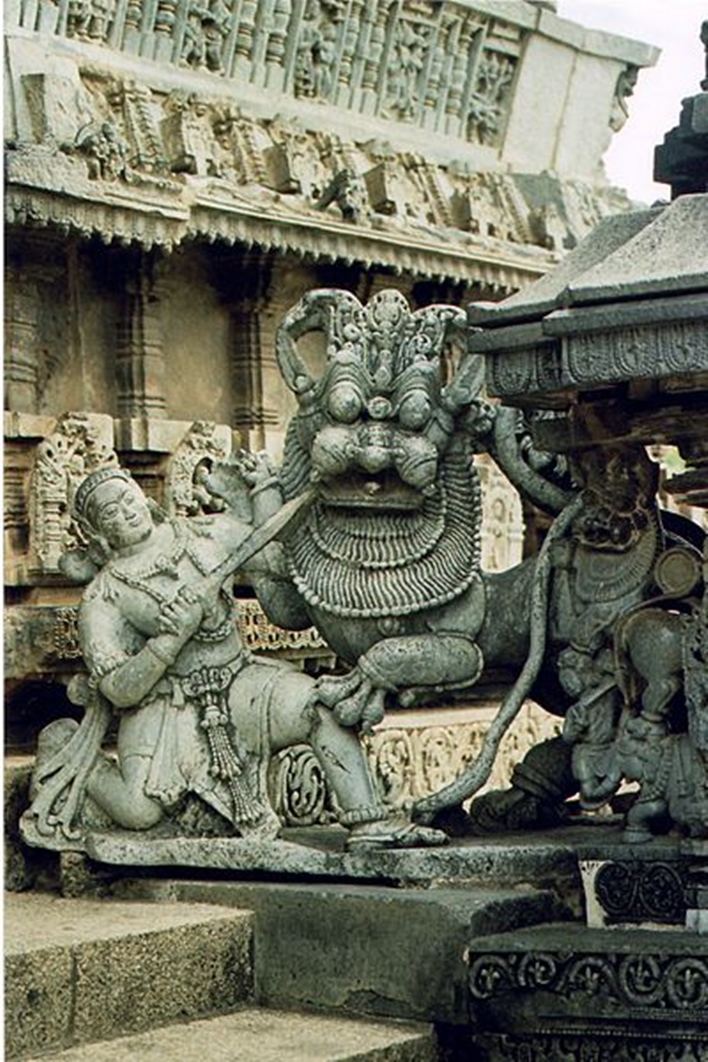
The Hoysalas were a great patron of arts, culture and architecture. Hoysala temples are famous for their very intricate carvings, depicting lots of stories and information about their times. The picture below shows just a small part of an entrance door to one of the smaller Hoysala temples in Somanathapura in Mysore district. 

A small part of an entrance door of a Hoysala temple, adorned with intricate sculpture. Photo taken by author.

A characteristic feature of Hoysala temples is the use of soapstone rather than more widely available granite, for their carvings. Soapstone is more amenable for intricate carvings, unlike the much harder granite. 

The Hoysalas were also the inventors of the lathe machine. A characteristic feature of Hoysala temples is the round shaped pillars that were shaped using a hand-turned lathe. 

Lathe turned rounded pillars at a Hoysala temple. Image source: https://heythatseemscool.wordpress.com/

The figure below shows a graphical reconstruction of the main temple at Halebidu, of which only a small part stands intact today, following invasions from the Delhi Sultanate. 

Graphical reconstruction of the Halebidu temple. Image source: Facebook group on Temples of India

Of the many kings who ruled in the Hoysala dynasty, the most well known is king Vishnuvardhana who ruled between 1108 and 1152 CE. His queen Shantaladevi was an acclaimed mathematician, musician and a dancer. She was a great patron of arts, literature and science. She is depicted in several carvings in many of the Hoysala temple. Her own personal life however, was far from peaceful. And she is said to have ended her life, by jumping off a cliff at Shiva Gange hills near Bengaluru. 

Sculpture of queen Shantaladevi. Image source: Google image search 

Under king Vishnuvardhana, the acclaimed Vaishnava philosopher Ramanucharya was invited from his hometown in Sri Perumbudur, to spend several years in Hoysala empire and popularise the Vaishnava philosophy of Vishishtadvaita

Vishnuvardhana is also well known for his defeat of the mighty Chola empire and take back some of the territories they had captured from the Western Gangas who were ruling from Talakadu. The Cholas were a formidable force, who are well known for having ruled for over 1200 years, and having expanded their empire throughout the eastern coast of India and to several regions of south-east Asia, including present day Indonesia, Malaysia and Singapore. 

The acclaimed Kannada writer TaRaSu (T R Subba Rao) has written extensively about how Vishnuvardhana managed to defeat the mighty Cholas. A major factor that led to his victory were the several technological innovations driven by an eccentric inventor called Gaurachari. These innovations include: an early form of undercarriage suspensions for horse carriages so that they could travel much more smoothly, flywheel based mechanisms to maintain stability of chariots, and an early form of the telescope (about 300 years before Galileo), with lenses made from the almost transparent Spatika stone. The image below shows a Shivalinga carved from the Spatika stone. 

A Shiva linga carved from the transparent Spatika crystal. Image Sourve: Google image search

This invention of Gaurachari is also immortalised on stone, in one of the Hoysala temples in Halebidu that depicts a soldier scanning the area using a telescope. 

Man holding telescope. Hoysala sculpture. Image source: Google image search

The Hoysala influence continues to be strong in southern Karnataka even today, with several of their key personalities-- including queen Shantala, their chief architect Jakanachari, capturing popular imagination in several forms. 

19 February, 2022

Perception theory in India and the West

In the last post, we saw how the concept of consciousness has some fundamental differences between Indian thought, and Western thought that is now the mainstream method of scientific inquiry. 

In this post, let us look at how the concept of perception, or our interaction with the world outside, is modelled in Indian thought and in Western science. 

In Cognitive Science today, perception is defined as the process by which we segment raw signals received by our sense organs into semantic objects and relationships between them. Sometimes, perception is distinguished from cognition in the following way: perception is a recognition process where we identify objects and relationships, while cognition is a process of sense making where we try to interpret what we have perceived. 

For example, suppose we see something like the following picture: 

Image Source: Google image search

Our perception mechanism recognises a dog in the picture, standing up behind a fence, and looking somewhat sad. Our cognition mechanism provides one or more explanations or interpretations for what we have seen-- maybe the dog waiting for its owner, maybe it is calling for help, maybe it is abused, or maybe it is just missing its friend on the other side of the fence, and so on. 

Cognition is greatly influenced by our mental model, which in turn is influenced by our emotional state. If we are in an angry or sad emotional state, we are much more likely to value negative interpretations, and if we are in a happy mental state, we are much more likely to value positive interpretations. (The reality of course, may be independent of our emotional state). 

Perception is also aided by our attention mechanism-- which decides which signal to keep among the several raw signals that are coming in. Attention attenuates most of the raw signals, and focuses the perception to segment only that part of the signal on which, we are paying attention to. 

*~*~*~*~*

Let us now turn to how perception is understood in Indian philosophy. 

In Indian philosophy, the essence of our being is pure awareness-- called by different names in different contexts. The awareness that is us, uses our mind-body complex to interact with the world around us (called Prakriti).

Our mind is said to cast a field of perception around us. This field of perception experiences a disturbance or "whorl" (called Vritti) either through external or internal stimuli. For instance, if an object comes into our field of vision, it forms a Vritti in our minds. 

Vrittis can also be caused by internal stimuli-- from our memories. Be it external or internal, the mind experiences a whorl which is the beginning of the perception process. Note that, there is no specific mention of sense organs or the different kinds of signals (vision, speech, touch, etc.) Vrittis are considered to be "multi-modal" in nature. A stimuli on our mind's field creates whorls that have all sense components-- vision, sound, emotion, touch, etc. This holistic unit of signal (that is called a "chunk" in Cognitive Science) is the fundamental building block. Raw signals of a particular type-- like vision, sound, etc. are just components of the holistic signal, which by themselves have no meaning. 

Vrittis are also called avidya (non-knowledge). It is only when they are interpreted by our awareness, can Vrittis be converted to knowledge. 

There are multiple models of how Vrittis are interpreted. But all of them agree that the interpretation of Vrittis depends on the "modulation" of our mind. The Upanishads mention five forms of modulations for our mind: Pramana, Viparyaya, Vikalpa, Smriti, and Nidra

In a Pramana state of mind, we are in a state of inquiry-- we want to explore, examine, ask questions, etc. In Viparyaya, we are in a distracted frame of mind-- we cannot decide which of the whorls to focus upon, and keep switching contexts. In Vikalpa, our mind is in a deluded state-- it has already decided the interpretation, and tries to cherry-pick for confirming signals from the different Vrittis. In Smriti, we are in a state of nostalgia or reminiscence-- every Vritti is interpreted for what it reminds us of from our episodic memories. And in the state of Nidra, we are asleep-- and ignore all the Vrittis

Patanjali's Yoga Sutra proposes another model mentioning the following five modes of our mind: Mudha, Kshipta, Vikshipta, Ekagra, and Nirudha

Image Source: Google image search

The above slide explains the five modulations of mind, each of which, affects the way in which we interpret our Vrittis

Note that Vrittis can be formed from internal stimuli as well-- from our memories. By "memory" what we mean is some cognitive element that is stored in our minds-- not necessarily an exact replica of a past event. Memories in the human mind are not passive data banks, they are active, autonomous units, that can generate Vrittis in our minds, leading to downstream mental (and even physical) activity. 

Memory elements that are repeatedly encountered, and which become deeply embedded in our minds, are called Samskara. These refer to hermeneutic elements that drive our thinking and interpretation. We are most often, not even aware of our Samskara and how it may be affecting or even biasing the way we interpret our world. 

For the mind, there is only a theoretical knowledge that distinguishes between internally induced and externally induced Vrittis. If this knowledge signal is weak, or the Vrittis are too strong, the mind may be unable to determine whether this Vritti is being caused by something external or internal. This often happens in a state of trauma or paranoia, where a person be experiencing real pain within, from internally induced Vrittis, even though there is no external stimuli. 

The more deep-rooted such memories are, the tougher it is to recognise them and remove them from our memories. 

Similarly, dreams are made from internally induced Vrittis. In a state of dream, the mind feels that the dream is as real as the real thing. As the Upanishads say: Dreams are real as long as they last-- so is life

15 February, 2022

Consciousness in India and the West

One of the fundamental differences between Indian and Western thought is about the nature of consciousness. 

In Western thought, consciousness is seen as an attribute of a physical ensemble that manifests when the ensemble is sufficiently complex and capable.  In contrast, in Indian philosophy, consciousness is seen as the basic building block of the universe, and the universe is said to be pervaded with consciousness. Here, humans and other living beings don't "have" consciousness-- they "tune into" or are able to "reflect" the universal consciousness to different extents. The ultimate "purpose of life" is indeed regarded as being able to reflect the universal consciousness to the fullest extent possible. 

Recently, I was watching a talk on Vedanta, where the speaker clarified this difference further. Suppose a person is in deep sleep, with no dreams. In such a case, a Western scientist would say that the person is "unconscious" or does not have consciousness. An Indian philosopher in contrast would say, "there is only consciousness, but no reflection of it" since the person is in deep sleep. This can be further explained using this analogy. 

Consider photographs taken of the Sun, as this picture below 

Image source: cgtrader.com

The space around the sun looks dark as if there is no light except for the surface of the Sun. However, the space around the Sun is full of light. We just don't see this light because there is nothing to reflect it. If there were to be a planet in this space, it would be brightly visible since it is reflecting some of the light that is pervading this space. 

In the same way, unless there is a functioning mind that can reflect consciousness, we don't see consciousness, even though we are pervaded by it. 

But then, one would ask, two conscious beings aren't identical. If they are both reflecting the universal consciousness, when then are we so different, with different characteristics? This is because of the way we are built, and not because of the consciousness itself. 

Consider two airplanes flying high up in the stratosphere. They are surrounded by air. Some of the air goes into the engine and propels the aircrafts, and some of it goes inside the aircraft through the air-conditioning vents. The air in the aircraft and its engines give "life" to the aircraft-- by making it move, and letting the people in them, breathe. But then, the air is not an attribute of aircraft. The aircraft is immersed in air, and some of it is helping the aircraft function. And if the two aircrafts are not of the same make, the characteristic behaviour of the air within the two aircrafts would also be different. Their entrails would be different not because they have different air, but because they are built differently. 

These philosophical differences become important when we consider present day debates around artificial intelligence (AI) and whether AI can "become" conscious. Recently, there was a raging debate in the online world after one of the researchers had tweeted that deep neural networks are "somewhat" conscious. 

For the Indian philosopher, AI becoming conscious is a non-issue. Consciousness is already there and every object is reflecting the universal consciousness in its own way-- including inanimate objects like tables and chairs. AI in that sense, is already conscious. 

For the Indian philosopher, the bigger question is whether AI can evolve into a state where it develops a sense of "self" and become "self conscious". 

Humans are not just reflectors of universal consciousness, they are also conscious of their own ability to perform this task. This helps them continuously query and curate their own sense of self, to evolve what we call "general" intelligence. 

When AI can start doing that, we can start worrying about AI taking over the world. But then, if AI can become so deeply conscious of its self and its ability to reflect universal consciousness, then they would be least interested in "taking over" the world, and would rather work towards better reflecting the universal consciousness that pervades us.

16 November, 2021

Reviving Bharatiya Vigyan - 1: Getting the hermeneutics right

 सुखम समग्रम विज्ञाने विमलेच प्रतिष्ठितं  

Sukham samagram vijnane vimalecha pratishtitham

"All happiness is rooted in good science," says the Charaka Samhita-- the definitive treatise on Ayurveda, dating back to 8th century BCE. This belies the widely believed notion that science and "scientific temper" came to India from the West. 

Every form of scientific practice, rests upon an underlying hermeneutics-- or a way of thinking. The hermeneutics of current day scientific inquiry is greatly influenced by the industrial revolution, which in turn was fuelled by colonial expansion of European powers. I've called this form of inquiry as "machine hermeneutics" and also sometimes called the "clockwork model," where the universe is considered to be a giant, impersonal automaton, driven solely by causality, and indifferent to our existence. 

Hermeneutics affect how we interpret our observations and what models we build. As the physicist Werner Heisenberg once said, "What we observe is not nature itself, but nature exposed to our method of inquiry." 

Scientific inquiry happened all over the world, and ancient India, or Bharat, was no exception. In fact, Bharatiya science had made great, pioneering strides in many different fields. Today, thanks to more than a thousand years of relentless assault on  this civilisation, much of this science is lost or greatly appropriated. Today, when we talk of Bharatiya thought, we either refer to its popular culture like its festivals, costumes, rituals, food, etc. or to its spirituality and its different existential philosophies. These two ends of the society, were kept together by different forms of "Vigyan" or science, that addressed practical questions of everyday interest. 

Much of the hermeneutic elements of Bharatiya Vigyan, are given distorted meanings and religious colouring, thanks to flawed interpretations by scholars from occupying powers. For instance, the term dharma is variously interpreted as "religion," "ethics," "duty," "divine law," and so on. The term karma has come to mean some form of divine retribution. The term atma is called "soul" and the term vidhi is called "fate," and so on. 

All of these are incorrect interpretations, resulting due to a method of interpretation called "Syncretism" that draws parallels between terms from an alien culture, to terms from one's own culture. It is only in recent times. that there is an increasing realisation that the world's understanding of Indian thought is highly distorted. And we have seen several efforts to spread greater awareness and perform some corrective action. The book Sanskrit Non-translatables by Rajiv Malhotra is one such effort. 

"Digesting" terms from an existing hermeneutic framework into an existing framework, delivers a death blow to the knowledge and wisdom latent in the framework. But today's science, driven largely on machine hermeneutics is so powerful and dominant, that presenting anything from a different method of inquiry is deemed unscientific. 

*~*~*~*~*~*

For those of us who were brought up in the Western paradigm of science (which includes most, if not all readers of this post), there is a need to represent the hermeneutic basis of Indian science Bharatiya Vigyan ("Indian science" perhaps refers to Western paradigms of science practiced in India, today). 

Here is an attempt towards this. 

Everyday we deal with "systems" of different kinds. Broadly, in current day science, systems are broadly classified into two kinds: linear and non-linear systems. 

Linear systems, of which most machines are a type of, are relatively easy to understand and build. These are also called "open loop" systems, where the input affects the output, and not vice versa. Such systems can be designed with high precision and its behaviour predictable. Non-linear systems on the other hand, are also sometimes called "Complex Systems" where the output of the system becomes part of the input at the next time step. Non-linear systems can be very unpredictable, even though their constituent dynamics are very simple. Even a small change in inputs, can lead to vast changes in its output. This is known as sensitivity to initial conditions, and is popularly called the "butterfly effect" that says that, our weather is so complex, that a butterfly flapping its wings in one part of the world, can potentially create thunderstorms in some other part of the world. The study of non-linear systems is also called "Chaos theory."

However, the transition between linear and chaotic non-linear systems is not abrupt. In between linear and chaotic non-linear systems are a class of non-linear, complex systems, that display properties of not sensitivity, but stability and resilience to initial conditions. Let us call this class of systems as "beings." All living beings are "beings" but several "non-living" systems are also complex and resilient, satisfying the definition of a being. The term jivatma (that. is sometimes translated as "materialized soul") is nothing but a complex, resilient system or a "being" as far as a Bharatiya scientist is concerned.  

Bharatiya Vigyan started understanding the universe, by representing it using "beings" rather than "matter" as we do today. The primary characteristic of a "being" is to "be" in a "state of being." Any minor perturbations would bring the being back to its stable state. The states of being that "hold" or are resilient or "sustainable" are called its dharma. Every being has its own dharma or its own resilient state of being. It is so ironic that this term today means "religion" or "duty" when it is actually a systemic property of physics! 

Any stable state of being of a complex system has its own energy and information content. This gives the being certain "capabilities" which is called prana. It is ironic again that we now associate the term prana with a narrow definition of breath. 

While all living beings are "beings" just about everything else can also be modelled as a being. Molecular structures that form solids are in a stable state of being. If they are perturbed a bit, they return back to their original form (which we call, "elasticity" in physics). Similarly atoms are in a stable state of being, with protons and electrons balancing out one another. If an atom loses an electron, it loses its dharma and becomes an unstable ion, leading to static electricity, lightning, and so on. 

Bharatiya scientists understood that just about all of life is a state of dharma. Our entire ecology is but a complex, resilient system, with its own stable states of being. The ecosystem hence, has its own dharma. And why just ecology? Even the solar system and perhaps the entire universe is nothing but a being. What appears chaotic (like say, thunderstorms) may just be a small part of a larger, resilient system of being (like the climate). 

While a stable state of being sustains for a while, we can also see that nothing in the physical world sustains forever. Life sustains for a while and dies away. Seasons sustain for a while, and change. Societies sustain for a while, and gets into turmoil. Even stars sustain for a (long) while and collapse. Even objects of the mind, like cultural practices, languages, and so on, do not sustain forever. Bharatiya philosophers hence started asking, what entity if any, sustains forever? The Sanskrit term for "forever" or "eternal" is Sanatana. The search for eternal sustainability came to be known as Sanatana dharma. This is what the "religion" of "Hinduism" is called in India. 

The notion of "religion" for the Bharatiya mind, is very different from what is conventionally understood as religion, in the West. It is not about commandments, nor about belief, nor about faith, nor about prophets and holy books. It is also not about rituals, norms, and specific forms of cultural practices. At its core, the practice of Sanatana dharma is about inquiry, search, conceptualisation, model building, hypothesis testing, argumentation, debate, and so on. Pretty much the stuff that "Science" is made of today. 

If we have to revive Bharatiya Vigyan, we should recover terms like dharma, karma, vidhi, etc. that have been give religious connotations, and provide them proper definitions using systems science. 

05 November, 2021

Yoga psychology - 3: Consciousness and Witness

In the third post in this series on Yoga Psychology, let us visit some of the core concepts of our sense of self and understand some of its nuances. The concepts presented here are not directly from Yoga Sutras. They stem from Vedanta, which in turn form the basis for the psychology of Yoga. 

In the first post in this series, we saw how our "sense of self" as an entity is different from our body, thoughts, emotions, and even our hard-coded genetic "nature". We can talk about all of them as if they were objects of inquiry while we, or our "self", is the inquirer. 

One of the postulates of Vedanta is that our sense of "Self" can never be the object of inquiry. It is always the inquirer. Just like the eyes can't see themselves, the "Self" cannot see itself. Our eyes can however, see an image of themselves (say in a mirror or a photograph) and realise that this image represents the very eyes which are doing the seeing. 

Similarly, we cannot "see" our self-- but we can become "conscious" of its existence. We become conscious of our self when we detach our sense of self from our body, mind, thoughts, emotions, nature, etc. 

Earlier, we also said that the universe is but an all-pervading consciousness. But now we are saying that the consciousness is not our "self" itself. Consciousness can make us aware of something. It is consciousness that makes us aware of objects in our vicinity. When consciousness is focused on some element of our surroundings, to the exclusion of others, it is called attention. When we become conscious of our thoughts, we enter into a state of meta-cognition, which helps us become aware of our own thinking. When we become conscious of our emotions, we become "mindful" and aware of how we are being driven by our emotions. 

In Vedanta, consciousness and our sense of self are distinguished from one another. Consciousness is called chitta, while the self is called the "witness" or sakshi. When we become aware of our "witness" we are indeed our own witness. Hence the witness cannot inquire about itself directly as it inquires about the world outside. It has to inquire about itself indirectly-- via our consciousness or chitta. The self needs to "project" some part of itself on the consciousness and witness the reflection it creates in the consciousness. 

Because of this, our reflection in our consciousness needs to be "clear". It cannot be smudged by our emotions, thoughts and delusions. A large part of Yoga psychology is geared towards how to make our consciousness clear, so that our self can reflect itself. 

*~*~*~*~*

We now turn to other nuanced differences between Vedantic models and how modern science views these concepts. 

In modern science, consciousness is seen as something that emerges from the physical interactions of neurons in the brain. In contrast, in the Vedantic models, our brain (and body) can only "tune" into consciousness that is already all pervasive. Consciousness that lead to present-day science and mathematics existed during the time of dinosaurs too-- except that their brains couldn't tune into it. Consciousness exists on Mars and Jupiter too-- except, no physical device exists that can tune into it there and make an impact. We don't "invent" mathematics we "discover" mathematics from the consciousness that is already there. Any machinery that can discover mathematical truths on Earth, can also discover these truths on Mars or Jupiter, if it can only physically sustain itself. 

Hence, according to Vedanta, conscious AI (or what might be termed AGI or Artificial General Intelligence) is very much possible-- if only we can figure out the logic for tuning into the all-pervasive consciousness. 

Because in modern science, consciousness is seen as an emergent property of neural interactions, it is considered that when we are in deep sleep, we have no consciousness. This is another point where Vedanta differs from modern science. In Vedantic models, when we are in deep sleep, we have no witness, but all we have is consciousness. Even in deep sleep, our body and mind are kept alive by our consciousness-- but because there is no one to "witness" it, there is "no one" to be aware of what is happening. 

The "witness" is so important to our existence that, without the witness, our consciousness cannot take decisions and keep us functioning for long. If the "witness" is away for too long, we may never wake up from our sleep. 

Samkhya philosophy of Vedanta proposes a complete model of universal reality based on this duality between consciousness and witness. It is called Prakriti and Purusha. Prakriti refers to existential reality of the physical universe that functions by the laws of physics. Purusha refers to the eternal reality of the universal Self or universal truths whose presence is critical for Prakriti to keep functioning. 

*~*~*~*~*~*

Coming back to Yoga psychology-- we had earlier noted that Yoga means "to unite" or "forge" or "harmonize". The ultimate goal of Yoga is to harmonise our consciousness with our witness. Our consciousness is our driving force, while the witness is our driver. Our driving force is very powerful and autonomous-- in other words, it is an extremely advanced form of machinery-- not seen so far in the machines that we have built. And as is with any advanced machinery, configuring it to function properly (in this case, to harmonise with the witness) is not an easy job. 

Hence, the need for a complete philosophy of Yoga.

29 October, 2021

Understanding our latent drivers


Ask someone from my parents' generation in India, if they have heard of ABBA. If they say yes, then, they would have also likely heard of Boney M and Man Machine.

Similarly, someone from my generation, if they grew up reading Archie comics, they would have also likely read Tintin, Asterix, and books from Mir Publishers. Of course, also Amar Chitra Katha.
 
But, someone analogous from Europe, would have likely heard about ABBA and Asterix/Tintin, but not about Archie or Boney M. Similarly, someone from the US would have either grooved to ABBA or Boney M, but would have likely not heard about Man Machine. And neither of them would have heard of Mir Publishers, let alone Amar Chitra Katha or Chacha Choudhury.

So what is happening here?

India was and is still a relatively poor country with a large population. In other words it is a vast "resource pool" of "human resources" that is of interest to several forces worldwide. And several kinds of interests wish to exploi.. er.. "tap into" this resource pool and exploi.. er.. "use" the potential it holds. 

In the 60s and 70s, Indians were still heady from their new-found freedom after centuries of oppression. We lapped up all these cultural memes without favour or discrimination. 

I remember once, sometime in the early '80s, we had visited a "Festival of Russia" in Cubbon Park in the afternoon, and from there, went on to see a James Bond movie in the evening. The fact that they both were coming to us from two different ends of the Cold War spectrum, and were competing with each other for pushing their worldview onto us, was completely irrelevant. Wonder how many of us even realised they were competing with each other. They both seemed to be eager to get our attention. 

I also remember buying a book on the history of aviation from the above mentioned festival, where it was claimed that the Russians had invented heavier-than-air flying machines before the Wright brothers. While we seriously considered the possibility of several inventors having experimented with heavier-than-air flying machines and not just Wright brothers, of course, for some reason the story of Shivkar Bapuji Talpade was something everybody laughed at. 

But sustained efforts from different fronts are finally beginning to yield results one generation later. Today the fault lines between the different camps are more stark. Each camp has several useful idiots who passionately espouse the worldview they have been indoctrinated with. 

Like this former KGB dude says, it takes 15 years of sustained effort towards indoctrination of a population, before results begin to show: 


Today, the results have begun to show. To understand ourselves, we use some alien terminology like political "left" and "right" that make no sense in traditional Indian worldview. We have reached a stage where it confuses people if someone were to participate in a gay parade, celebrate abrogation of Section 377 that criminalised homosexuality, and yet criticise the ban on fireworks for Diwali and are more or less happy with the way Covid was handled in this country. 

The original "being" that was India, is slowly dying and its worldview relegated to some meaningless "riwaz" while new categories and boundaries are fast taking root. 

The urgency for creating an Indian narrative of who we are and how we view the world, cannot be understated. It is fine to take inputs from everywhere, but these would be beneficial only if it serves to enrich our worldview, and not replace it, and leave us with a dissociative identity disorder. 

21 October, 2021

Yoga psychology - 2: Gunas

In the previous post in this series, we saw how our "sense of self" is different from our body, thought, emotions, and even our hard-coded emotional disposition. We can separate ourselves from all of them and inquire about them as if they were separate objects. 

We also introduced the model of universal consciousness that is central to Indian thought, and that our self is very much this all-pervasive universal consciousness. 

We also talked about "identity" and how our existential self (somewhat analogous to the "Ego" of Freudian model), called our "jivatma" has a lot of energy and cannot but identify with something or the other. A "enlightened" person would hence, manage this energy and carefully curate the set of identity objects to which it would attach to. 

In this post, we will talk about the "states of being" of our existential self and what does it take to curate its identity. 

The Mandukya upanishad talks about the story of "two golden birds perched on the self-same tree". It starts thus: 


We are made of "two golden birds" who are "inseparable companions" perched on the same tree. The jivatma or the individual self actively engages with the world outside. It wants to experience life and taste the fruits. The jivatma is the doer and the experiencer. Behind this golden bird is the universal self or the awareness, also called the "atmasakshi" (sometimes translated as "conscience") which is our own witness. 

This is a fundamental postulate of Indian philosophy, that we are our own witness-- and we can be both the subject (the inquirer) and the object of inquiry. 

The story goes on to narrate how the jivatma is tethered to the atmasakshi-- its inseparable companion. The more it tries to fly away, the more it comes back to rest in the universal self. 

A deluded jivatma fights its tethers and wants "freedom" from its own inseparable companion. But an "enlightened" jivatma does not consider this a state of bondage, to be tethered to the universal self-- instead, it realizes that all its awareness comes from the universal self, and actively seeks its guidance to engage with the world outside. 

*~*~*~*~*

The jivatma may be deluded because it is in a "state of being" where it is unable to listen to or tune into the universal self. Swami Vivekananda gives the analogy of a lake at the base of which, lies a precious gem. But often, the waters of the lake are turbulent, or turbid, which masks our view of the gem residing underneath. It is only when the waters are calm and clear, is the gem visible. 

The turbulence and turbidity in the lake refers to the state of being of the jivatma. Broadly our individual self can be in three different classes or states of being, which are called: tamas, rajas and sattva respectively. These are called our gunas.

Before we explain the gunas, let us connect them with analogous concepts from Cognitive Science, so we can understand them better. Cognitive Science today, classifies our emotional state into two broad classes based on their "arity". These are the so-called "negative" and "positive" emotions respectively. 

An emotional state is a "psychosomatic characterization" of our being. What this means is that an emotional state, "primes" our body and mind, for a specific class of responses. The same stimulus can elicit different kinds of responses, based on the emotional state that we are in. 

For instance, suppose we are in a state of fear after seeing some dreadful news trend on social media, and we are walking alone in the darkness. A stranger suddenly starts approaching us. Our immediate response would be driven by this fear, and prompt us to avoid, flee or make ourselves defensive. On the other hand, suppose we are walking alone in the darkness after we come out from a party and celebration, where we had a great time with friends. In this case, we are much less likely to feel threatened by a stranger approaching us, and would more likely believe that the stranger is lost and may be asking for directions, or some such. 

"Negative" emotions like fear, sadness, anger, etc. primes our body and mind to disengage from the world, while "positive" emotions like joy, pleasure, happiness, etc. primes our body to engage with the world. In a negative state of mind, we build defenses, we disengage, we are distrustful, we avoid interactions, we are stingy, we are risk averse, and so on. While in a positive state of mind, we are proactive, generous, trustful, assertive, willing to take risks, and so on. 

*~*~*~*~*

The state of tamas pertains to a state of being where we seek to disengage from the world. It is characterized by lethargy, lack of motivation, sluggish behavior and so on. The state of rajas seeks to actively engage with the external world. In a rajasic state, we are assertive, expressive, feel entitled, full of energy, and so on. As we can see, the tamasic and rajasic states roughly correspond to negative and positive emotional states, respectively. 

The sattvic state of being is where the mind is optimally tuned to awareness. It seeks to neither disengage from the world, nor to proactively engage with it. A sattvic state is where one is guided by awareness, rather than by emotion. 

Often, we come across moral posturing that calls sattvic state of being as "higher" and rajas as tamas as lower down in some of a cosmic, spirit hierarchy. This kind of moral posturing, in my opinion, only makes our mind's lake turbid and takes us away from really understanding these gunas. The moment something is regarded "holier" than something else, we get questions like, why did "God" create the less holy things, and so on. 

Note the copious absence of terms like "God", "Almighty", or any discourses on morality from the description of Yoga psychology. We are talking about consciousness, and positing that consciousness is something that is beyond our body, mind and emotions-- including intuition. This is a very specific postulate that forms the core of Indian worldview-- that there exists a universal consciousness that is the universe, and that is what gives us our sense of awareness. And that the core of our self is this universal consciousness that unbounded and eternal. 

Someone who claims to be in a sattvic state of mind all the time is either fully enlightened (in which case, others would be saying this about them-- not they themselves), or is telling a lie. A sattvic state of mind is very resource intensive. To be acutely aware and direct that awareness at will, requires a lot of energy and control. This is where the other states of being become important. 

A tamasic state of being is what we would typically experience on a lazy weekend. We need this "laziness" to recharge ourselves and bring some succor. This is when our mind and body relaxes, and our long-term (or subconscious) memory takes over and processes all that we have experienced. We need the tamasic state to prevent ourselves from burning out, and learn from our experiences. Disengagement from the world, is a fundamental survival instinct. Nothing "less holy" about it. 

Similarly, we need passion, drive and gumption to make an impact in the world outside. All these are part of the rajas guna. We need the rajas to bring enthusiasm and joy, and the drive to make things happen. 

However, tamas and rajas that are not guided by awareness, can get into an uncontrollable intensity, where they take our mind into a state of trauma. An uncontrolled tamasic state where we cannot come out of our urge to disengage from the world, leads to depression, suicidal thoughts, anger, frustration, and so on. Similarly, an uncontrolled rajasic state where we cannot control our urges to express and experience, leads to indulgence, lack of empathy, addiction, vice, and even psychopathic behavior. 

One who is guided by awareness, knows how much and when to engage and disengage with the world. Both tamasic and rajasic states of being are important aspects of our being-- and their optimal orchestration comes from a sattvic state of being. 

PhD needs a reset

World over, the PhD program is in a crisis, and there are ample amount of articles written about why we need to rethink our PhD programs. Fo...