A common source of confusion that we often encounter is regarding the terms "subjective" and "objective" statements.
The term "subjective" is often defined to mean as expressing an opinion or sentiment, while the term "objective" is defined to mean statements that are factual or unbiased.
But there is a problem with such definitions. How do we know that what we are stating is indeed factual? We may believe it to be a fact, while it may not actually be factual. Similarly, how do we know that what we are saying about something is unbiased? We may not even know what are all the possible sources of bias, and we may not have the complete picture about something even if we believe otherwise.
Yet another (really weird) definition of these terms is that, a "subjective" question (in an exam, for example) is something that requires an essay-type answer, while an "objective" question is something like a multiple-choice question, or a fill-in-the-blank question, etc.
To really understand these terms, we need to understand what is a "subject" and what is an "object". The "subject" is the inquirer or agent who is inquiring something or doing something. The "object" is the inquired or the "patient"-- that which is being inquired, or that on which the action is performed. In the picture above, the man is the subject, while the flower is the object.
An "objective" statement or question simply means that the statement or question pertains to the object. While a "subjective" statement simply means that the statement or question pertains to the subject.
Hence, we can very much ask an essay-type objective question in an exam-- for example, asking the student to provide a proof for a mathematical theorem. Similarly, we can ask an MCQ-type subjective question-- for example, in a feedback form where we ask for opinions in the form of a set of options.
The reason why MCQs are often called "objective" questions is that the answer-key for them does not depend on the opinions of the examiner. There is an objective answer to the question, that is independent of any subjective opinions of the examiner. But see that this is also true for evaluating the proof for a theorem, which is in the form of an essay-type answer. Here also, the opinions of the examiner does not matter. The proof can be deemed correct or wrong, purely based on objective considerations.
An objective statement can very much be biased-- or even be non-factual. It is just a statement or an assertion about the object. The assertion should be subjected to further inquiry to ascertain whether it is unbiased and factual.
*~*~*~*
Once we get the above distinction clear in our minds, we are ready to take the next leap: What happens when the subject is the object of inquiry? As in self-inquiry?
If I am inquiring about my opinions about something-- then are the opinions (which are "my" opinions) the subject or the object?
Once we seriously start inquiring this problem, we make our first steps into Indian philosophy about the self.
When we study Advaita Vedanta, we learn about the impermanent and transient nature of existential reality that is called Maya. Our daily experience of reality comprising of matter and interactions among them are in a continuous state of flux. Vedanta posits that the underlying substrate of all of our experience is an unchanging reality (that is called Brahman), that is the only reality that exists. This substrate is existence itself-- and forms the "is-ness" of everything that is.
An example that is oft quoted is that of a clay pot. A clay pot is just clay and nothing else. There is nothing called a pot if we remove the clay from a clay pot. The cause of a clay pot is the clay, and the clay itself appears as a pot. The name, form and function that forms a pot is not at the same level of reality as the clay. The clay can exist without the pot, but the pot cannot exist without the clay.
The transactional reality of our universe comprising of laws of physics and of mathematics, are all existing objects. They are termed to be just different appearances of the same underlying existence. No amount of existential laws can affect the fundamental nature of reality itself. Somewhat like how all the water in a mirage cannot wet a grain of sand of the desert where the mirage appears; or how all the happenings in a movie (like say, an explosion) that is played on a screen cannot affect the screen on which it appears.
The transactional reality of our physical and even mathematical universe, is at a lower, transient level of existence than reality itself, that is eternal.
One of the implications of such a philosophical theory is that it is wise to not embroil ourselves in the complexities of existential reality, and instead remain rooted in the ultimate reality that is indeed the true nature of our Self.
Uttara paksha:
While the philosophy of Advaita is itself solid and cogent, there are certain implications of such an inquiry that makes us infer that existential reality is somehow "inferior" or "irrelevant" as it is only transient, and does not represent the real nature of our selves.
Such an interpretation can lead us to a state of nihilism, where all existential issues, including notions of ethics, patriotism, loyalty, human rights, justice, etc. are all considered transient and unreal, and therefore, not worthy of inquiry.
To be sure, most key philosophers of Advaita were anything but nihilistic-- be it Adi Shankaracharya, Vidyaranya, or Vivekanda-- they were not just philosophers, but also key figures that changed the course of Indian history. There were also however, philosophers like Gaurapada (Shankaracharya's Guru's Guru) who was known to be a complete renunciate, and spent his life as a hermit in the mountains.
But the question still remains-- if all of existential reality is Maya, and no more an appearance in Brahman, why and how do we motivate or advocate for anything at all? Do concepts like honesty, loyalty, justice, fairness, etc. mean anything at all? Or are they just movies played on the screen of reality?
Swami Vivekananda grappled with such questions-- given that in his time India was in the grip of oppressive colonial rule, and philosophers struggled to unite against the oppression. In response to such questions, Swami Vivekananda came up with his own philosophy called Integral Advaita, about which, I had written about earlier.
This post is about the importance of giving due diligence to the considerations of Maya or existential reality, despite the fact that it is "just" an appearance in Brahman, and not our true nature.
For one, if Maya had not worked in my favour, I would not be sitting here writing this blog post, wondering about the true nature of the universe.
The core substrate that is my reality is also the very same substrate of the table in front of me or of the dog that is barking outside. Yet, it is me imagining about reality and writing this blog post, and not the table or the dog.
Similarly, while the screen is the only real entity in a movie being played on TV, it is for the movie that we buy the TV and not just the screen. Suppose I have a broken TV which doesn't work anymore, I cannot possibly sell it to someone saying that they are getting the real thing (the screen), and the movies that play on the screen aren't real anyway!
The clay may be the only reality of a clay pot, but it is debatable to say that the cause of the clay pot is the clay alone. If the clay alone were to be the cause of the pot, then all clay would turn into pots! Rather than the clay, it is the idea of a pot is the cause of the pot. The idea of a pot has a sound mathematical structure that can be argued to exist even when we remove the clay from a clay pot. The idea of a pot may not have physical properties like size and weight. But it does have mathematical properties like its topology and geometry.
Hence, despite being "just an appearance" in the reality of Brahman, Maya is the reason that we are all here trying to understand what this is all about. Unlike Brahman that is the nature of eternal existence-consciousness-bliss, Maya is of complex hues and forms and characteristics. It is what that gives us all our existential dilemmas, all ethical quagmires, all philosophical schools, all scientific theories, and all religion and spirituality.
Despite the reality of the screen in which our movie plays, we are but characters in the movie that we are in, and we better play our roles well.
In an episode of Young Sheldon, young Sheldon who is supposedly a genius and a budding scientist, is listening to the live broadcast of the Nobel prize ceremony live from Stockholm. He had invited several of his friends to listen to this live broadcast, even tried to engage in debates with them on who ought to be winning the Nobel this year, and also arranged for snacks for them to have a listen-party-- but no one turns up.
The next scene shows him lamenting that he may end up dying all alone, at this rate. The scene then shows other future BBT protagonists as kids, and what they are doing at that time. Young Howard is tinkering with some machine, Young Raj is looking at the stars, Young Leonard is reading something, Young Penny is sleeping, and so on. None of them had invited anyone else to listen to the live broadcast from Stockholm and were lamenting about no one turning up.
It appears from this, that the real budding scientists were Young Sheldon's friends. Young Sheldon only showed interest in the game of science, while his friends showed interest in science itself. They were more interested in science itself, and not the social practices around science, like awards and recognitions. Young Sheldon only deluded himself as a scientist, but was more interested in who gets what award.
Of course, it is more likely that it is Sheldon who would stand the best chance of winning a Nobel prize later on. We tend to get what we really want. What Young Sheldon wanted was recognition as a scientist-- and his friends were more inclined to be a scientist.
*~*~*~*~
The difference between some field of activity, and the "game" of that field of activity, is the most important thing that we need to teach our next generation. Today, it is very hard to find those rare individuals who are really interested in scientific inquiry as an end in itself-- and are willing to pursue it sincerely, regardless of whether they get published and cited for their work. Their voices are drowned by the shrill rhetoric of very many scientific tournaments that abound.
Most administrative decisions around science today, are based around the game of science, and not around science itself. Science is supposed to be a systematic inquiry into something that helps us understand reality better, and overcome some of our problems and challenges that we face. But the game of science is about award, glamour, recognition, fame, power, and such things.
I often give an analogy to help understand this better. Consider a space research organization that has the capability to send humans to the moon. Even in such an organization, not every employee gets to go to the moon. The few astronauts who do get to go to the moon, get a lot of visibility, glamour and fame. But by far, they are not the ones who are practicing the science of going to the moon. There are typically hundreds or thousands of scientists and ground staff-- most of whom get no recognition at all-- who are pursuing the actual science of sending humans to the moon-- and of bringing them back!
Scientific inquiry is a dispassionate and collaborative process. We all possess some nugget of insight from our own inquiry, and only when we collaborate and exchange notes will we get a glimpse of the deeper picture of reality. But the game of science sets up a competitive atmosphere of credits and awards, that goes against the spirit of collaboration. Imagine cartographers from olden days who each had an understanding of their region and just a broad idea about how the rest of the world looks like, competing with one another and pushing their version of the map as the authoritative one! (Such things did happen, but advances in technology made all such games obsolete).
Scientific breakthroughs are often a result of several independent pursuits and there is typically no one inventor of anything. Unlike what we were taught for example, it is not just Wright brothers who built heaver-than-air flying machines. Several people around the world had independently created heaver-than-air flying machines-- that also included an Indian scientist named Shivkar Talpade (who does not feature in any "mainstream" articles or on Wikipedia for obvious reasons). Even if it is only the "Hindu nationalists" who mention Shivkar Talpade, it is entirely plausible that thinking minds existed in India too just like in every other corner of the world, and someone could have very well attempted building flying machines.
The game of science is all about territoriality and turf wars, that is intricately affected by prevailing socio-political power structures. The science of radio was discovered and practiced by the Bengali scientist J C Bose quite successfully but the game of science only reluctantly acknowledged his contributions (with many conditions and caveats) several decades later.
Science is driven by curious minds, while the game of science is driven by commercial and political interests and their power dynamics. The game of science is about winners and losers-- while science is about knowledge and ignorance.
*~*~*~*~
Oftentimes to promote scientific temper, we create one or more "games" around science to "motivate" people to pursue science. However, unless we understand the psychology of how our minds interact with games, such efforts lead pretty much to the exact opposite of the intended outcome.
Sometimes I ask the younger generation who are in their early 20s, whether they remember the marks they obtained in their crucial 10th standard Board Exams that they took when they were 14. Invariably, most of them would remember the exact marks that they had got in 10th standard. In fact, more than the students, their aunts and uncles would remember their marks much more clearly-- as this becomes a benchmark for their own children to aspire for, and get better results and "win" against their cousins, in this game.
But when I then take up a random topic from their 10th standard syllabus and ask them a question about it (like say, "What is Apollonius Theorem"? or "What are Eucledian axioms of geometry?"), most of them would have forgotten the answers to these! I've also asked questions like "How do you measure the height of a tall coconut tree without climbing it?"-- something that the assimilated knowledge of 10th standard education should have helped them solve, even if they didn't remember specific theorems. But most of the times, the students are clueless about how to do this.
The marks, which is an artifact of the game of science lives for much longer in our minds, and gets a life of its own, than the science itself! The marks is supposed to have represented how good we are in the science that we were taught-- yet, after a few years (or sometimes, just after the exams are over), only the marks remain, and the science is forgotten!
And this is not relegated to just individuals. Entire institutions and nations are gripped in the game of science, and neglecting the practice of science in this process.
Recently there was this news about the University of Zurich calling it quits and withdrawing from the game of university rankings expressing concerns about the quality of its research suffering from an obsessive emphasis on quantitative metrics.
Some years ago I got to speak with an agency that advises universities on how to get better rankings. The person speaking to us was almost boasting that their agency had played a critical role in convincing the government to make these rankings mandatory-- and now they are advising universities (for a fee, of course) on how to get better rankings. He even when on to say that while he himself did not get admission in a prestigious technical university several years ago-- these universities now come to him for advice on improving their rankings!
It reminded me of a scene from a Charlie Chaplin movie, where Charlie first sends out a boy, who goes about throwing stones at glass windows and breaking them, and then Charlie himself walks in a few minutes later, selling his services for window repair! Rankings are a classic case of the broken window fallacy where actual scientific activities get upended, to cater to the requirements of the game.
Real scientific pursuits results in a congenial and cooperative work environment where the focus is on the scientific object of inquiry and problem-solving, while emphasizing on the game of science results in toxic work environments, full of mistrust, backstabbing, and an indignant and judgmental atmosphere.
*~*~*~*~
The only thing worse than not having a scientific mindset, is to have a "game of science" mindset.
Recently, I had the opportunity to visit several locations in rural Malawi in southern Africa, to study different initiatives towards financial inclusion. This was part of my collaboration with a UK based organization called Rural Inclusion, and its implementation partner, CADECOM (Caritas Malawi). This activity was supported by a grant from the Frontiers Programme of the UK Royal Academy of Engineering.
Rural Inclusion, as an organization, works with several Community Based Organizations (CBO) in multiple countries to provide training on financial literacy through their platform named Ostrii. The CBOs in turn work with several communities to impart this training as well as assess impact on the ground.
As part of our visit, we interacted with several communities in the Dedza region, and the Ntchisi region of Malawi. Communities in these places had organized themselves to create informal banking systems called VSLA (Village Savings and Lending Association), where community members are encouraged to make deposits regularly. Unlike formal banks, VSLAs are run completely for and by the community members. Depositors in VSLAs are not customers, but members of the community, and hence stakeholders in the VSLA. Unlike a formal organization, a VSLA runs on community principles of social responsibility, openness, honesty, and caring for each other.
VSLA deposits are then invested in multiple projects in agriculture, education and small businesses to lead to dividends. These dividends could also be in-kind, as in agriculture produce-- that are then shared with community members in proportion to their investments.
Community members of Golomoti village in Dedza region of Malawi, with their community bank (the locked treasure box)
These community banks were run by mostly the women-folk, although there were some men as part of these initiatives as well. We also interacted with a youth club in the village of Golomoti, which started in 2019 and had members ranging in the ages of 10-40 years old. This group had a more heterogenous mix in terms of gender and age, among its members.
A self-help youth club, started in 2019, with members ranging from 10-40 years of age, becoming financially self-sufficient from the training provided on the Ostrii platform and the guidance from the local CBO
Several institutional players are also involved in these community initiatives in different ways. Major telecom providers like Airtel and TNM are pushing mobile money initiatives, so that the community banks do not have to store cash. The community coffers currently have three locks whose keys are with three different office-bearers, requiring all their consent before the box is opened. In mobile money initiatives, apparently, the PIN is split into single digits and four different office-bearers know one digit of the PIN each.
The ubiquitous Airtel mobile money kiosks that are found in most public areas and marketplaces, that enable subscribers to perform all their banking operations using feature phones, with the help of the kiosk attendant.
We also interacted with officials from the Malawian Reserve Bank, as well as from the UN Capital Development Fund (UNCDF), both of whom are keen on promoting digital technologies towards financial inclusion. I also noticed some marked differences in their opinions regarding digital inclusion as well. While the official from the Reserve Bank was keen on promoting digital identity solutions and bringing community banking into the formal sector, the official from UNCDF voiced concerns about such establishmentarian solutions that could upend traditional community-oriented solutions that also fostered a sense of belongingness and identity to the population.
We could also notice several interesting elements of the community dynamics. For one, they had elaborate songs and dances celebrating the community and our visit to them. One of our hosts translated some of the lyrics of these songs to us. In one of their songs, for example, the community was welcoming us as "co-workers" that have come to enrich their community. We learned that in these communities, everyone who contributes-- including external collaborators like us-- are co-workers, and there is no strict hierarchy within the community as well.
The women of Ntchisi welcoming us to their community bank
I also learned something interesting about the interplay between families and communities. Many tribes in this area practice a matrilinear system. Here, wealth is primarily held with the womenfolk, and a man's wealth for example, is not inherited by his sons, but by his sisters' children, because the female sibling is seen as the primary custodian of generational wealth. These traditions that have a long lineage, have been an integral part of the tribal dynamics in the region, leading to several interesting outcomes that are unique to the region.
Some specific challenges included the challenge of getting community members to understand the need for insurance. Many community members were expecting their principal to be paid back by the insurer if they had suffered no loss, and there was no need for the sum insured to be paid out. Rural Inclusion had created several instructional videos in their local language Chichewa, to explain many fundamental concepts of financial management. These videos typically featured a central character called Mr. George, operating in different scenarios that require different kinds of financial wisdom.
In this specific visit, the community members were shown a series of videos on different kinds of mobile money frauds and how money is lost to fraudsters when using mobile money. We encountered several responses from community members, detailing similar situations that they had been in. Thankfully, none of them had lost any money to fraudsters so far.
Overall, the visit was a very good learning experience, showcasing a real use case of digital empowerment with the use of Internet, mobile and digital banking technologies.
In order to truly understand the core of Indian thought, it is important to understand the ontological difference between "Nothing" and "No-thing".
The idea of a "no-thing" is unique to Indian worldview, and to the best of my knowledge, is found nowhere else in philosophies across the world.
The "no-thing" refers to the core of our subjective experience, or pure awareness, or consciousness. To understand this better, we need to start with the notion of inquiry-- where, a subject or the inquirer is inquiring about an object, or the inquired.
All entities that can be objects of inquiry, are "things" and the absence of a thing becomes "nothing". Conventional science today, regards everything as objects, and considers a subject or inquirer, to be just an object when viewed from the vantage point of some other subject.
However, Indian thought argues that what we see about other inquirers are just some objective shell in which the real inquirer resides, and we can never see the real inquirer. We can only see others' body, and to some extent "see" (or infer) their thoughts, emotions, etc. None of these form the core of their subjective experience, or the inquirer.
We can see that, we can become aware of our own bodies, thoughts, emotions, and even our sense of person or ego, in pretty much the same way that we become aware of some object outside of us. The philosopher Ashtavakra, describes succinctly thus:
यथा प्रकाशयाम्येको देहमेनं तथा जगत् । अतो मम जगत्सर्वमथवा न च किञ्चन ॥ २ ॥ (Ashtavakra Gita 2.2)
As I alone give light to (become aware of) this body, so I do to the world, As a result the whole world is mine, or alternatively, nothing is.
Whatever we consider to be the core of who we are-- like our mind, or intellect, or ego, etc.-- we can become aware of it.. meaning that there is an inquirer separate from all of these. Hence, our body, mind, intellect, emotions, ego, etc. are all objects to our subjective experience! They are all things!
When our mind has several thoughts-- it has a lot of "things" in it, and when our mind is blank, it has "nothing" in it. But the fact that we can discern whether our mind is full of thoughts, or is it blank, means that there exists some other entity that is the core of our subjective experience, that is neither a "thing" nor is it "nothing".
The property of the core of this subjective experience is that it can never be objectified. The core of our subjective experience is a "no-thing". It is not the absence of a thing-- it is an entity that can never be an object of inquiry. The moment we believe that we have located the core of our subjective experience, we can ask, "who" has located this, and realize that the inquirer is the one who is locating.
Philosophers in ancient India-- more than 6000 years ago, had postulated that the core of our subjective experience, which is pure awareness, or consciousness, cannot be objectified in our or anybody else's experience. This means that consciousness exists as a separate entity in the universe, and is not something that is produced by material interactions. This kind of formulation is found in the most ancient philosophical schools of thought in India-- like Samkhya, Nyaya, Vaisheshika, and Yoga.
Modern science still struggles to understand this, and keeps arguing about what does it take for artificial intelligence (AI) to produce consciousness.
About 3500 years ago, there was another great leap in our understanding of consciousness, which is now called Vedanta, and recorded in this vast body of literature, called the Upanishads. The Upanishads brought about one small change to our understanding of "no-things" in that, it argues that there is only one instance of "no-thing" in the entire universe!
This can be illustrated quite easily. All non-physical objects have just one instance. There is just one instance of the number "5" for example. There may be several instances of 5-somethings-- like 5 cows, 5 fingers, etc. But the conceptual object 5 itself, is the same.
This is illustrated by this joke, where a boy is sitting by the roadside and crying. When asked why he is crying, he says that his father gave him five rupees in his left hand, to buy some milk, and another 5 rupees in his right hand, to buy some vegetables. But, the boy says, he forgot and bought milk with the 5 rupees in his right hand, and vegetables with the 5 rupees in his left hand. And now, the boy cries, his father will be very upset with him!
We can see that even though there were multiple instances of the currency, their value referred to just one conceptual object.
The same argument is brought to the core of our subjective inquiry-- by noting that consciousness, even though it exists on its own, is not a physical entity. And because of that, there can be only one instance of it.
Hence, according to the Upanishads, all of us have the very same core, that forms our subjective experience! We are all literally the same being! We may have different bodies, minds, intellects, egos, etc. but the core of all of us is literally the same no-thing!
The Upanishads had such a huge impact on humanity that the author Evan Thompson writes in his book "Waking, Dreaming, Being", that:
“The Upanishads is a watershed in the evolution of consciousness. Instead of being ethnocentric and dividing all global history between B.C. and A.D., we should really divide it between before Upanishads and after Upanishads—B.U. and A.U.—because the sophisticated psychology of consciousness in the Upanishads represents a quantum leap forward in human development.”
But for millennia before the Upanishads, Indian philosophers had postulated the existence of a "no-thing" that is still not realized or acknowledged in modern society. Our no-thing is the core of our subjective experience-- and it is also the source of our sense of agency, freewill, and autonomy.
The introduction of no-thing into our ontological models, would be somewhat akin to the introduction of zero as a number in its own right into a number system. We know that the introduction of zero into a place-holder number system by Bhaskara, was a watershed event in our understanding of numbers and quantities.
If we look at an OWL (Web Ontology Language) ontology today, at the root of this ontology lies an entity called "OWL: Thing". Every other class is a subclass of "OWL:Thing" and is considered a "thing". A pizza is a thing, and so is a person. A table is a thing, and so is a dog.
But we can see that a person or a dog, are more than just things-- unlike a table or a pizza. They have a subjective experience in them, which means that their core is made of the "no-thing". It is because they have a no-thing, they can act on their own, decide on their own, be driven on their own, and their responses to physical stimuli cannot always be predicted by Newtonian models.
All forms of oppression, territorial wars, colonialism, slavery, etc. can be attributed to the fallacy of treating other peoples as things, and oneself as inquirers with agency and desire-- or no-things. Even today, TV anchors urge the world to be more concerned about the war in Ukraine, because "it is not some war in Syria or Africa, but in Europe"-- meaning that, wars in Syria or Africa happen between "things" while a war in Europe involves real people.
It is time we introduce "no-thing" as another root entity in our ontological models.
*~*~*~*~
This blog post is a compilation of my thoughts after watching this video:
The way we approach our inquiry into the universe is called hermeneutics. Hermeneutics refers to the way of thinking, and the underlying approach we use to make sense of what we experience.
Our hermeneutics is so deeply ingrained within us that we are often unaware of its existence and the way it biases our thinking. As the saying by the physicist Werner Heisenberg goes:
What we observe is not the universe itself-- but the universe that is exposed to our method of inquiry
We get answers based on the kinds of questions we ask-- and while we are so obsessed with the answers, we often forget to inquire into our method of questioning itself.
Let me illustrate with an example. This video called "A tale of two brains" by Mark Gungor is quite popular on the Internet:
According to this theory, men's brain are characteristically different from women's brain. Men's brain categorises the universe into neat little boxes, and thinks only within that box. It puts back one box before taking on another. On the other hand, in women's brains everything is connected to everything else, and the entire connected web runs on an energy called emotion.
The argument in the video is compelling, and as seen by the comments, this theory is quite popular. But if we notice carefully, according to this theory, this theory itself is a "men's brain" kind of theory-- that categorises brains into neat little boxes called men's brain and women's brain!!
Maybe, seen from another perspective-- a perspective called "women's brain" by this theory, a brain is considered functional only when it has some form of connection from any concept to any other concept. A brain where concepts are partitioned into disconnected compartments may be considered dysfunctional. Hence, anyone who claims to have a "men's brain" may well be claiming to have a dysfunctional brain according to this method of inquiry! 😁
I'm not commenting on which way of thinking is the "correct" one-- just observing that there may be multiple methodologies of inquiry which may all be consistent and sound in themselves.
The above is my favourite example of what I call a hermeneutic lock-in. We have been so conditioned to think in a specific way-- in this case, the way of "reductionism" or "divide and conquer" where we breakdown the universe into neat little categories and sub-categories, until we are able to tackle the complexity-- that we are pretty much unaware of it.
This reductionist way of engaging with the world around us has given certain benefits, but it also has resulted in several problems like over-segregation, alienation, stereotyping, etc. And to deal with the problems created by reductionism, we once again resort to reductionism and say "our brains are like this, and your brains are like that"-- which doesn't solve the problem.
*~*~*~*~
One of the most common hermeneutic lock-in we see today in modern science, is what I call machine hermeneutics or the "clockwork" model of the universe. This is the hermeneutics of Newtonian mechanics that pretty-much still drives much of the dominant worldview today.
In this method of inquiry, the physical universe is thought to be made of inanimate, impersonal objects, operating under the laws of physics, and creating a causal chain of events. While this method of inquiry works well for things like engineering and machine design, it is a different story altogether when it comes to fields like medicine or social science or administration. Here too, we use machine hermeneutics extensively-- and often disregard all other approaches.
In medicine for example, until rececntly in India, Western medicine was one of the many alternatives that existed, and was called the "Allopathic" form of medicine. But today, Allopathy has become mainstream and everything else has become "alternative" medicine, which are equated on par with witchcraft and pseudoscience. When someone says they are studying medicine, no one asks them which kind of medicine are they studying, anymore-- it just means they are studying Allopathy.
I have a personal example of how machine hermeneutic lock-in of Allopathy has affected me.
Some years ago, I had to undergo a surgery in my temple area in response to a neural degeneration problem I had been having. The surgery took place under general anaesthesia, and right from the moment I woke up after surgery, I started feeling a lack of sensation in my pelvis area. I mentioned this to the doctor, and he said that the two are not connected-- as he never touched anything near the pelvis area. He suggested that it is probably the effect of the general anaesthesia, and it will wear off soon.
But the lack of sensation remained for days and weeks, and continues to do so to this day! This lack of sensation directly affects my food digestion and other downstream activities. So much so that I need to be greatly wary of what I eat today, and the subdued activity in that part of my body has resulted in several other forms of chronic pains and aches.
However, every allopathic doctor I went to, only said that the lack of sensation in my pelvis has nothing to do with the surgery in my head area, as there is no causal link between the two. I was sent to specialists who deal with the pelvis area, who could not find anything wrong there either (like a tumour or something). I had been telling them that my lack of sensation there is due to my nerves, but they didn't have any standard procedure for such a condition.
Only recently, a practitioner of an "alternative" form of medicine (which was once the "mainstream" form of medicine in India) had a completely different explanation for what was happening within me.
The human body is not at all designed like a machine-- although it is treated as one, by medicine practitioners. Our body is made up of trillions of building blocks called cells, which act autonomously and cooperates and competes with other cells in the body. In that sense, our bodies are more like societies, than machines. When new cells are born, they are in a nascent state and are called "stem" cells. The stem cells can go on to become any specific kind of cell-- like a muscle, cartilage, nerve, blood cell, bone cell, etc. as it "grows up". In fact, the probability that a stem cell becomes a specific kind of cell, depends on the economic demand for that kind of cell. Hence, if we exercise regularly, the economic demand for muscle cells go up, and more muscles are formed. If we read regularly and keep ourselves intellectually active, the economic demand for brain cells go up. Typically, just like what happens in a society.
But more than just autonomous actions, all cells of our body are characterized by a pervasive sense of self. They know that they collectivevly belong to this body and not some other body. In fact, when we are grafted with an organ from some other donor, it is often the case that our own cells reject it as a foreign body. Our immune system relies critically on this pervasive sense of self. To keep ourselves immune from infection, white blood corpuscles in our blood stream routinely mark foreign cells that are potentially harmful, to be removed by the spleen. For this, they somehow know which cells belong to this body and which are foreign cells.
The explanation to what was happening in my body was based on this pervasive sense of self across all my cells. When one part of my body was subject to surgery, it underwent trauma. This was interpreted as an attack on me, by some other part of my body, which then went into an introverted state as a trauma response. (Actually, the doctor's explanation used different terminology based on a notion of chakras, but I'm renarrating it using terms that are relatable by modern medicine).
To give another example, some years ago, in New Zealand, there was a horrific incident, where a man went on a shooting rampage in the religious place of some community that he hated. He even live-streamed his rampage on social media, which had resulted in a shock worldwide. A few months later, in Sri Lanka, a member of the same religion that was affected in New Zealand, went on a bombing spree in several places of worship, killing hundreds of people belonging to the religion of the perpetrator in New Zealand.
There was no physical causal link between the incidents in New Zealand and Sri Lanka. It is just that the perpetrator in Sri Lanka identified with the same religion as the victims in New Zealand, and ended up killing several people who identified with the same religion as the perpetrator in New Zealand.
*~*~*~*~*~
Associations of identity have no fundamental axiomatic place in machine hermeneutics. Identity dynamics operate in a very different way from physical causality. It is very hard (with our current method of inquiry) to predict actions that are performed based on identity. Recently, there was another news report that a well respected doctor in Pune, who had made important contributions to the field of medicine, was arrested because he was also recruiting people for a terror organization! Conventional wisdom about education leading to moderate and responsible behaviour, does not hold true when one has a strong sense of identity towards some external entity or ideology.
Wigh digital technology pervading around the world and connecting it like ever before, we will only see several more instances of identity-related dynamics, for which, we are woefully ill-equipped with our deep-rooted training in machine hermeneutics.
Judea Pearl, one of the prominent researchers in the logic of causality, argues that current-day mathematics and logic does not have mechanisms to represent causality. And this has caused great confusions in several instances.
Let us consider how causality is represented in current day mathematics and logic.
One of the most common situations where we interpret causality, is in a mathematical equation. An equation of the form
y = f(x)
is often interpreted as the value of f(x) causes y to get a given value. This is the interpretation used in several programming languages for example. In a language like C or python, when we say:
a = b
it means that the value of b causes the variable a to attain a given value. It is not the value of a that changes b, but the value of b that changes a.
But mathematically, the sign "=" simply means equality. In mathematics, a = b is the same as saying b = a.
This overloading of the "=" symbol causes complications in programming, when we have to distinguish between logical equality, and assignment. Programming languages hence, distinguish between the two kinds of operations. In languages like C or python, logical equality is represented as "==" that tells the program to check for equality, while the symbol "=" represents an imperative-- that tells the program to do something.
Even here, there is no separate operator for checking causality. When we say "a == b" in a programming language, we are only asking the program to check whether the values of a and b are the same. We are not asking it to check whether a caused b or b caused a to take on a specific value.
For instance, if 'a' were to represent the air pressure in a canister, and 'b' were to represent the reading of a barometer attached to the canister, then, whether we say "a == b" or "b == a", the outcome would still be the same. However, we can see that, if we manually change the air pressure to a different value, versus, if we manually change the barometer reading to a different value, the logical equality holds in the former case, but breaks in the latter case. This is because, this is not just an equality, but a causal relation between the two variables. The air pressure is causing the barometer reading, while the barometer reading is not causing the air pressure.
~*~*~*~*~*
Another common operator that is commonly mistaken for causality is the logical implication operator in formal logic. A statement of the form
P --> Q
is read as, "if P is true, then, Q is true."
A commonly used example is if P represents "it is raining" and Q represents "the lawn is wet". In this case, we can see that the logical implication is also interpreted as causality. The statement only says that "If it is true that it is raining, then it is true that the lawn is wet." But it is often interpreted as, "If it is raining, then it causes the lawn to be wet."
There is this common example to illustrate correlations versus causality. It is often seen that increase in ice-cream sales is correlated with increase in drowning incidents. But of course, it is not the ice-cream sales that is causing the drowning incidents. They are both increased because of the summer season, where people eat more ice-creams, and also go swimming more.
But, if P were to represent "increase in ice-cream sales" and Q were to represent "increase in drowning incidents" then the implication P --> Q is very much valid. The implication only says that if P is true, then Q is true-- not that P causes Q to be true.
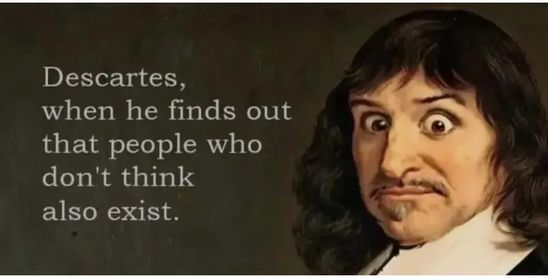
Another confusion that is caused because of the lack of a causality operator is the famous saying by Rene Decartes: "I think, therefore, I am".
It is often interpreted as "I think, and therefore it causes me to exist" and leads to several jokes like the following:
René Descartes walked into a bar. The bartender said “would you like a beer?” René replied “I think not” He disappeared.
Or this..
But the problem here is of course, that of interpreting implication as causation. "I think, therefore, I am" can be interpreted as "I think, and that causes me to exist" or as "I think, and therefore I can infer that I exist."
What Decartes meant was the latter. The fact that "I think" leads me to infer that "I exist". In other words, it is my existence that is having a causal dependency on the fact that I think, and not the other way around!
An implication of the form P --> Q can also legitimately mean that Q is the cause and P is the effect!
To understand his even better, consider the equivalence between an implication and its contra-positive. An implication of the form P --> Q and another implication of them form ~Q --> ~P (where ~ is interpreted as "not") are both equivalent.
Using this, we can see that "I think, therefore, I am" is equivalent to saying that "I am not, therefore I do not think". which is consistent.
Even if Decartes had meant that my thinking is causing me to exist, the implication that "I don't think, therefore I don't exist" is still a fallacy-- called the inverse fallacy. "If P then Q" is not equivalent to either "If Q then P" or "If not-P then not-Q".